Des Moines leaders are keeping tabs on two property tax reform bills that would cap the city’s revenue growth, which, among its impacts, could limit its ability to use tax incentives to spur development.
The Iowa Senate, House and governor each have property tax proposals that include changes to revenue growth, property rollbacks and exemptions. The measures are in fluctuation, but city officials said they believe all three legislative bills could be negotiated and combined into one bill.

Des Moines City Manager Scott Sanders said one of his chief concerns with the bills is that they could limit the city’s ability to use multiple forms of tax increment financing, an economic development tool where local governments waive property taxes for a period of years on the value of improvements to a site to help a developer offset the cost of construction and to build public amenities like streets and sidewalks.
It’s a mechanism that’s played an essential role in the transformation of downtown Des Moines and has been part of every successful downtown project and development for 25 years, Sanders wrote in an email to the Des Moines Register.
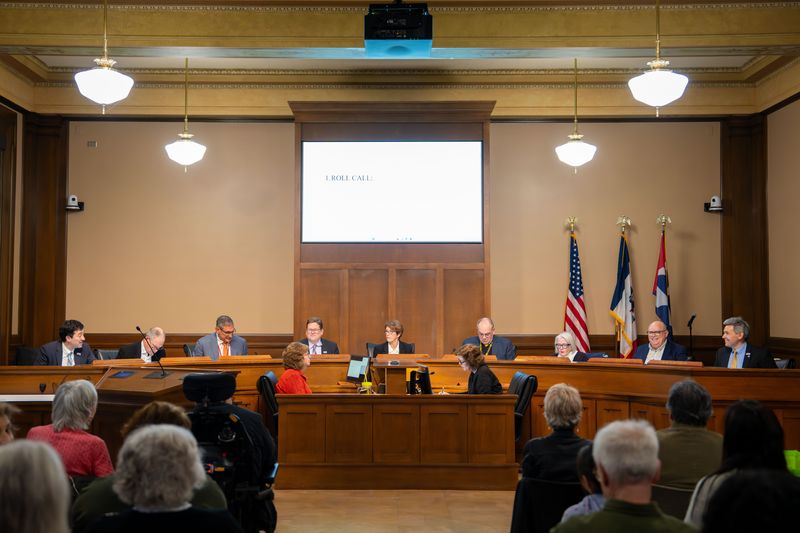
At a Des Moines City Council work session Monday, April 20, Government Relations Manager Emilee Harris distilled the latest details on the multiple proposals swirling at the Iowa State Capitol.
Republicans have called cutting property taxes their main priority for the year, though the lack of agreement between House and Senate leaders and Gov. Kim Reynolds is one of the largest obstacles to adjourning Iowa’s legislative session.
In efforts to keep money in taxpayers’ pockets, the proposed legislation limit the amount of revenue cities and counties can collect from property taxes, which Des Moines city leaders said makes it harder to balance the city’s budget — and leaves services at stake.
In 2024, Sanders called House File 718 the proverbial cherry on top of the state’s “detrimental” changes in the tax system that have been “compounding” over the last decade. The legislation established a formula that requires local governments to use a portion of any revenue growth above 3% to lower property taxes. For Des Moines, the impact of those changes totaled $12.5 million that fiscal year.
Ahead of the city approving its upcoming $855 million operating budget, Sanders said the fiscal years rotate between “good” and “bad” years based on property value assessments, which are recalculated in odd-numbered years. The 2027 fiscal year, which starts July 1, is a “good” year because the city’s budget is driven by the new assessments from 2025, he said.
On Monday, Sanders said these legislative proposals could thwart the city’s ability to regain what the city would in a good year.
“This would mean low years, or even lower years, in both proposals,” he said.
In an email, Sanders added that the city is closely watching the legislative process and will need time to analyze the impact of any legislation once passed.
“However, we are preparing for a difficult, and public budget cycle beginning early this summer to give our council and community time to grapple with the tradeoffs of tough budget decisions,” he wrote.
What do the proposals say about tax increment financing?
House File 2745 would include changes to tax increment financing, or TIF, such as allowing cities to collect up to 60% of revenue generated on continuous TIFs 20 years after the bill’s effective date, Harris said.
It would also limit future TIF districts certified, once the bill is passed, to 23 years.
Under Senate File 2472, TIF districts would be limited to 20 years unless otherwise approved by the Iowa Department of Management, Harris said. Perpetual TIFs also would need to be closed within 20 years with no additional debts in the district as it’s phased out.
TIF revenue couldn’t be used for the city staff’s salaries or benefits.
What do the proposals say about tax revenue limits?
Each bill would establish some form of cap or limit on city revenue growth.
House File 2745 calls for a 2% revenue cap across all local government levies, including pension and health care levies, Sanders said. Cuts could be made to the city budget to keep up with pension and health care costs, he said.
Senate File 2472 ties limits on property tax revenue growth for local governments to inflation, an approach local governments have favored to keep up with rising expenses.
It establishes a 0.5% minimum budget guarantee or up to 1.75% general levy growth for fiscal years 2027 — which starts July 1 — and 2028, Harris said. That general levy growth would rise to 2% for fiscal year 2029.
The Senate measure would establish a 2% “soft cap” on general levy growth in fiscal year 2030 and beyond, with a potential for incremental increases when inflation is high, Harris said. That would be based on the U.S. Department of Labor’s Consumer Price Index, which measures the average change in prices consumers pay for goods and services.
On Monday, Sanders warned the growth percentages would only apply to the city if it could grow past the valuation after exemptions are taken into consideration, including those for seniors and veterans.
“But oftentimes, we were actually lower in the past than the 2% growth,” he said.
Similar to the potential challenges with pension and health care levies, Sanders told council members that the Senate bill could pose a “problem” for salaries that increase beyond 1.75%.
The House proposal also would limit the amount of a city’s unassigned reserve funds to 35% of its general fund. The last time that fund was measured on June 30, 2025, the city’s balance was just under 35% of the general fund, Sanders wrote. It will likely be lower once it’s calculated at the end of this fiscal year.
Both pieces of legislation include items from the governor’s proposal, Harris said.
Virginia Barreda is the Des Moines city government reporter for the Register. She can be reached at vbarreda@dmreg.com.
This article originally appeared on Des Moines Register: Des Moines leaders confront Iowa property tax reform proposals
Reporting by Virginia Barreda, Des Moines Register / Des Moines Register
USA TODAY Network via Reuters Connect