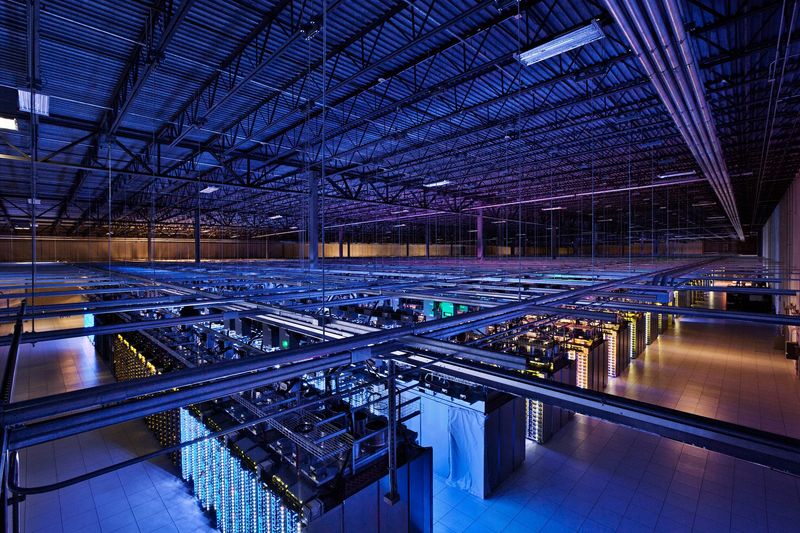
A digital infrastructure company’s proposal to build what would be Iowa’s largest data center so far on roughly 1,100 acres of private land near the City of Clinton’s airport has sowed distrust among residents opposed to the project, while others see huge opportunity.
Recently, a split City Council in the eastern Iowa river town chose not to place a moratorium on any new data center projects. Some other Iowa locales have done so as they’ve weighed what local controls need to be in place.

Instead, the city is drafting an ordinance to guide data center developments and establish enforceable standards before any formal site plans or proposals from QTS Data Centers are considered.
“The council’s action (against a moratorium) does not predetermine the ultimate outcome of any future proposal,” the city said in a press release.
Mayor Scott Maddasion, under fire from residents concerned that city leaders and economic development officials are not being transparent and moving too fast, said the city didn’t need the four-month moratorium because the project is still in the early stages.
Instead, he said, a small group is pulling together ideas from other ordinances to help shape one for the City of Clinton. He said he hopes to present an ordinance in a public hearing, likely sometime in July, so residents can provide input.
The new ordinance is expected to address water use, utilities, noise, lighting, setbacks, buffering, traffic, stormwater, emergency response, environmental compliance, decommissioning and enforcement.
Being a hotbed of data centers becomes a harder sell
Iowa has become a hotbed of multibillion data center developments as the AI explosion has accelerated. But the projects have become increasingly unpopular as more becomes known about how they can max out water supplies, increase utility costs, and contribute to air and noise pollution.
A recent Reuters/Ipsos poll showed only one-in-three Americans approve of the fast pace of data-center construction that supports artificial intelligence and most would oppose building one in their own community.
A hot-button political issue for both parties heading into the midterm elections, data center construction is opposed by most Americans, with only 14% of respondents saying they would be comfortable with one built nearby, the poll found. Seventy-seven percent said they worried AI-driven data centers would raise their electricity costs.
Trying to get ahead of the kind of controversy Clinton and other cities have faced, the Linn County Board of Supervisors in February approved an expansive ordinance that created new zoning rules for both small and large data centers to operate in unincorporated areas of the county.
The model rules, adopted in February, address setbacks, noise limits, traffic and road impacts, emergency planning, and site-plan review.
For large projects, extra requirements were added to address long-term impacts on roads, utilities and natural resources, especially water use. The ordinance requires a study to show enough water is available, as well as a water use agreement.
But the ordinance only applies to unincorporated Linn County and does not cover data centers built within the city of Cedar Rapids. QTS is constructing a $10 billion facility on the southwest side of the city believed to be the largest economic development project in the city’s history.
Some have suggested state legislators need to step in with a baseline legislation to better protect Iowans and water resources while encouraging responsible development.
QTS has said its campus in Clinton, if approved, would represent a multibillion-dollar investment, supporting construction jobs and “creating hundreds of long-term careers, while also contributing to projects and initiatives that matter most locally.”
In itsCommitment to Communities, it promises to invest in neighborhoods and operate responsibly, which includes funding its energy costs so utility rates are not affected.
In addition, Microsoft is building out its sixth campus in the metro, extending its West Des Moines development into Madison County. Meta has expanded its Altoona facility, the company’s largest data center footprint in the United States.
In Council Bluffs, Google is expanding a massive campus on the western side of the state.
Iowa resident: ‘Everyone feels lied to’
Transparency, or lack of it, has become a big issue in Clinton.
Ally Burke, whose home on the outskirts of Clinton could be surrounded on three sides by the mammoth project, said she doubts Clinton’s mayor really wants an ordinance. She questions the sincerity of council members who have been pressing forward in spite of widespread concerns by residents.
She said emails released earlier this year under Iowa’s open records law show Grow Clinton, the city’s economic development agency, and city officials discussed the project for a long time while keeping the public in the dark.
“It all makes us question their sincerity,” she said. “Everyone feels lied to. They have not been working with the community … and none of us feel very hopeful that the council will do anything to protect us.”
Maddasion said, despite what critics think, he hasn’t fully made up his mind about the QTS proposal. He said he wants to make sure that any project would not have negative effects on residents, such as utility rate hikes.
“I’m trying to compare apples to apples,” he said. “(QTS is) who we’d be in partnership with. If we have some bad actors, that doesn’t mean this company does the same thing.”
But the mayor also said cities like Clinton face more financial challenges with a new law limiting how much revenue local governments can raise from property taxes. A law signed by Gov. Kim Reynolds this year is projected to lower Iowans’ property tax payments by $4.2 billion over six years but implement a 2% growth cap on local governments’ general levies, with exceptions for new construction.
“We have to look at everything and we got to grow some way,” the mayor said.
The data center project envisioned by QTS would be significantly larger than its roughly 700-acre project in Cedar Rapids, Maddasion said. The company has optioned land to build on the west end of Clinton in an area zoned industrial east of the airport and north of an existing mobile home park on Highway 30, near South 54th Street and Heart’s Mill Road.
The site proposed is now mostly cropland and not far from one of Clinton’s more affluent neighborhoods. Folks there are worried about light and noise pollution, so using berms and noise cancelling would have to be considered, he said.Maddasion said Iowa-American Water Co. has said it has the water capacity for the job. The company is permitted to treat 8 million gallons a day out of wells. But it currently only uses about 3 million gallons. Alliant Energy also has said it has the capacity to provide for the electric needs.
Project has potential for regional water impact
But Keith Schilling, the state geologist of Iowa and director of the Iowa Geological Survey, said pulling water from the Jordan Aquifer can be more complicated than projects in other parts of the state. That’s because its old, confined water that is deeper underground.
Schilling has long said Iowa needs a statewide water plan, in part to understand how one locale’s project can affect other water customers. “Right now, it’s just kind of a free for all,” he said.
Schilling said no one has contacted his office about the proposal in Clinton or its potential impact. But if the facility is air-cooled, as has been discussed, water use would be less substantial.
Last year, the state altered its existing data center incentives to impose a 10- or 15-year limit on sales tax exemptions for new data centers constructed in the state. At the same time, however, the state granted a new data center property tax exemption — one of the biggest benefits for locales who agree to have a data center — beginning in 2027.
But Maddasion said the council would have to approve any property tax exemption and said the city’s not in the position yet to even consider one.Some homeowners, he said, already have been approached by the developer to purchase land. But if the project at that site “is going to happen, we need to make sure their wells and infrastructure are safeguarded,” he said.
Lee Rood’s Reader’s Watchdog column helps Iowans get answers and accountability from public officials, the justice system, businesses and nonprofits. Reach her at lrood@registermedia.com, at 515-284-8549, on Twitter at @leerood or on Facebook at Facebook.com/readerswatchdog.
This article originally appeared on Des Moines Register: Clinton eyes Iowa’s largest data center — but wants an ordinance first
Reporting by Lee Rood, Des Moines Register / Des Moines Register
USA TODAY Network via Reuters Connect
By Lee Rood, Des Moines Register | USA TODAY Network