It’s rare to sign on to an agriculture secretary candidate’s website and, instead of platitudes and campaign talking points, find a script that reads like poetry.
“I imagine a day when a miracle has happened,” begins Chris Jones’ introduction. “On that day our streams run clear, our air smells of nature and not the moldered waste of a swine legion. Children play in our lakes while parents look on unconcerned about infection. From our faucet flows water we can know is safe to drink.”

Iowa’s environment is at a critical point. We’re second in the nation for new cancers, which some scientists say can be attributed in part to chemical fertilizers and pesticides that lead to nitrates in water, as well as toxic runoff from animal waste. At the same time, farmers under pressure are committing suicide at 3½ times the rate of the general public.
But Jones, the Democrat who will face two-term incumbent Republican Mike Naig in November’s general election, is not your typical candidate. He knows the causes and solutions like few others. He managed the Des Moines Water Works water quality testing lab for eight years, helped oversee nitrate removal at a facility to tackle agricultural runoff, worked as an environmental scientist at the Iowa Soybean Association and was a University of Iowa research engineer who helped develop Iowa’s first public water quality sensor network.
Jones doesn’t try to appease all sides. He even tramples on one of the most sacred cows of Iowa’s corporate agriculture industry: ethanol. In his 2023 book, “The Swine Republic: Struggles With the Truth About Agriculture and Water Quality,” he wrote, “You can’t achieve the state’s environmental objectives until ethanol is killed and left for dead.”
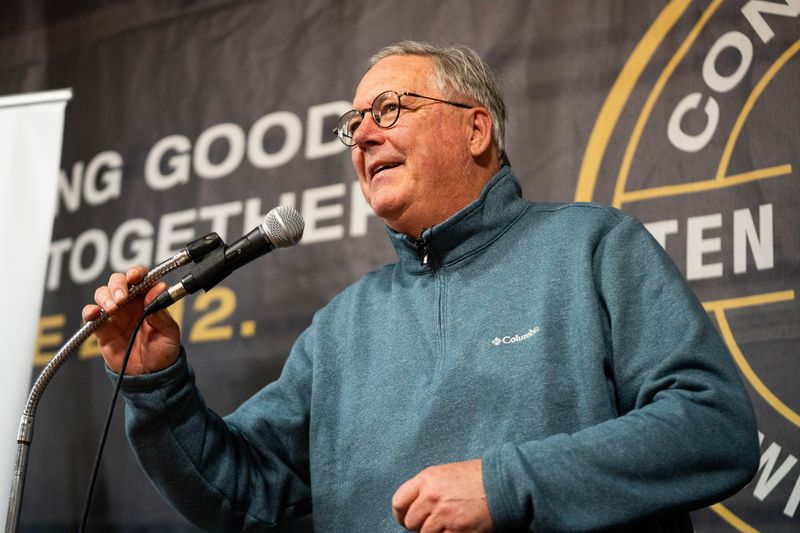
He underscored that message at a Des Moines fundraiser July 31 on his behalf. Describing our reservoirs as muddy, foamy and filled with nitrates, he said, “We’re in the belly of the beast. We should not have to choose between prosperity and clean water, between safe beaches and high yields, We should have prosperous farms and good environmental outlooks at the same time.”
But he also reassured a crowd hungry for change, “The outrage has arrived.”
Cancer rates around the country are falling, except in three states. Iowa is one in which they’re rising. Jones decried the state’s lack of regulations on agricultural runoff, accusing large industrial farming entities of failing to control theirs. He rejects the state’s voluntary Nutrient Reduction Strategy, and what he calls the incrementalist approach. He called for systemic change, saying, “We put the entire onus of this problem on the backs of farmers.”
He wants to see Iowa’s corn-and-soybean crop monocultures transformed by adding “a third, fourth or fifth crop to work into the system.” That, he said, would lessen the need to import food ― the U.S. imports 800 million bushels of oats a year from Canada ― and greatly reduce Iowa’s soil erosion.
And though Iowans “desperately want local foods” and Iowa farms should be supplying at least half the food served in schools, Jones said, 70% of the land is devoted to corn for ethanol to fuel cars ― an environmental and economic dead end. Noting the growing popularity of electric cars, which are going for $13,000 in China, and the declining demand for liquid fuels, he said that land could be better used to grow oats, or as pasture for cattle, and for solar panels.
You could tell from the applause inside the Locust Street venue that Jones’ message was resonating. The issue is personal for Jones supporter Rod Stevens, who lost his wife three years ago to pancreatic cancer, which began asymptomatically and quickly claimed her. Though doctors couldn’t pinpoint the cause, Stevens pinpoints the nitrates.
Raised on an Iowa family farm where they grew corn, soybeans and oats, baled hay and raised some livestock, Stevens swam in Lake Ahquabi, where his parents fished. “Now you don’t dare put your toe in the water, ever,” he told me. Nor will he dare drink unfiltered tap water in his Johnston home. He recently bought a reverse osmosis water processor, which can range in cost from a few hundred dollars to as much as $7,000, to filter out nitrates.
Annie Brandt of Des Moines, who works in banking, has been seeing her 30- and 40-something friends driven away from Iowa because of its high cancer rate and water quality. Formerly a Republican, Brandt said she talks to people in both parties who are equally concerned about Iowa’s environment.
“I firmly believe we can solve this,” she said, highlighting Jones’ campaign.
Until now, it has mostly fallen to nonprofits and protesters to advocate for a leader who wouldn’t kowtow to Big Ag and would reign in industry excesses. Many of the same voices have demanded more humane treatment of livestock. Now there is someone. Still, for a Democrat facing a two-term Republican incumbent in a state where Republicans hold all but one elective state leadership position, Jones has his work cut out for him. He will need to harness the dissatisfaction with President Donald Trump he says he is hearing from farmers: “Republican famers feel there needs to be a disruption” he said, “and they see me as a disruptor.”
An audience member asked Jones if Rob Sand, the Democratic nominee for governor who is typically not considered a disruptor, was on board with his ideas. “I met him once,” Jones replied. “None of the candidates meet and strategize on these issues.”
Republican gubernatorial nominee Zach Lahn has also mentioned support for farmers in his campaign ads. I asked Jones if he and Lahn share common concerns or approaches. Jones replied that though “his views may be held genuinely,” it was hard for him to take Lahn seriously because his talk is too abstract and superficial.
Lahn, on the other hand, recently posted on X about meeting U.S. Agriculture Secretary Brooke Rollins on changing USDA regulations to allow Iowa farmers to sell food to Iowa public schools. The post then blasted Sand and his team as unable to understand someone who “actually wants to make a difference for the people of the state.”
Mary Riche, a Jones supporter at the July 31 rally, is a farm-raised Des Moines resident who still loves the feel of soil under her fingernails. She’s indignant about having to treat her drinking water and says, “The need to address this issue is now. They should have done it 20 years ago.” But she believes Jones is the one who will. “He’s very, very smart,” she said. “He’s passionate and solution-oriented. You can’t throw much at him that he can’t answer.”
Of course, running a campaign like this also costs money, which doesn’t always go to disruptors. But then again, as some recent U.S. primary elections showed, it doesn’t always need to.
Rekha Basu is a longtime syndicated columnist, editorial writer, reporter and author of the book, “Finding Your Voice.” She retired in 2022 as a Des Moines Register columnist. Her column, “Rekha Shouts and Whispers,” is available at basurekha.substack.com.
This article originally appeared on Des Moines Register: Chris Jones can-do message resonates in cancer-stricken Iowa | Opinion
Reporting by Rekha Basu, Guest columnist / Des Moines Register
USA TODAY Network via Reuters Connect
By Rekha Basu, Guest columnist | USA TODAY Network