State-imposed limits on property tax collection mean that “the city of Des Moines can no longer afford the assets and the level of service that we’ve been providing in the past,” City Manager Scott Sanders told City Council members in June.
That’s the right starting point for public discussions of how to close what the city says is a $12 million gap in its budget for the year beginning July 1, 2027. The argument over Iowa’s new property tax law and its 2% cap on year-over-year revenue growth will continue in other forums, but carping at lawmakers won’t help city leaders in the capital, or their local government peers across the state, balance their budgets.

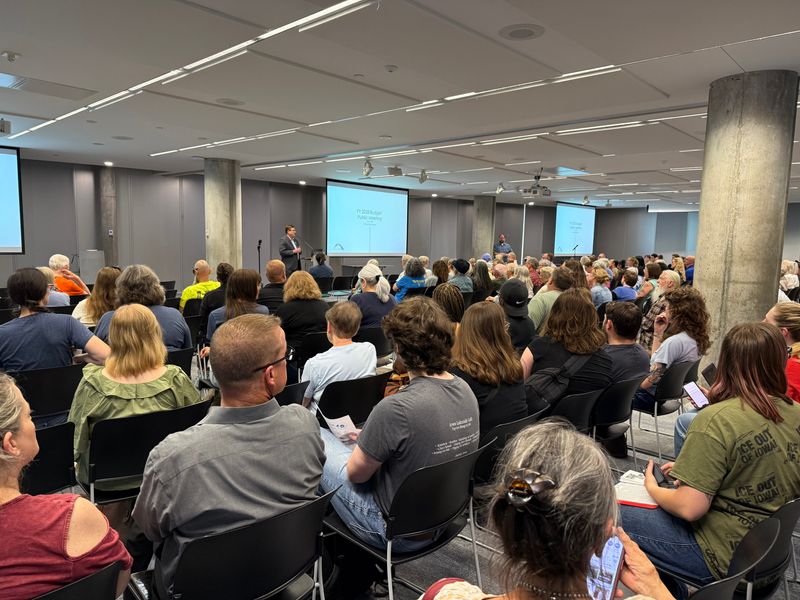
Des Moines opened public input on its budget planning months earlier than usual, including an online survey that included various proposals for saving or bringing in tens or a few hundreds of thousands of dollars. Survey results were announced Aug. 7, and the City Council is expected to see a more detailed proposal for its general fund, about $256 million in the current fiscal year, in the next few weeks.
As that process plays out, here are a few considerations that elected and appointed officials should keep in mind:
Public safety isn’t untouchable
“The reality is 60% of our general fund budget is public safety,” Sanders said at the June meeting. “I find it very hard to believe that these cuts are going to be 60% to public safety.” He’s surely right about that, not least because taking away police, fire or emergency medical coverage is bad politics. But leafing through the 200-plus pages in the city’s budget book, there isn’t a function the city performs that is ripe to be gutted. And if Des Moines isn’t going make massive reductions in other areas, the police and fire departments needs to absorb some of the pain.
The public budget exercise did include options to reduce the numbers of police officers, detectives and firefighters and to cut programs including fire investigations and neighborhood-based policing. More than half of the survey respondents favored cutting traffic and patrol officer jobs. But several council members and other officials made it clear that they aren’t interested in reducing the authorized force of those departments. Holes in fire coverage have been a sore spot in the city for years. Police Chief Michael McTaggart said that the force was already stretched to its limit and that its size hadn’t kept up with the city’s workload for decades.
That testimony deserves some weight, so it is not realistic to find $7 million of savings (that is, a proportional amount of the budget shortfall) in the police and fire departments. But those functions should not grow, either. Des Moines residents should be able to see a proposal for police and fire cuts and their effects so they can weigh them against proposals for other departments, a point made in June by council members Rob Barron and Josh Mandelbaum.
Focusing on alternative revenue is dicey, at best
A few proposals from the city manager’s office seek to address the shortfall on the accounts receivable side. That could mean revamping fee structures for permits and recreation programs or charging for some parking at Gray’s Lake Park. City leaders have also been vocal about collecting money, voluntarily or involuntarily, from state government and nonprofit parcels that don’t pay property taxes and take up a disproportionate chunk of Des Moines compared with other cities.
Whether any fee is currently too low, it’s dangerous to give the appearance of going around the property tax law ― which was framed as giving financial relief to property owners ― by extracting money from them in another fashion. If there is one thing many supporters of the revenue cap have been clear about, it is the idea that cities and counties are profligate spenders. The accusation is hyperbolic. Still, people hoping to persuade a future Legislature soften the new law’s effects should not be dreaming up new ways to collect money from taxpayers right now.
As for collections from government and nonprofits, also known as payments in lieu of taxes, Des Moines has been down this road before to little avail. It’s fine to keep advocating and negotiating, but the expectation should be that nothing will happen.
Among unpleasant choices, geography can be a tiebreaker
Des Moines Public Library supporters have been lobbying the public and city leaders in force for a couple of months, recognizing that library spending is always seen as one of any city’s most dispensable line items. Similarly, public outcry contributed to the reversal of Sanders’ 2025 recommendation to close the venerable Birdland Pool on the city’s north side.
If drawing a line around police and fire spending should not be tenable, then neither can libraries and parks escape the hatchet. Libraries (in the past) and swimming pools (now) have endured random weekday closures to save money. That step will be required at minimum.
Nobody wants to see a facility closed for good. Closing a library was the least popular choice in the city’s survey. But if that painful choice is unavoidable, the idea should be to preserve access in all parts of the city. The most geographically redundant library is the North Side branch on Euclid Avenue. And the west side’s Ashworth Pool ― which will turn 100 years old on Aug. 28 ― is historically the least used and has relatively close alternatives.
Give management roles extra scrutiny
Sanders explained that the city intends to close over $6 million of its gap with various “administrative changes.” He also cautioned the City Council that changing or eliminating some jobs will mean less work on improving processes and other things that maintain or improve the city in the long run. That is fair, and it’s true that “administrative bloat” can be a reflexive accusation about public spending that sells short managers’ contributions. Sanders and his staff should hold firm, though, and lean toward retaining “boots on the ground” over veteran supervisory employees. Government officials are employers with responsibility to their employees, but their duty to taxpayers takes precedence in times like this.
Officials in Des Moines and other places say they’re also pursuing partnerships and consolidations, such as for emergency communications centers. That is entirely appropriate ― the state as a whole has too many duplicative governments ― but real change there is not going to happen quickly enough to help a budget that’s due in mere months. Des Moines made a good first step by getting the public involved in these discussions early on. The more difficult steps get under way soon.
Lucas Grundmeier, on behalf of the Register’s editorial board
This editorial is the opinion of the Des Moines Register’s editorial board: Rachel Stassen-Berger, executive editor; Lucas Grundmeier, opinion editor; and Richard Doak and Rox Laird, editorial board members.
This article originally appeared on Des Moines Register: Balancing Des Moines’ budget means police cuts and more | Opinion
Reporting by The Register’s editorial, Des Moines Register / Des Moines Register
USA TODAY Network via Reuters Connect
By The Register's editorial, Des Moines Register | USA TODAY Network