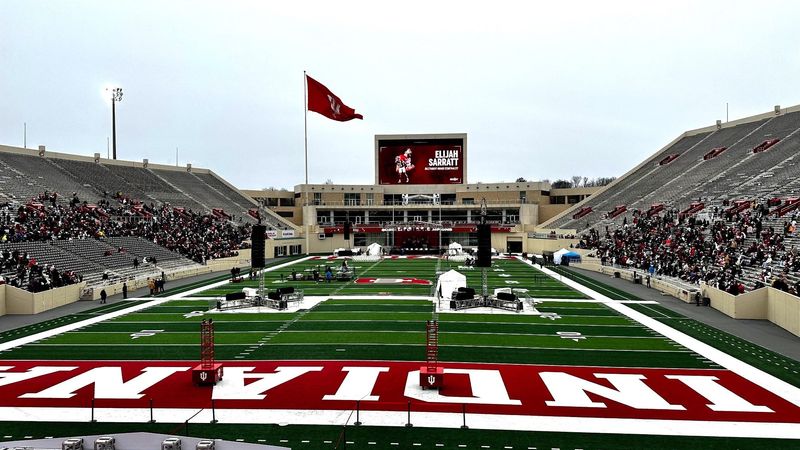
BLOOMINGTON — Indiana football coach Curt Cignetti is dreaming big for Memorial Stadium.
At the 2025 Big Ten Media Days, he joked about replacing the press box on the west side of the stadium. More recently, he lobbied for increasing the venue’s seating capacity.

If the Hoosiers remain a championship contender, Cignetti might eventually get his wish, but neither of those proposed ideas will be in the initial phase of the wider-scale renovation the athletic department has in the works for the 66-year stadium.
Over the last 12 months, Indiana’s athletic department has worked to develop a master plan in partnership with HOK, an architecture and design firm based out of St. Louis, that will define the venue’s future.
“I think for our initial phase, keeping the capacity where it is now, but really modernizing the experience is the smart way to continue to move forward,” IU athletic director Scott Dolson said in an interview with The Herald-Times.
Those renovations are inching closer to reality, with the Hoosiers currently in the silent fundraising stage of the project.
This is separate from the $50 million in funds Indiana’s Board of Trustees approved last week for Memorial Stadium that will go directly towards work aimed at maintaining the infrastructural viability of the building. The board also voted to request an additional $150 million from the state for related-improvements, again unconnected to the larger capital project IU is fundraising for behind the scenes.
“It’s taken time to really get the clear vision on what the end result is we’re trying to get to,” Dolson said. “I think we really have honed in on where we want to go.”
Indiana football’s dramatic turnaround impacted Memorial Stadium renovations
The origins of the project date back to 2023, when IU sent out a survey seeking feedback from ticket buyers, fans, donors and business leaders about much-needed upgrades.
After receiving more than 4,000 responses, Indiana acted on certain elements of those evaluations — the school has added additional premium seating options in recent years and spent big upgrading the venue’s concessions through a partnership with Levy — but the larger makeover remained in the development stages.
In 2025, Indiana distributed a second round of surveys, a necessary step with Cignetti’s success prompting never-before-seen fan interest and attendance numbers.
Since the stadium expanded to 50,000 seats in 1970, the program has sold out 18 games. Eight of those came during Cignetti’s tenure. Dolson described the second survey as a “recalibration,” given the program’s drastic transformation.
The follow-up questionnaire ensured IU had all the information it needed to move forward.
“That threw kind of a wrench in the idea of what we were planning, in a positive way,” Dolson said with a chuckle. “Really positive, but it impacts a lot. What’s the appetite for how many club seats if you’re building a new club area? What’s the appetite for suites?”
From the start, Dolson wanted to make sure every dollar spent on the project was put to good use, just as it was when the university spent $45 million renovating Simon Skjodt Assembly Hall in 2016, a project that will mirror what the school is attempting for the football facilities.
“We got so much out of that,” Dolson said of the Assembly Hall project. “It was really, really well done. I want it to be the same thing with Memorial Stadium. Whatever we end up spending, I want fans to feel like that was super smart. We are confident that we’ve got a great plan.”
Why Indiana football isn’t adding seats to Memorial Stadium just yet
In the not so distant past, it wasn’t uncommon for visiting teams to outnumber Indiana fans at Memorial Stadium.
Those interlopers will be lucky to find a single seat in 2026. With a listed capacity of 56,626 — 14th among 18 teams in the Big Ten — the Hoosiers expect Memorial Stadium to be sold out for all of their home games for the first time in program history.
Dolson would love nothing more than to welcome even more IU fans through the doors, but a surge in demand alone won’t justify the costs of attempting to add seats in the initial phase of the project.
“When you add seats to a great environment, you’re not adding great seats, location-wise, there has to be a cost-benefit analysis,” Dolson said. “Do you spend $400 million to add 10,000 seats in the upper deck? Are you really getting the value out of that?”
And tearing down the press box and suites on the west side of the stadium isn’t a simple solution to the problem.
“What you learn in this process is in a stadium that is older, anytime you tear things down, because of the code that it was built under, you can lose seats,” Dolson said. “To get those seats back would cost so much more. If all of a sudden we go down in capacity, they’re gonna lock me up and throw away the key.”
That isn’t to say those areas of the stadium won’t get a facelift.
The focus of the project’s initial phase is to modernize and improve the fan experience throughout the building, while continuing to add premium seating areas, which are key for revenue generation. Dolson stressed the importance of making improvements to the concourses, restrooms and concessions, along with upgrades to Memorial Stadium’s infrastructure, pointing to what he described as the venue’s “inadequate” sound system a perfect example.
Dolson still didn’t want to lay out a timeline for the initial phase of the project. Once IU raises the funds, the renovations will require the approval from the Indiana President Pam Whitten and board of trustees, but he once again pointed to the past to offer an example of how planning can quickly turn into action.
The key will be locking in a lead gift, as was the case for Assembly Hall back in 2013.
“Cindy Simon Skjodt, what probably wasn’t as heralded as much as the gift was, her making the commitment she made, it just had that project take off like a rocket ship,” Dolson said. “We got the lead gift going, then it just made it real. And that’s what we’re looking for now. That’s how a campaign works.”
Dolson is hopeful those initial renovations will help Memorial Stadium “thrive” for the next 25 years, and open the door for the possibilities Cignetti keeps alluding to.
“We’re super excited about the vision for the stadium,” Dolson said. “And down the road, we continue to sell out and do all these great things, we hope adding seats will be the next phase of all this.”
Michael Niziolek is the Indiana beat reporter for The Bloomington Herald-Times. You can follow him on X @michaelniziolek and read all his coverage by clicking here.
This article originally appeared on The Herald-Times: With vision in place, Indiana eyes funding for Memorial Stadium renovations
Reporting by Michael Niziolek, The Herald-Times / The Herald-Times
USA TODAY Network via Reuters Connect
By Michael Niziolek, The Herald-Times | USA TODAY Network