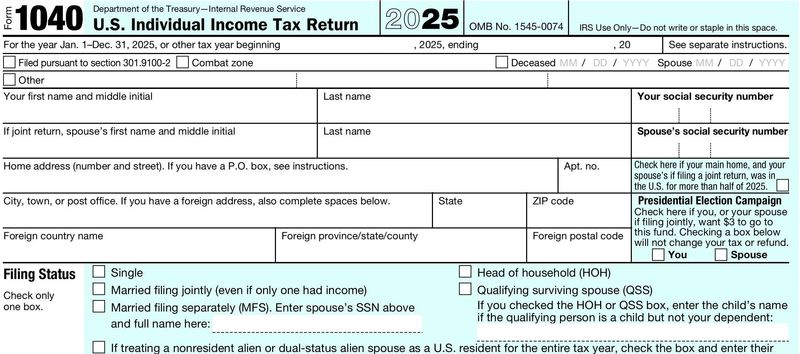
My wife and I claim, as a dependent, our 16-year-old son, who worked part-time last year and earned about $1,400. No federal taxes were withheld by the employer. However, state and local Indiana taxes were withheld. Does he have to file a federal return? How about an Indiana return?

— C.C., e-mail
No federal income tax return is required because your son falls below the $15,750 earned income filing threshold for people 64 and younger (it’s $17,750 for ages 65 and older). He should definitely prepare and file an Indiana return (per page 24 of the IT-40 instruction booklet, which states, “enter $1,000 . . . even if you are claimed on someone else’s tax return, such as a parent or guardian”). The $1,000 will reduce his Indiana taxable income and probably generate a state income tax refund. Once that extra money shows up in his bank account, he will probably laugh at a few of your “Dad” jokes that day.
I know it is only April 12, but what should I be doing to prepare for my 2026 filing next year?
— Ad Hoc
When you finish your taxes, take a few minutes to prepare for next year. Planning for tax time throughout the year can help you save time and stress, file a more accurate return, and maybe get your refund faster. Here are steps you can take to make filing next year’s return easier:
• Organize your tax records and create folders for your tax documents, including tax-specific documents and receipts you gather during the year, as well as forms sent to you in January and February.
• Find out how long to keep tax records and update your information as it changes.
• If you move or change your name, promptly update your information.
• Check your withholding. As we have mentioned in the past, if your refund or tax bill wasn’t what you want for next year, you can adjust it by changing your withholding. Check your withholding any time your income or tax situation changes throughout the year. To change the amount you withhold, give your employer an updated W-4.
• Consider life events. If you move, get married or divorced, have a child, get a second job, retire or have other changes, it can affect your taxes. Find out what to do for certain life events.
• Amend your return. If you get a notice from IRS about an error on your return or realize you made a mistake, you may need to file an amended return.
Ken & Klee’s Tax Notebook
Based on a well-respected accounting website, let’s look at the way the United States’ “largest revenue collecting agency” (collecting over $5 trillion), the Internal Revenue, is operating.
There have been seven different commissioners and/or acting IRS commissioners since the beginning of 2025. When Treasury Secretary Scott Bessent’s temporary term expired early in March, a new position, IRS CEO, was filled by Frank Bisignano, who is also the commissioner in charge of the Social Security Administration. Those are two pretty heavyweight departments to be managing at once! We’re calling that STRIKE ONE!
Staff cuts at the IRS find the agency currently working with about 83% of the staff that was in place in 2024. And most of the people who left were the experienced personnel. STRIKE TWO!!
The use of Artificial Intelligence (AI) at the IRS was being ramped up by former IRS Commissioner Danny Werfel before he stepped down. Specifically, AI was going to focus on audits of large partnerships, big corporations and the wealthy. However, the staffing reductions cited above resulted in the IRS not having enough skilled employees to support or develop the new AI tools. The cut in personnel also means the IRS doesn’t have a plan to identify and address the AI skills its workforce needs. STRIKE THREE!!!
We are all the umpires in this above scenario. All of the information cited comes from the Accounting Today website, which is authored by Michael Cohn, the editor-in-chief of AccountingToday.com, who has been covering business and technology since 1985. We could go on, but three strikes are all you get before a new batter gets a chance.
According to Cohn, the current CEO of the IRS has to answer to an overestimated Direct File program (which many lower income taxpayers appreciated) cost that led to the program being terminated. Also, there are more than 1.4 million taxpayers who are having their refunds delayed because the IRS wants direct deposit information instead of sending out paper checks. Cohn reports that number is growing by 300,000 each month.
In fairness, the IRS did warn taxpayers in the instructions for this year’s return that it had, starting in October 2025, generally stopped issuing paper checks for any type of federal disbursements, including tax refunds, unless an exception applies.
Finally, add to that the significant tax law changes included in the OBBBA, and we now have an IRS whose ability to give taxpayers high-quality customer service in addition to reducing a growing backlog of taxpayer correspondence and the time to prepare technology systems for upcoming tax filing seasons that is, at best, threatened and, at worst, almost impossible. It seems like it should be a priority for Congress to review the operations of this incredibly important department!
We don’t want to close this Tax Talk season with a rant, but you can tell these items have been building up over the past year. Instead, we want to thank the many loyal readers who have either sent or posed questions to us. We’ve done the best we can. And using the words of Claude Renshaw (who died in February and waseulogized in this column that month), we want to wish you “many happy returns.”
Tax Talk is a community outreach service of the Vivian Harrington Gary University of Notre Dame-Saint Mary’s College Tax Assistance Program (TAP) which enters its 55th year of free income tax preparation in 2026.
Rick Klee served as the tax director at the University of Notre Dame from 1998 through August 2019. A retired CPA, Klee is a graduate of Notre Dame. You can contact him at rklee@nd.edu.
Ken Milani is a professor emeritus of accountancy at Notre Dame where he served as the faculty coordinator of the TAP from 1972 until 2011. Contact him at milani.1@nd.edu.
This article originally appeared on South Bend Tribune: Tips on preparing for 2026 taxes and how the IRS struck out in 2025
Reporting by Ken Milani and Rick Klee, Guest columnists / South Bend Tribune
USA TODAY Network via Reuters Connect