More than 30 years ago, Daryl Baldwin picked up a stack of fragile pages that would become the bedrock of his life’s work. The thin, almost translucent paper bore typed translations of words like mountain, hill, forest and wood from English into the language of the Miami people, Baldwin’s forebears. Passed down by his grandfather, the sheets spent years stacked in a cardboard box alongside old family correspondence.

Baldwin first laid eyes on the pages when he was a young father, transitioning from construction work to college. Fascinated by his find, he wound up earning a master’s in linguistics to learn as much as he could about the words his ancestors spoke.
“I was part of the lost generation born into that vacuum of nothingness with more questions than answers,” said Baldwin, now 63 and the executive director of the Myaamia Center at Miami University in Oxford, Ohio. “And there is this language sitting in front of me, and I want to learn more about it.”
Baldwin did not grow up speaking the language of his Miami ancestors, members of the Great Lakes people that counts present-day Indiana among its homelands. The last fluent speakers died in the mid-20th century, around the time he was born.
Now, more than three decades after Baldwin began to study the “sleeping” Miami language along with other scholars, myaamiaataweenki, as it’s named, is being taught to new generations of the Miami, who call themselves Myaamia.
The Miami nation and other peoples like the Lenape, which the federal government recognizes as the Delaware, are seeing the fruition of a decades-long effort to revitalize the languages that would have been common in Indiana 250 years ago when the United States was founded.
For people with Indigenous heritage, studying native languages forges a connection to their cultural identity that has been buried by centuries of federal government policies that forced them to assimilate into a Eurocentric lifestyle.
“Once I started to learn more about the language and how to speak it and how to put things together, it gives me a sense of maybe how [my ancestors] understood the world a little bit better,” said Jeremy Johnson, a citizen of the Delaware Tribe of Indians based in Bartlesville, Oklahoma.
Removals that scattered the Miami speakers
Baldwin’s Miami heritage comes from his father’s side, which traces roots back to tribal homelands around Fort Wayne. The family attended events on the powwow circuit and referred to each other by names passed down in the Myaamia language. But they no longer knew what those words meant, said Baldwin, who grew up in the area in and around Maumee, Ohio, where part of his family relocated in 1826.
The tribal homelands — which stretch between Indiana, Illinois, Ohio, Michigan and Wisconsin — are central to the Miami identity and language. Their emergence story, which tells how their people arrived in their homelands, begins with their ancestors using tree limbs to pull themselves from the St. Joseph River near what is today South Bend after a grueling journey from a place likely north of the Great Lakes region, according to a Myaamia-run blog dedicated to tribal culture.
In the 18th and 19th centuries, the Miami signed treaties ratified by the U.S. government that shrank their homelands, including the 1840 Treaty of the Forks of the Wabash. That forced the tribe to give up their 500,000-acre reserve in north central Indiana and move to a plot of equal size in what would become Kansas.
In 1846, much of the Miami nation was forcibly removed from Indiana. In 1867, yet another treaty relocated the tribe to what would become Oklahoma, where the federally recognized Miami Tribe of Oklahoma is now headquartered.
Some members were granted exemptions to remain in Indiana and Kansas, splintering the group and over time contributing to the spoken language’s decline. But while the Myaamia didn’t have a system akin to Europeans for writing down their words, Baldwin said, they gave their knowledge to new generations through oral traditions.
“There [were] all kinds of mechanisms for the preservation of knowledge, the passing on of knowledge,” Baldwin said. “Storytelling was certainly one of them.”
‘Hard to track’: Recordings helped the Lenape assemble a dictionary
Like the Miami, the Lenape have worked on preserving their language — called Lënapei èlixsuwakàn —which faded from everyday conversations after multiple rounds of removals. They originally lived in communities along the East Coast around the Delaware and Hudson River Valleys, but beginning in the 17th century, a series of deals and treaties forced them west, including to Ohio and Indiana, where the Miami invited them to live on their homelands.
Further removals splintered the communities, landing members in Missouri, Kansas, Texas and Oklahoma, among other locations, said Johnson, cultural education director for the Delaware Tribe of Indians. As with the Miami, this took a toll on the Lenape’s ability to communicate with those who had been forced to settle elsewhere.
“The language is hard to track because of the different dialects and the different forced removals and relocations,” he said.
Two of the Delaware’s current sovereign nations are located in Anadarko, Oklahoma, and Bartlesville, where Jim Rementer, now 85, traveled in the early 1960s to study the language. He recorded interviews with the last generation of fluent Lenape speakers before they died around the turn of the 21st century.
Through their stories, Rementer, now the director of the Lenape Language Project for the Delaware Tribe of Indians in Bartlesville, learned the difficulty of reviving a language that was fast falling out of use.
“At one point — it was before I came out here — the elders decided to get together, and they were going to meet on certain days and only speak Lenape,” he said. “To make it a little firmer that you had to speak Lenape, if you used any English, you had to pay a nickel … for every English word you used, and one old man said, ‘Well, we’d all be broke by the end of the first class.'”
Over the past six decades, Rementer’s interviews, as well as the work of tribal members and other scholars, helped create an online English-Lenape dictionary, where one can hear how the words should be spoken.
Centuries-old manuscripts help piece together Miami language
Many in previous generations lost fluency when they were forced to attend boarding schools that banned native tongues. Often, former students did not talk to their families about the emotional scars left by such re-education. Even those who didn’t attend the schools internalized the cultural devaluation, Johnson said.
“My great-grandmother Elizabeth [Longbone Skye West], she was told that language had no use, and there was no reason to continue it on,” said Johnson, whose family taught him some words and phrases as he grew up in Copan, Oklahoma. “This is what you were told. This is how you’re going to survive in these harrowing, traumatic instances.”
Others were determined to continue speaking Lenape and thus avoid forced assimilation, he said.
As some native languages have faded from conversational use, scholars have recognized the need to preserve them. About four decades ago, an advisor told David Costa, who at the time was pursuing a doctoral degree in linguistics, that not much was published about the Miami. So Costa traveled to Indiana and Oklahoma but could not find fluent native speakers or significant sound recordings of the language.
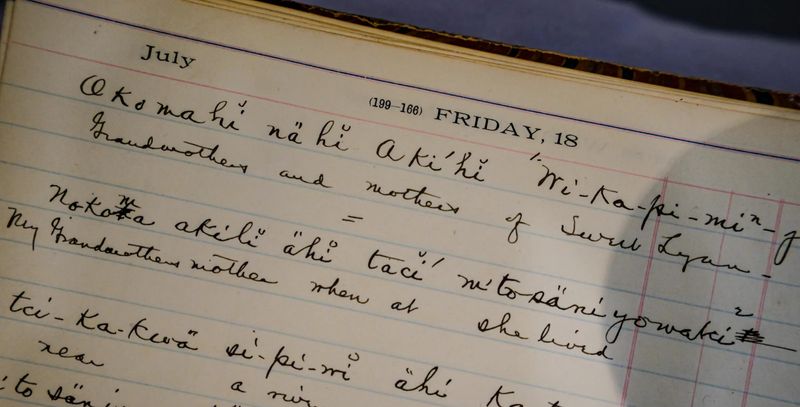
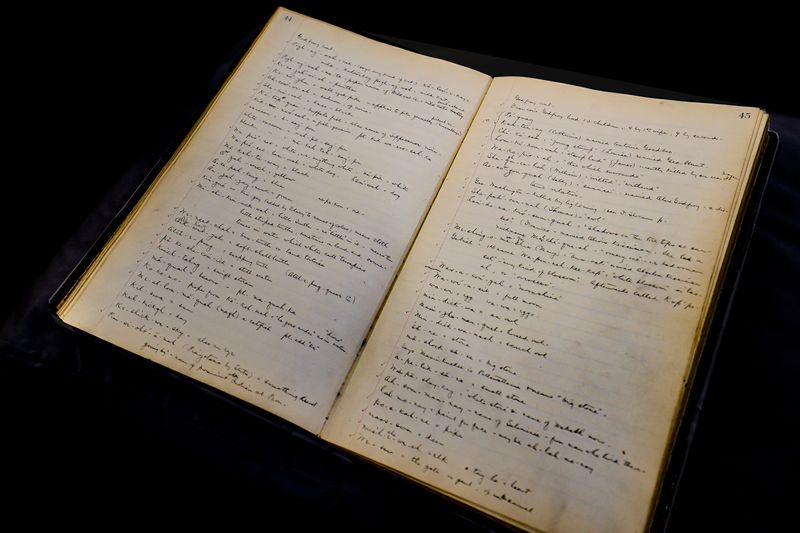
However, Costa, now the director of the Language Research Office at the Myaamia Center, did locate a plethora of archive manuscripts that contained translations, many in French and English. The oldest dates back to French Jesuit missionaries in the late 17th and early 18th centuries, who wrote dictionaries while working with the Illinois in the area of what is now the state of Illinois.
The native communities there spoke what was called Illinois at the time, a slightly different dialect than what the Myaamia spoke, Costa said. Linguists today use the term Miami-Illinois to refer to the dialects called Myaamia, Wea, Peoria and Illinois, among others.
In the 19th century, more English speakers, including an assistant secretary for the Indian Department of the Great Lakes area and a Swiss-American linguist, worked with the Miami people to capture words, sentences, autobiographical narratives and animal stories, according to a chapter Costa and Baldwin wrote in the “Oxford Handbook of Endangered Languages.” The work continued into the early 20th century, and the Indiana State Library holds a historic Jacob Piatt Dunn collection of Miami language translations.
But non-native transcribers didn’t necessarily correctly hear and record vowel lengths and the “h” sound in the Miami language that precedes certain consonants, which led to inconsistent accounts and spellings, Baldwin and Costa said.
“Any vowel in the word can be long, or it can be short,” Costa said. “And it was important because making a vowel long could make it into a whole different word.”
To piece together grammar and pronunciation patterns, Costa consults related Algonquian languages like Meskwaki, Ojibwe, Shawnee, Kickapoo and Cree, which still have native speakers, and looks to dictionaries, 19th-century records and other linguists’ work.
“If you knew one, learning the others would have been easy,” he said. “It was kind of like if you know Portuguese, learning Italian isn’t a massive challenge.”
How the tribes are building the languages’ daily use
As the Myaamia Center has collected archival materials, researchers have encountered efforts to dismiss the language’s complexity. In the 1961 book “Miami Indian Stories,” for example, the late Martha Una McClurg, a Hoosier who compiled Miami narratives, wrote in the appendix: “The vocabulary of the Miamis was not very great, probably containing not over six hundred or eight hundred words, but it was all they needed in their savage life.”
Such degradation has only spurred Baldwin and others to strive harder to highlight the nuances and intricacies of the native languages.
“That’s exactly what we’re working against, and in some ways that way of thinking started to seep into the minds of our own children who are going to these public schools, that their ancestors’ language was a simple, undeveloped language, which is not true. It was a highly complex language, complex grammar,” Baldwin said.
Added Costa: “And, you know, tens of thousands of words.”
Savannah Strack, a rising senior at Miami University, has benefited from the efforts to reverse the cultural damage. Growing up in Fort Wayne, she knew of her Myaamia heritage but little else about the culture until college. Ever since, she has been learning myaamiaataweenki through card games, lacrosse and storytelling.
“It felt a little bit like imposter syndrome freshman year for sure, just going in and seeing all these really, really cool things and not wanting to step in and try them because I didn’t feel native enough,” Strack said. “The biggest change that I’ve seen to my Myaamia identity is unapologetically jumping into Myaamia crafts or Myaamia ideals and figuring out what that looks like for me.”
The Miami are continuing to build the college program and others to teach the language. People can search words in English and myaamiaataweenki using an online dictionary and app. The Myaamia Center supports others doing similar work through the National Breath of Life Archival Institute for Indigenous Languages, which is housed at the center.
Johnson has taught classes in Lenape to tribal citizens, but many students find it difficult to find the time to master the language.
“We do have people who are really interested, but it gets tough when you’re juggling life, and you’re trying to pay bills and you’re trying to go to work,” Johnson said.
Both Johnson and Baldwin embrace the deeply personal benefits of speaking their native languages, especially to connect with their families.
“I was always told by my grandmother and others that if you speak Lenape, then your relatives and your ancestors can hear and understand you,” Johnson said. “I really wanted to be able to offer a prayer in Lenape.”
Baldwin said that he’s most likely to speak the Myaamia language when talking to his children and grandchildren.
“I’m proud to say,” Baldwin said, “that my grandchildren don’t have the questions I had when I was young.”
This Indy newsletter has the best shows, art and eats
Contact IndyStar reporter Domenica Bongiovanni at 317-444-7339 or d.bongiovanni@indystar.com. Sign up here for the newsletter she curates about things to do and ways to explore Indianapolis. Find her on Facebook, Instagram or X: @domenicareports.
This article originally appeared on Indianapolis Star: This sleeping language was spoken before U.S. was born. Now it’s awake
Reporting by Domenica Bongiovanni, Indianapolis Star / Indianapolis Star
USA TODAY Network via Reuters Connect
By Domenica Bongiovanni, Indianapolis Star | USA TODAY Network