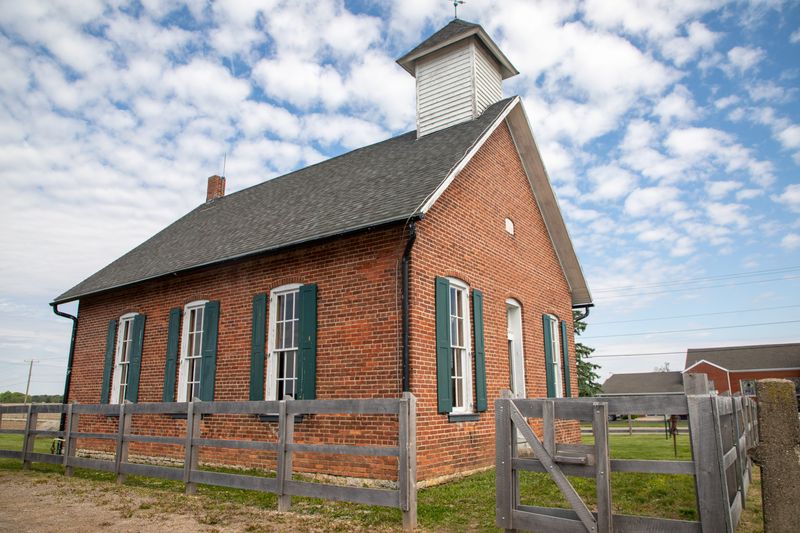
MUNCIE — The Corinth Schoolhouse, also known as One Room Schoolhouse No. 3, has been standing since 1875.
It survived the end of the one-room school era, decades of neglect, and years of use as storage for farm equipment and livestock before anyone thought to save it.

Now, for the second time in its 150 years of life, it needs rescuing. And a group of Delaware County community members has decided they’re the ones to do it.
The newly formed nonprofit One Room Schoolhouse No. 3 Inc. is racing to raise $52,000 before time takes away any more of the roof and brick and mortar of what the nonprofit’s board believes is one of the last remaining structures of its kind in the state.
“(Abandonment) is what we didn’t want to see happen. It’s already to this point, it’s been saved (before), we just need to get the doors back open,” said Colleen Cooper, president of the board.
The schoolhouse, at 6501 S. County Road 200 W., is just south of Muncie in Monroe Township. According to research by Ted Shideler, an East-Central Indiana historian who documents the region, a separate structure, the McKinney Schoolhouse, once stood about a mile south near the site of the original Corinth church.
By 1874, the District 3 schoolhouse had moved to its current location. The wood-frame building that stood there was replaced a year later by the brick one that still stands today, built in 1875.
In its early years, the school served as more than a classroom, acting as the heart of a small rural settlement. One teacher instructed students from grades one through eight, all in the same room, with a typical class size of about 18 kids.
The nonprofit’s board said Delaware County once had 63 brick one-room schoolhouses and that Corinth is believed to be the only one that remains, one of a handful in all of Indiana still preserved specifically for educational use.
“Most of the schoolhouses have gone into disrepair and then torn down, or else, turned into something else,” Mary Coffman, the board treasurer, said. “There are very few left. I think in Indiana, that there are two or three at the most, left. And there used to be 63 in the county.”
The school closed after the 1910-11 school year, with its students sent to Cowan as a part of a broader consolidation movement sweeping rural Indiana.
But for the next 85 years, the building sat closed and neglected.
It was, as the nonprofit describes it, “a quiet reminder of the past, gradually succumbing to time and the elements.”
In 1992, the schoolhouse was donated to the Delaware County Historical Society. After a windstorm tore off the roof of the building, the society’s restoration plans stalled. Norman Miller, a local veterinarian, stepped in and bought the schoolhouse for $1, committing to complete the restoration at his own expense, with the help of community donations.
The schoolhouse was restored with a new roof, a reconstructed cupola, and a period-accurate interior to reflect the year 1900. It reopened as a living history classroom in the early 2000s, with fourth-grade field trips from nearby schools coordinated by the Delaware County Retired Teachers Association.
As Miller aged, he was unable to keep up with the increasing maintenance demands of the building, and it slowly began to deteriorate again.
“Norman, the week before he passed, was asking, ‘What’s going to happen to the schoolhouse?’” Cooper said. “There (have) been hundreds of kids that have come through here over the years.”
Cooper visited the schoolhouse on a fourth-grade field trip, never quite forgot it, and decided to act, approaching Miller’s family about forming a nonprofit. On March 4, 2026, One Room Schoolhouse No.3 Inc. was officially established.
The board Cooper assembled reflects the community the schoolhouse has served throughout its life. Several members grew up in the area, driving past the building every day, and have family histories in Monroe Township.
Secretary Peggy Hazlett has lived down the road since 1993 and was told that the person who built her house was the first superintendent of the school. The motivation was personal, too, because she and Miller were old friends.
After he persuaded her to join another local board in the community, getting involved with the schoolhouse was a no-brainer.
“That dang Norman has gotten me involved in another thing,” she laughed. “It’s a super cool place and it’s our duty to keep it going.”
Standing in the schoolhouse today, it is not hard to see both what it was and what it could be again. The connected desks, donated by community members who pulled them from attics and barns after the school closed, are still there, along with ink and feather quills, chalkboards and more.
But the roof is failing, and in a building this old and exposed to the open, this is not a small problem.
“It’s not a one-and-done, either. Depending on how the weather weathers it, sometimes it (needs replacing) every three to five years,” Hazlett said.
Although this is the board’s first restoration goal, soon they’ll have to address the building’s brick walls, too.
“Tuckpointing is another big thing, because if the bricks aren’t fixed, the water gets in, and the inside deteriorates,” Cooper said.
The $52,000 campaign covers a new roof, repaired gutters, a repaired and repainted cupola, new and repaired shutters and entrance door, ceiling and flooring repairs, and brick replacement with mortar tuckpointing.
The goal of this all? Strengthening the building to last another 150 years. Cooper is candid that $52,000 is a starting point, not a finish line.
“We’ve got to have something to operate on. Right now, there’s no electricity turned on, no gas,” she said.
Although restoring the building is the board’s first priority, they’re actively working to bring back the living history field trip experience spearheaded by Miller and the Delaware County Retired Teachers Association.
The field trip experience will again be coordinated by the association. Students arrive in period clothing, sit boys on one side and girls on the other, read aloud from McGuffey’s Reader, practice penmanship with ink and feather quills, and head outside for recess games like hoop-and-stick.
“I feel like, with technology and everything, things like these are forgotten. This is a living history museum,” Cooper said.
The building has been standing since 1875. The people who love it intend to make sure it is still standing in 2075 and that there are children in it when that day comes.
The nonprofit will have a presence at the Cowan Lions Club car show on July 25, and the schoolhouse itself will be open during Corinth Church’s car show on Sept. 12. All other visits are by appointment only.
To donate, volunteer or schedule a visit, go to oneroomschoolhouseno3.org, email oneroomschoolhouseno3@gmail.com, or call board President Colleen Cooper at 765-729-5177. Checks can be mailed to P.O. Box 84, Muncie, IN 47308. Gifts of appreciated stock and IRA charitable distributions are also accepted.
This article originally appeared on Lafayette Journal & Courier: The push to save Delaware County’s last brick schoolhouse
Reporting by Trinity Rea, Muncie Star Press / Lafayette Journal & Courier
USA TODAY Network via Reuters Connect