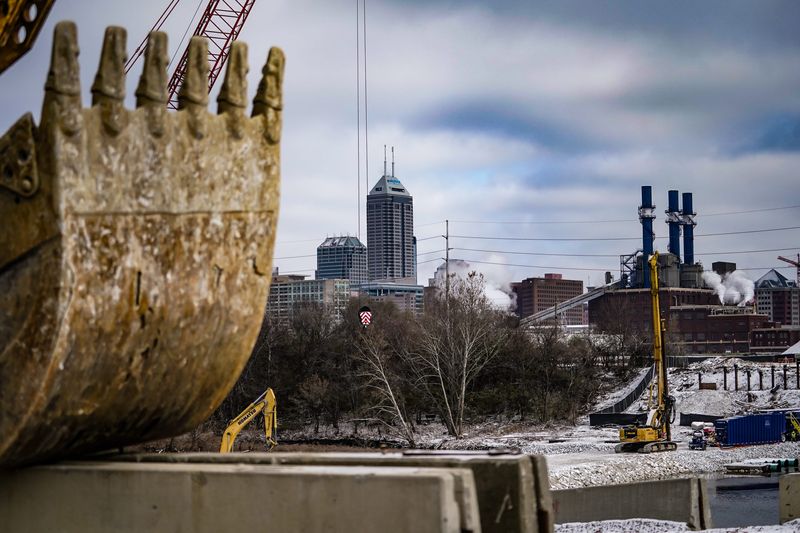
As the excavation of some of the oldest sections of the former Greenlawn Cemetery nears completion, the archaeology firm leading the project has found more than 1,100 graves filled with 19th century artifacts like necklaces, brooches and dolls.
Since late 2024, consulting firm Stantec has found nearly twice as many grave shafts as predicted by city officials ahead of work on the Henry Street right-of-way, which occupies about two acres of land between the White River and Kentucky Avenue southwest of downtown.

The historic burial ground, a roughly 25-acre site made up of four different sections, served as Indianapolis’ first cemetery before its closure in the late 19th century.
On top of the right-of-way, the city is extending Henry Street and building a new bridge, set to open in 2026, to connect South Street with a 15-acre White River State Park expansion and the new headquarters of animal health giant Elanco.
Before that can happen, however, the city is paying archaeologists and historians to map the graves in the right-of-way and publish a report about the people who remained there after some bodies were removed and reburied in newer cemeteries. While construction west of the White River around Elanco is nearly finished, work atop the right-of-way won’t start until 2026.
City officials say the archaeological work is essential to restore dignity to a site that has been disturbed by development, including a former baseball stadium and a manufacturing complex, over the past century.
“For so long, this history has sat there and it’s been disrespected, it’s been covered up and it’s been just mortified by people building things over it,” Indianapolis City-County Councilor Kristin Jones, who represents the area, said at a July 8 public meeting. “We are going to tell those stories. These folks are going to be respected.”
What excavation at former Greenlawn Cemetery is finding
Stantec Principal Investigator Ryan Peterson said crews have located 1,136 grave shafts so far and will finish excavation by this fall.
Only 17 graves were empty while more than 500 featured intact burials and nearly 300 contained some human remains, Peterson said. The rest remain under investigation.
The human remains are being exhumed and sent to Indiana University Indianapolis for a lab analysis that can reveal characteristics like age, height, gender and ethnicity. Afterward, the bodies and the artifacts will be reinterred in a different cemetery nearby.
Among more than 250 examinations to date, about 40% of those buried were juveniles while the rest were adults ranging from their 20s to their 80s, said Dr. Jeremy Wilson, a bioarchaeologist and IU Indy professor leading the lab.
The human remains show a mix of White and Black burials, meaning the site may have been more integrated than expected for a 19th century cemetery, he said.
The analysis will culminate in an osteobiography that recreates part of each person’s story based on their remains, Wilson said.
“This cemetery has been erased and effaced in excess of 100 years,” Wilson said. “And this is our unique opportunity to tell the story for each and every one of those individuals.”
Separately, researchers are using recovered artifacts to offer clues about when people were buried, how they were dressed and who they were, said Dr. Brooke Drew, a historical archaeologist with Stantec.
They have found multiple plaques bearing the words “Our Darling,” which were often used to commemorate infants in an era when many died young.
Based on four Civil War era military buttons found in one grave, researchers determined a man was likely buried in a Union Army four-button sack coat.
A necklace with a long brass chain, found around the neck of a child estimated to be around 2 years old, might have belonged to her mother — a parting gift for her little girl to keep forever, Drew said.
In a rare instance, Stantec discovered an intact headstone and footstone marking the grave of George D. Stapp, a boy who likely died between 6 and 9 years old and was the son of James and Susan Stapp.
“As our research progresses, we hope to link more grave monuments with individuals,” Drew said, “returning the identity to those we raised from the cemetery landscape.”
City webpage delves into Greenlawn Cemetery research
For more information on the cemetery and its inhabitants, visit the official city webpage documenting the excavation and construction progress: https://wridinfrastructure.com/.
Email IndyStar Reporter Jordan Smith at JTsmith@gannett.com. Follow him on X: @jordantsmith09
This article originally appeared on Indianapolis Star: ‘Tell those stories’: Greenlawn Cemetery excavation revealing hundreds of 19th century burials amid Henry Street expansion
Reporting by Jordan Smith, Indianapolis Star / Indianapolis Star
USA TODAY Network via Reuters Connect