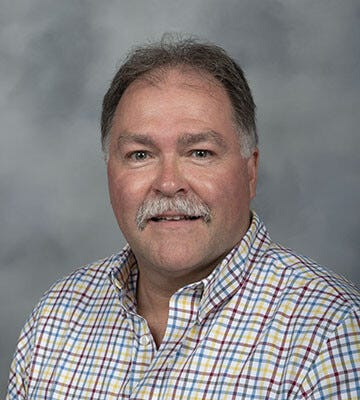
If you’ve never given a thought to geology or why anyone would want to study it, talking to Todd Thompson will inspire you to care.
As a longtime researcher and as state geologist since 2015, Thompson has been the go-to person in Indiana for geologic information about all the basic societal needs tied to this science: building materials, agriculture, hazards, energy, water.

Soon, that mantel of responsibility will have to rest on someone else. Thompson, 66, is retiring at the end of July, and Matt Johnson, assistant director for information services at the Indiana Geological and Water Survey, will serve as interim IGWS director until a new director/state geologist is hired.
Thompson won’t stop working altogether, though. That would be out of character. He’s already made plans to co-author a couple papers, continue working with Salem Limestone, and help rebox and catalog about 35,000 boxes of IGWS rock core that represent so many geologists’ life work.
He smiles thinking back to his heavy fieldwork days, lugging 150-pound vibracores through sand and swamps and back for more. “You were tired and your body hurt, but there was a sense of accomplishment at what you got done.”
“I got tired just watching him,” said Tracy Branam, who worked with Thompson for 38 years and has known him for 45. “He’d work all summer in the field, and it didn’t matter if he got rained on or if it was 90 degrees or if he was getting eaten by mosquitoes and ticks; he was as enthusiastic as ever. Nobody worked harder than him.”
A graduate of Allegheny College in Pennsylvania, Thompson moved to Indiana in 1981 to start a master’s degree in geology at IU Bloomington. That’s where he and Branam met, as associate instructors of Intro to Geology. “For some reason, I guess because I was older, the professor in charge made me the top one who’d give the overview to the class—which was kind of a mistake, because I wasn’t a geologist at the time,” Branam said. “Todd gave me a lot of advice on what I should say, which was amazing because he was so good, and I basically followed his lead.”
Thompson was named Outstanding Associate Instructor at IU in 1984; he started at the IGWS in 1986. “He was a visionary,” Branam said. “He can look at an outcrop and tell you exactly what kind of depositional environment it came from. I look at it and just see rocks.”
As a PhD student in the early ‘80s, Thompson began investigating the southeastern shore of Lake Michigan—an ever-changing landscape with hidden hazards. That appealed to the basis of his fascination with geology: “You’re sort of a detective, and you have to understand how the earth behaves, how it has changed through time, what materials it has that we can use as human beings, and also how we can keep it healthy,” he said.
His investigative tool of choice back then was a Vibracorer: a 15-ft-high metal tripod and gas-powered concrete vibrator attached to 3-inch-diameter and 30-ft-long aluminum irrigation pipe, which collects sediment cores of gravel, sand, silt, and clay. So many other researchers wanted to build and use Vibracorers, Thompson and four co-authors—including his wife, fellow IGWS geologist Linda Thompson—published a how-to paper in 1991 rather than continue mailing out slides showing the components.
Through the late ‘80s and all of the ’90s, Thompson and crew vibracored at the Indiana Dunes National Lakeshore and other parts of Tolleston Beach, Sleeping Bear Dunes National Lakeshore, and Wilderness State Park, as well as in Manistique, Mich., and Baileys Harbor, Wisc., to complete their lake-level change hydrograph of Lake Michigan started in northwest Indiana.
“The Great Lakes are essentially large rain gauges, and what we were able to show was that there were patterns of lake-level change in the Great Lakes, two important ones: one around 30 years and one around 160 years. These are quasi-periodic lake-level patterns, they’re still going on, and we expect them to go on in the future,” Thompson explained. “So, having that hydrograph allows us to not only understand the past but also to predict the future.”
Brian Keith, a colleague for 40 years, identified the lake-level studies as Thompson’s biggest impact on Indiana geology. “Nobody else had done that, and he’s the type of person who, when he’s going to do something, he’s going to do it thoughtfully and carefully, and nobody can really refute the data he’s accumulated and his interpretations because it’s all based on really careful analysis,” Keith said. “… I think particularly now with climate change becoming so important, having that data from the past is invaluable.”
That study also busted a myth that beach ridges were formed by storms; they are created instead by fluctuations in water level. That’s a finding that has had worldwide implications, and a study that has been used in many other scientific offshoots.
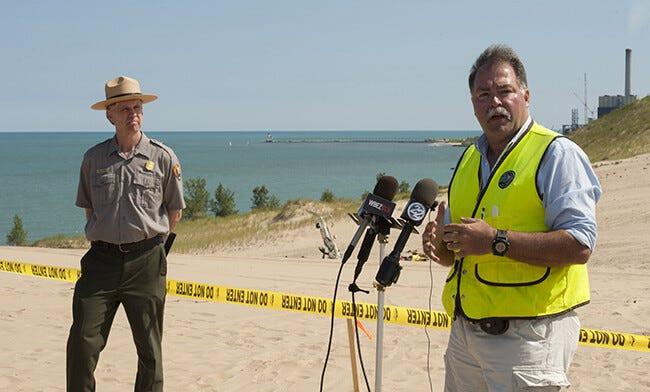
In 2013, after a 6-year-old boy fell into a hole at Indiana Dunes’ Mount Baldy, park staff called upon Thompson to investigate the cause. Thompson and a colleague at Indiana University Northwest mapped many more holes in the dune and identified what was happening: the formation of decomposition chimneys of trees under the sand, a phenomenon not previously documented in Indiana. That research led to increased safety measures on the dunes that persist today.
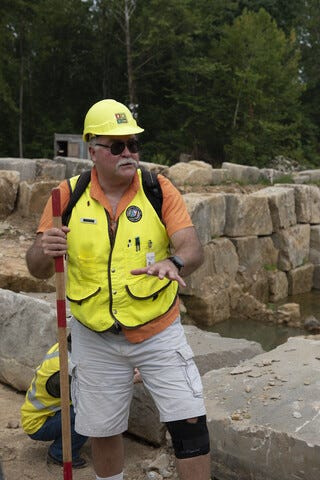
In addition to beaches, Thompson also spent a fair amount of his career at quarries. For operators, understanding the architecture of ancient carbonate shoals is critical to recover as much dimension stone as possible and do it safely. Thompson is eager to share what he knows. Thompson and Keith also learned a lot about the stone from closely studying the tall, smooth quarry walls, and gathering pieces with imperfections, such as stromatolites, that builders don’t want but geologists love.
For about a decade in the ‘00s and ‘10s—including five years when Thompson was assistant director for research—Thompson and Keith teamed up to map the bedrock geology of south-central Indiana. “Picking drill sites, describing core, we did all that together,” Keith said. “And out in the field one of us would often forget about something and the other would chime in, so we decided we each had half a brain and together it made a whole brain to do fieldwork. … We complemented each other.”
Keith and Branam both credit Thompson for being a stabilizing influence on the Survey as state geologist, doing what he could to build up the workforce and to encourage working across divisions. Retention has been especially challenging with a flat budget and with multiple facility moves, Thompson said, “and yet we’re still here and we’re still producing quality science.” He is also proud to have established the Indiana Journal of Earth Sciences, an online research journal based at the IGWS, to help distribute research widely and quickly.
In between field projects and leading the Survey, Thompson built pages for the former IGWS website after learning the programming language ColdFusion. He also wrote several computing programs; some are still in use at the IGWS and beyond.
He currently serves on Indiana’s Rare Earth Recovery Council and has directed recent projects commissioned by the Indiana Secretary of Natural Resources and the Office of Energy Development, such as assessing the state’s potential for sources of rare earth elements and critical minerals and its potential for geothermal energy generation. He represents Indiana on a national level at the Geological Society of America, where he was named a fellow in 2017 for his contributions to the geosciences through research, teaching, publication, and service; and the American Association of State Geologists, where he served as foundation president to work with the U.S. Geological Survey and other federal agencies to ensure an efficient and effective response to the needs of society.
In addition to all this, Thompson readily and regularly volunteers to teach Master Naturalist classes, to lead fieldtrips into quarries and along busy roadsides to point out interesting features and fossils, and to give presentations about Indiana’s extraordinary geologic history to anyone with even the smallest desire to learn.
“I never met anyone with the enthusiasm he has for geology,” Branam said.
“His attitude, it’s infectious, and when he gets enthused about something, it carries over.”
Yes, Thompson loves the work. But it’s been more than that. He thinks back to the lake-level studies again, coordinating as many as 15 people in the field from all different disciplines to work on a common goal—and then going back to a cabin together for the evening, and all the conversations that would occur. “All my colleagues and I talk about how we miss those days as our bodies wore out,” he said.
“I’ve never looked at being at the Survey as being about me; I’ve always looked at it being about us. … Being an old football player, I know that you can only succeed as a team,” he said.
It just so happened that he was tapped to be captain—a position he repeated many times in his life and career. “Somebody’s got to do it,” he said, “and I have the broad shoulders.”
Sara Clifford is the editor at the Indiana Geological and Water Survey and managing editor of the Indiana Journal of Earth Sciences.
This article originally appeared on The Herald-Times: State geologist retiring after 40 years at geological survey
Reporting by Sara Clifford, Indiana Journal of Earth Sciences / The Herald-Times
USA TODAY Network via Reuters Connect
By Sara Clifford, Indiana Journal of Earth Sciences | USA TODAY Network