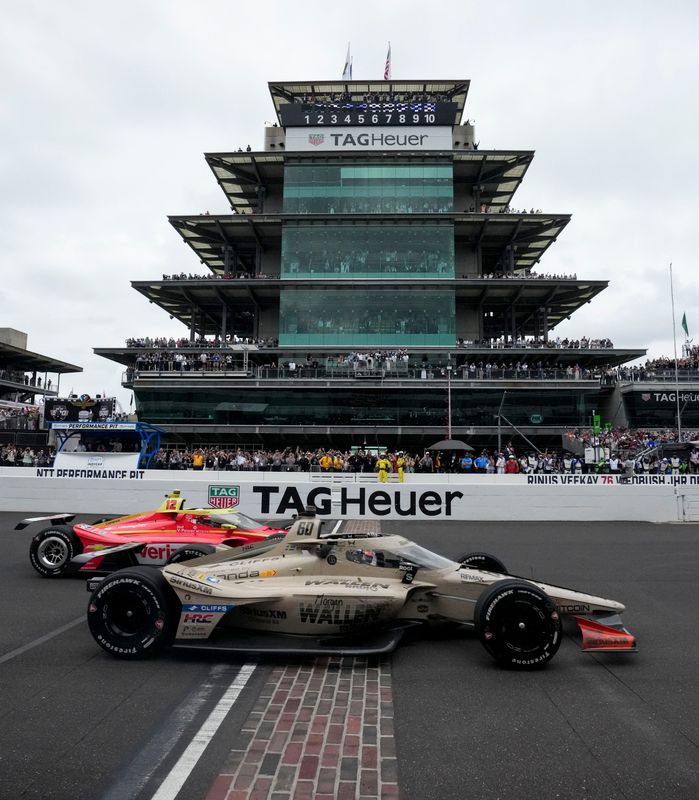
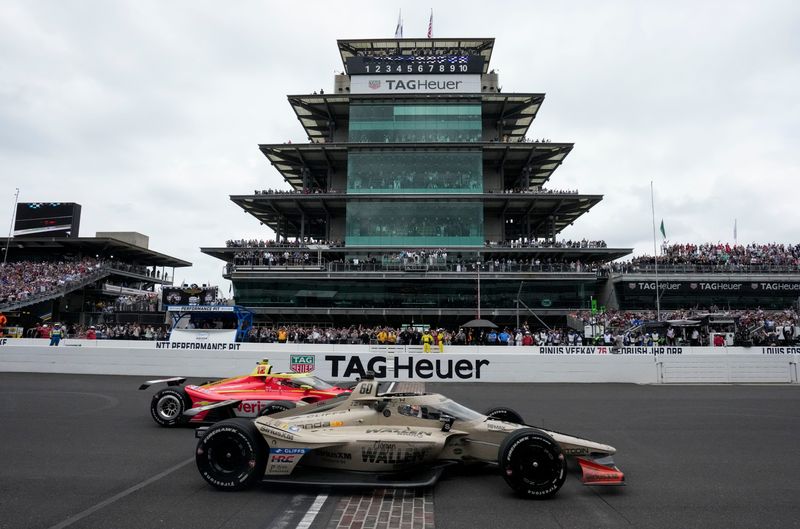
INDIANAPOLIS – Five of the last six Indianapolis 500s have gone into Lap 200 with multiple drivers in position to seize the Borg-Warner trophy, including Sunday’s jaw-dropping finish that saw Felix Rosenqvist beat out David Malukas in the closest finish the race has seen in its 110 editions.
Of those five finishes, the last three have seen the leader after Lap 199 not win the race, as Josef Newgarden hawked down Marcus Ericsson in 2023, and did so again to Pato O’Ward in 2024.

After Rosenqvist completed the third successful final-lap pass in four years by overtaking Malukas and Marcus Armstrong, it begs the question: If the race is up for grabs, do you want to lead heading into the last lap of the Indy 500?
What Marcus Armstrong saw
Armstrong was in first going into the Lap 200 restart after Mick Schumacher brushed the Turn 1 wall, leading IndyCar race control to deploy a caution. Malukas was in second and Rosenqvist third, and although Armstrong didn’t intentionally surrender the lead, he was fine with Malukas passing him before Turn 1.
“I knew Malukas was going to get me,” Armstrong said on the red carpet of Monday’s Indy 500 Victory Celebration. “I saved a bit of my (hybrid powertrain) deployment even for that, because I knew he was going to do me.”
Armstrong felt that, by catching a draft off Malukas and deploying his hybrid system, he’d be able to catch back up to Malukas and pass him in a similar fashion to what Rosenqvist did. But he didn’t anticipate his teammate staying on his outside and going two-wide with him into every corner of the lap.
Rosenqvist was then able to use the draft from trailing Malukas and being on Armstrong’s outside to gain speed. Rosenqvist stayed full throttle while also deploying what was left of his hybrid, as Armstrong lifted and saw his teammate make it to the bricks first.
“I think if I had kept Felix behind me, I would have been in a pretty good spot,” Armstrong said.
Instead of getting back to first, which Armstrong felt he would’ve done if not for Rosenqvist, Armstrong fell behind both drivers and two more — Scott McLaughlin and O’Ward — to finish in fifth. The last lap kept Armstrong from getting his first IndyCar win on the biggest stage while also being the difference between his current 10th-place standing in IndyCar’s championship and the fifth-place position he would’ve held with a win.
“If you lose first, as long as you don’t go back to third, you’re okay,” Armstrong said. “I think if Felix wasn’t where he was, it would have worked out pretty well for me, I think. But that’s just how it goes, isn’t it? It’s the Indianapolis 500.”
Armstrong said he doesn’t regret not staying at full throttle because if he did, he feels he and Rosenqvist — who are both in contract years according to MSR co-owner Mike Shank — would’ve made contact with each other and not finished the race.
“I did what I thought was right at that very moment,” Armstrong said. “And I was a little bit crowded, and I was also in turbulent air from Malukas. So it was a no-win situation for me down there.”
What David Malukas saw
Malukas, whose No. 12 Team Penske Chevrolet was clearly among the fastest at IMS all month, was committed to overtaking Armstrong heading into Turn 1. He believed if he held the lead going into the short chute between Turns 3 and 4, that the race would be his.
“I stared at the wall and just thought about 8,000 different scenarios of what I could have done differently,” Malukas said on Monday. “Which, always thinking back, there’s so many different things I could have done. But just in that moment, you’re making these high-speed decisions, it’s always tough.
“And from my side, I studied so many previous races in this new car. And normally, whoever’s leading into Turn 3 normally has it down. … Just was not expecting a run coming out of Turn 4.”
As Malukas was trying to break the draft that Rosenqvist used to his advantage, he veered just inside to make his last push toward the finish line, allowing Rosenqvist to stay full throttle on the high line. All 41.708 seconds of Rosenqvist’s final lap came with a threat of crashing if Malukas or Armstrong defended hard enough with Rosenqvist alongside the outside wall. But Malukas wasn’t comfortable putting himself and Rosenqvist’s race in jeopardy at the end.
“I mean, you’re coming down to the line to win the Indy 500,” Malukas said. “I don’t think he would have been able to react quick enough. I think we would have had contact and had a big crash. So to cut back down on the right, I don’t know. I don’t know. It could have maybe survived and maybe got us the win, or we could have just both crashed, and it could have been a really bad ending to finish it all off. And that would’ve heavily been on me, right?”
Malukas led the third most laps of the day, trailing only pole-sitter Alex Palou and Scott Dixon, who led 16 laps under caution. Malukas and Armstrong, both chasing their first IndyCar win, weren’t willing to risk what Rosenqvist was.
What Felix Rosenqvist saw
Rosenqvist, who said he “would hate to be in the lead for that last restart,” thought being in third was the best scenario. He observed that over the course of the race, which saw an Indy 500 record 70 lead changes, the leader got passed soon after restarts all but once.
“I tried to convince myself third might actually be exactly where you want to be,” Rosenqvist told IndyStar on Monday, “because it normally allows you to get a really good run when the two leading cars go side by side and basically have to punch a hole in the air, both of them.”
When Rosenqvist was involved in a two-lap shootout following a red flag in 2022, he lifted and took the low line, ultimately leading to a fourth-place finish behind Ericsson, O’Ward and Tony Kanaan. Rosenqvist, who’s now 34 years old, wasn’t going to go down in the same fashion this time.
“Adrenaline takes over and you’re also willing to risk a lot at that point,” Rosenqvist said. “I think Indy is the only place that can get that out of you in that sense, where you just don’t care about the aftermath of your actions. So it was pretty easy for me. I just kind of let the adrenaline do its thing and yeah, it was a really cool moment.”
Rosenqvist letting the adrenaline take over allowed him to perfect one of, if not the, best laps in the history of the Indy 500. It caught the eyes of his peers, many of whom don’t believe they could’ve pulled off the lap themselves.
“He put everything on the line all day, really,” said O’Ward, who was the best man in Rosenqvist’s wedding. “I’ve never seen him be so aggressive with where he was placed in the car. It was win it or crash, that’s what I saw from him yesterday.”
Rosenqvist is just pleased at the fact that, somehow, none of the three drivers competing for the win put each other in the wall. It would’ve been easy for Malukas or Armstrong to knock him off his line, and some will argue they should’ve. Instead, each car made it to the bricks intact, and Rosenqvist became a hero.
“I think the last lap showcased what IndyCar racing is all about — wheel-to-wheel racing, high stakes, super-fast speeds,” Rosenqvist said. “But still, respectful racing with some of the best drivers in the world. And I’m just super happy that everyone there gave each other room, enough to just get that finish for the fans.
“Because as a fan, when I watch it, it’s just such a cool thing. That’s a ‘hell yeah’ moment.”
Is first the spot to be in?
The construction of the IMS oval puts leaders in a vulnerable position on restarts. The course’s 0.625-mile straightaways and changing winds around the track leave any leader who doesn’t have a sizeable advantage and warm tires in a tricky position.
Ask Shank, who claimed Armstrong “did everything he needed to do” despite having the win escape him at the mercy of his teammate.
“When you restart (first) at Indianapolis, you’re a sitting duck if people want to pass you,” Shank said on The Fan Morning Show on Tuesday. “Aerodynamics aren’t going to allow you to stay out front.”
Many IndyCar tracks — some ovals included — lend themselves to follow-the-leader racing. At IMS, you probably don’t want to be the leader being followed, especially if it’s soon after a caution.
Rosenqvist joined Ericsson and Kenny Brack as the three Swedes to win the Indy 500 (only five have ever been in the race). In back-to-back years, Ericsson led a restart in the last five laps of the Indy 500. In 2022, he managed to hold off O’Ward despite O’Ward and Ericsson being even heading into Turn 1 of Lap 200. The next year, Newgarden got Ericsson on the back straight on a one-lap shootout for the win.
“It’s really tough, especially at this track with the draft, it’s really tough to keep the guys behind — almost impossible,” Ericsson said. “So it’s really a tough situation. I managed to pull it off in ’22, tried again in ’23 and didn’t. So I’ve been on both ends of it, really. … At the end of the day, it’s just such small margins, and this time it was meant to be for Felix.”
“You got to have the right instinct, and you got to make the right decision,” Newgarden said. “It’s hard to do that, it’s so hard to do. It’s hard to do for anybody, so when you get it right, it’s satisfying.”
The changing conditions of IMS depending on the day, weather and time of the day make it hard to base strategy on prior finishes, as Malukas tried to do. Twenty years ago, Sam Hornish Jr. made a similar pass of Marco Andretti on the front straight, but Hornish overtook Andretti by getting to his inside after breaking the draft.
In recent years, IndyCar has been less willing to end races on yellows, instead opting to deploy red flags if the aftermath of a yellow isn’t cleared in time for a restart. (In 2023, Ericsson called it “unfair and dangerous” that IndyCar deployed three red flags late to avoid ending on a caution.) That’s led to three brief shootouts to end the last four Indy 500s, and the leader on those restarts has maintained the lead just once.
Ultimately, unless a driver is in an elite car (like Ericsson was in his Chip Ganassi Racing Honda in 2022), chances are the construction of the track will set them back when trying to hold off pursuing cars on a restart. Even Malukas, who is with Team Penske, known for its success at IMS, couldn’t break the draft enough at the end to outlast Rosenqvist.
Drivers and teams can’t plan for when cautions come (although some try). But when race control does wave those yellow or red flags in the final five laps of the Indy 500, it’s probably best for a driver to see a car or two in front of them.
Zion Brown is IndyStar’s motorsports reporter. Follow him at @z10nbr0wn. Get IndyStar’s motor sports coverage sent directly to your inbox with our Motor Sports newsletter. Subscribe to the YouTube channel IndyStar TV: IndyCar for a behind-the-scenes look at IndyCar and expert analysis.
This article originally appeared on Indianapolis Star: Should IndyCar give Indy 500 leader the option to drop to 2nd on a last-lap shootout?
Reporting by Zion Brown, Indianapolis Star / Indianapolis Star
USA TODAY Network via Reuters Connect