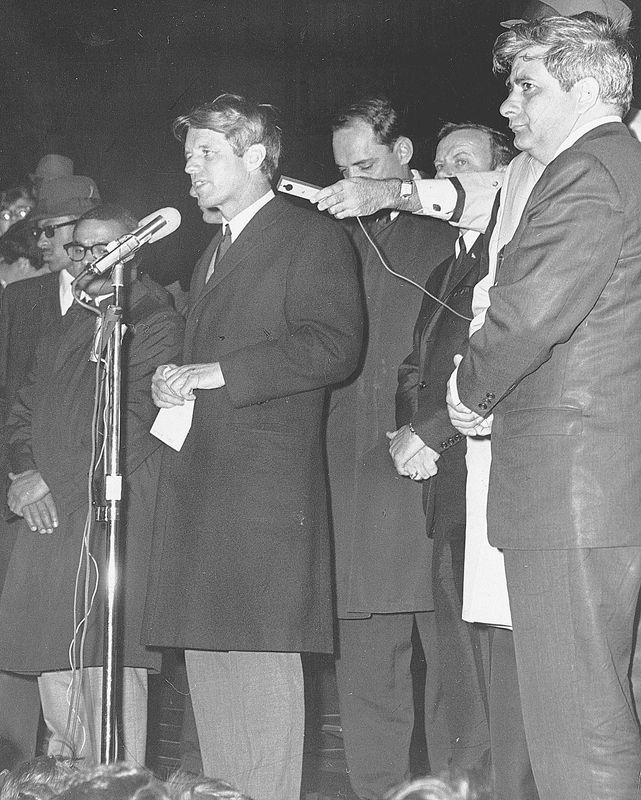
In 1968 when Robert F. Kennedy ran for president, he saw Indiana’s May 7 primary as a critical one to win. The New York senator faced Minnesota Sen. Eugene McCarthy and Indiana Governor Roger Branigin on the Indiana ballot.

Branigin billed himself as a “favorite son,” though his presence on the ballot was as a stand-in for President Lyndon B. Johnson who had announced at the end of March that he would not seek re-election. An April 2 Indianapolis Star story hypothesized that Branigin stayed in the race because a win would give him control over the state’s 66 delegates’ votes, power that could prove useful at the party convention later that summer.
But Kennedy saw Indiana as a useful testing ground for whether his candidacy would be viable. He told an aide that his performance in the state primary would determine whether he should continue with his presidential quest.
“Indiana is the ballgame,” he said, according to a 2021 Indiana Historical Society blogpost.
While Kennedy spent the days before the election traversing the state, stumping before groups as varied as Indiana housewives and the American Legion, some of his primary success may well have stemmed from an appearance in Indianapolis the prior month.
On April 4, Kennedy scheduled a speech at the Broadway Christian Center outdoor basketball court at 17th and Broadway. As his plane touched down in Indianapolis that evening, he heard that Martin Luther King Jr. had just been shot. Fearful that the news would spark a riot, Indianapolis Mayor Richard Lugar tried to persuade Kennedy to cancel the speech, according to an IndyStar article.
At least, Lugar said, have police on hand to quell the crowd if necessary.
But Kennedy insisted he speak and do so alone. Arriving about an hour late, Kennedy found a crowd of about 2,500 people, most of whom knew only that King had been shot, not that it had been fatal. Hopping on a flatbed truck, Kennedy delivered the tragic news. He gave an impromptu speech from the heart, talking about the loss of his beloved brother and exhorting the crowd to find a way forward.
“(W)e have to make an effort in the United States, we have to make an effort to understand, to go beyond these rather difficult times,” Kennedy said in his speech that lasted only about five minutes.
The speech was long enough, however, to have a decided effect on the crowd. In more than 100 cities, riots broke out in the wake of King’s death. More than 2,000 people were injured and nearly 40 killed. Historians have credited Kennedy’s words that night with preventing a similar scenario in Indianapolis.
Still, not everyone was impressed. Publisher Eugene C. Pulliam, who presided over the Indianapolis Star and News, famously minimized Kennedy’s appearance that night. The only mention of the speech in the next day’s papers came under a headline about young Hoosiers backing Branigin.
Not a fan of Kennedy, Pulliam missed few opportunities to promote the hometown favorite.
On May 5 the Indianapolis Star ran a rare front-page editorial exhorting Hoosiers to vote for Branigin, even encouraging Republicans to join the movement by voting in the Democratic primary.
The editorial came a few days after an editorial in The New York Times that asked, “Is Indiana For Sale?” and detailed Kennedy’s spending in the state in the quest for votes. “(I)n its gross effects the power of money is writ large across the Indiana primary,” the East Coast paper wrote. And the Star editors responded that Indiana voters should tell the “whole world” that Indiana was not for sale.
Little wonder, then, that in a May 7 Indianapolis Star article the day before the election, Branigin predicted that he would win the tight race, noting the large number of undecided voters.
But Kennedy won the primary handily, defeating both Branigin and McCarthy in the state with 42 percent of the Democratic ballots with Branigin receiving about 30 percent of the votes and McCarthy about 27 percent.
Kennedy’s wife Ethel called the result “sensational” in a May 8, 1968 Indianapolis Star article. Kennedy himself offered a more measured assessment, saying the fact that he had done this well was “very encouraging.”
One month later Kennedy was assassinated in California, after a speech declaring victory in that state’s primary.
This article originally appeared on Indianapolis Star: Retro Indy: Indiana gov said he’d win ’68 race. RFK proved him wrong
Reporting by Shari Rudavsky, Indianapolis Star / Indianapolis Star
USA TODAY Network via Reuters Connect