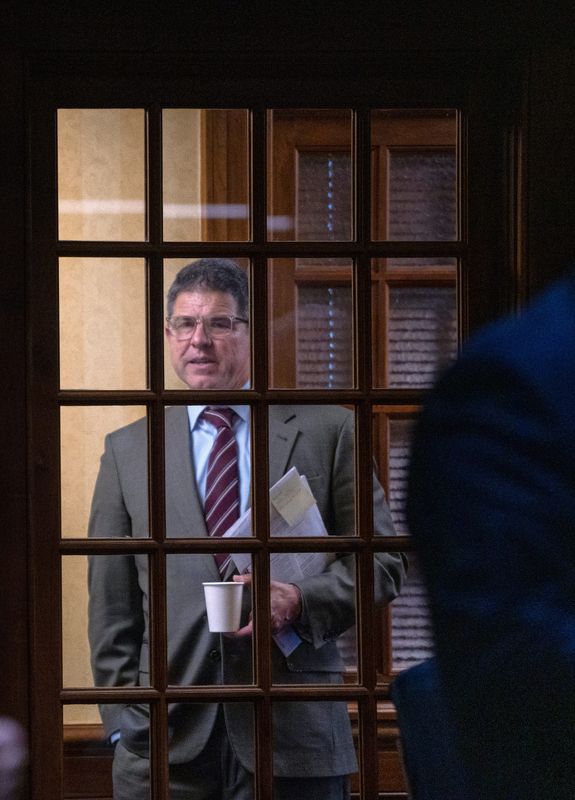
Indiana Senate President Pro Tempore Rodric Bray wasn’t on the ballot on May 5, but he had a lot at stake.
His caucus’ campaign arm spent millions trying, and mostly failing, to defend their incumbents against the bloodbath brought upon them by President Donald Trump-endorsed challengers. Bray donated hundreds of thousands from his own campaign coffers. The president and the governor have called for his ouster as leader over his caucus’ fateful decision last December to reject mid-decade redistricting.

Of the eight candidates Trump endorsed to either challenge Republican Senate incumbents or run in an open seat, six of them prevailed, and several by large margins. Only one incumbent survived. Another might be headed to a recount.
However, Bray said he still doesn’t have regrets, nor does he plan to step down on his own accord.
IndyStar had five minutes the morning after the election to catch up with him. Here’s what he said.
Q: Tell me your initial reactions to last night’s results. Were you surprised? Does this align with any polling you’ve seen?
A: Yeah, I’m not entirely surprised. A lot of money was spent in this election over the last several months, last few months, really just since January or February. As we all know, money does matter in politics. At the end of the day, though, the voters have spoken. We’re going to accept those results and continue to move on from here.
Q: Do you think it was more the money, or more the Trump endorsement, or a combination of both?
A: Yeah, I think there’s no one thing that makes the decision there. It’s a combination of several things, including those things. The Trump endorsement clearly did seem to make some difference.
Q: What do you think this says about the president’s influence over the party, and ultimately, the Indiana Statehouse?
A: I don’t know. What I do know is we’ve done some really good things in Indiana. Indiana is in a really good spot. We’re going to continue trying and move Indiana forward with growth and opportunities. Otherwise, I mean, that’s the way I see it.
Q: Do you have concerns about this outcome and the new people coming in if they win November?
A: Our Senate turns over all the time. I’ve been amazed since I was elected, that there’s constantly a change of turnover from people that are retiring, get defeated in the primary or general election. So that’s a constant. … That’s just part of the way this Senate has worked my entire time we’ve been there.
Q: There are suggestions that you should step down as leader. What do you say to that?
A: That decision will be made by the caucus in the fall. I intend to offer my services up again, as I’ve said before over the last few weeks, if the caucus decides, they don’t want me to lead, then they’ll choose somebody else, and I’ll go back to trying to be the best senator I can be. But at this point, I’ll continue to lead it to the best of my ability.
Q: Do you think the numbers are there to oust you?
A: We’ll figure that out toward the end of the year.
Q: On CNN, you were asked if you regret your redistricting vote. What’s your answer to that today?
A: Same answer. I don’t regret it. I try to make the best decision you can, and I still feel the same way about that issue. You take a look at this election, the redistricting really wasn’t an issue. It may have propped up occasionally in some of the dialogue, but if you watched any of these races, redistricting was not the issue that was run on, really. It was other things. So that I wouldn’t say that had a lot to do with the ultimate result in these races.
Q: What other things jumped out at you as the main issues driving it?
A: Some of them were kind of mischaracterizations. For instance, there’s a lot of talk about how there’s a policy passed in the General Assembly that allowed China to own land in Indiana. In fact, the opposite is true. We completely limited any of our foreign adversaries, China included, from being able to own land in the state of Indiana at this point ― certainly farmland and land near any military bases. And so, there were issues like that I think seemed to make a difference in the race. But certainly not redistricting.
Q: If these six people are elected in November, they could have the votes to make redistricting a possibility in 2028. Do you see that as a possibility or something that could come up and be successful in Indiana next time?
A: I haven’t thought much about that yet.
Contact IndyStar Statehouse reporter Kayla Dwyer at kdwyer@indystar.com or follow her on X@kayla_dwyer17.
This article originally appeared on Indianapolis Star: Q&A: After Indiana Senate primary bloodbath, Bray resists calls to step down
Reporting by Kayla Dwyer, Indianapolis Star / Indianapolis Star
USA TODAY Network via Reuters Connect