WEST LAFAYETTE, IN — Three of Purdue’s cultural centers — long regarded as havens for minority students to congregate, learn and socialize — could be slated for demolition to clear ground for a new residence hall, according to university planning documents.

The plans are included in the university’s Giant Leaps Master Plan, which was adopted in 2018 and opened the gates for administrators to begin building new housing to accommodate a swelling student population.
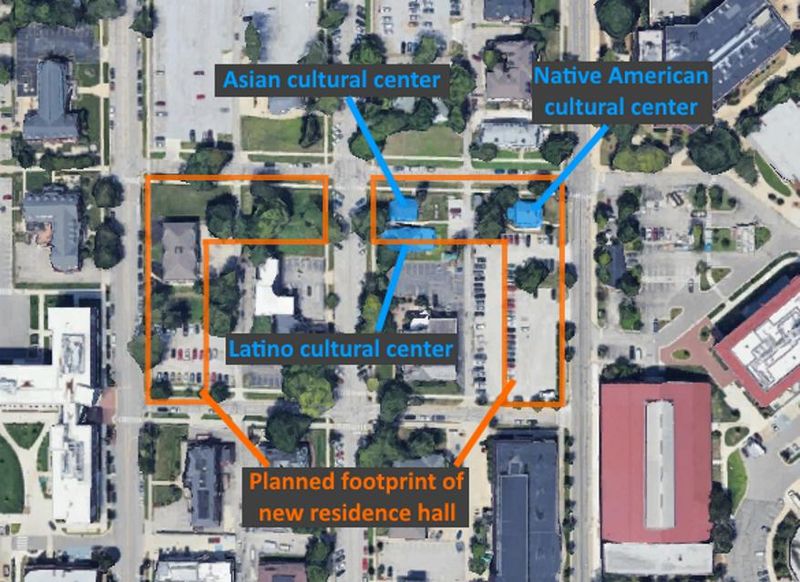
The plan proposes a new residence hall, called “The Island,” to be built on lots currently occupied by the Latino Cultural Center, the Asian American and Asian Resource and Cultural Center, and the Native American Educational and Cultural Center.
The Island would add about 1,000 new beds to campus and stretch between Russell and University streets, according to planning documents. The plan doesn’t say when it is slated to be built or what would happen to the cultural centers currently located on the site.
“The centers are a major social focal point in the lives of many, many, many students,” said Stephanie Masta, a professor in Purdue’s College of Education who studies the experiences of minority students on college campuses. “To think that a campus master plan did not consider maintaining those and increasing student housing at the same time is very disheartening.”
She said cultural centers serve an important role in making minority students feel at home on college campuses and provide education, community and sometimes even social services for the students they serve.
Tearing them down, Masta said, would be a blow to those students.
“What we would lose is that sense of community,” she said. “Because if our campus buildings were already welcoming in this way, that’s where students would gather.”
Purdue spokesperson Trevor Peters said there are “no current proposed projects” for the area, but he did not respond when asked for a timeline of when the new residence hall could be built or whether Purdue still plans to do so.
Administrators at the cultural centers did not respond to detailed lists of questions.
Purdue’s plan was originally approved by the university’s board of trustees in 2018 as a 50-year road map to connect campus through pedestrian-friendly green spaces, new residence halls and the renovation of existing buildings.
A key part of the plan is what administrators call “the island” in the center of Purdue’s campus: a strip of West Lafayette tucked between academic buildings and already existing residence halls running from Stadium Avenue to Mitch Daniels Boulevard.
This spot, which is currently dotted with the three cultural centers as well as private apartment complexes and parking lots, is where the new residence hall of the same name would eventually be built, the documents say.
The space has long been eyed by university administrators as prime real estate for development. Purdue has methodically bought land in the strip for decades, and in 2018 administrators affirmed it as a key part of the 50-year plan.
At the time, Adam Gross, an architect who helped develop the plan, said the university should seek to “make that island a bridge” connecting the two halves of Purdue’s campus.
“We feel this really can be an extraordinary transformation,” Gross said.
The planning documents don’t mention that strip of land by name or the cultural centers already there but instead excitedly point to an abundance of “open sites” to build new residence halls.
“By building on open sites, Purdue will increase the overall bed count without disrupting the existing residence halls,” the document says, making no mention of any other potentially affected buildings.
For all of the centers, the looming demolitions could mark yet another relocation, though the documents don’t mention whether that’s in the cards.
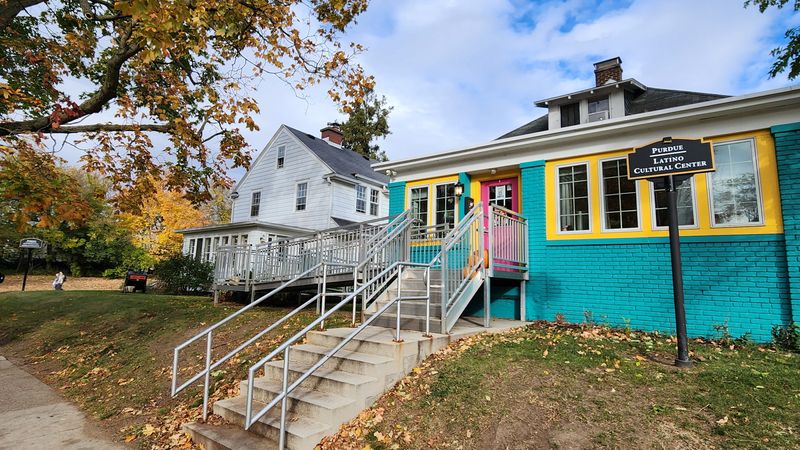
The Latino Cultural Center was already forced to move once in 2017, when its spot at 600 N. Russell St. was demolished to make way for a parking lot — a move LCC administrators said they didn’t learn about the details of the forced relocation until they read about it in the news.
From there, the LCC moved into 426 Waldron St., now within the footprint of the proposed residence hall.
The Native American Educational and Cultural Center has also been forced to relocate in the past, being moved into its current location at 903 5th St. in 2016 to make way for renovations at its original spot on Harrison Street.
The Asian American and Asian Resource and Cultural Center moved into its current spot at 915 5th St. in 2016 after spending a year in the Stewart Center.
Masta said the relocation of a cultural center can be a good thing, like when the Native American center moved closer to campus from Harrison Street, for example. But the three centers are already in the heart of campus, she said, and it’s unclear where they could be moved now — if at all.
Purdue administrators are currently reviewing the master plan for an update by 2026, according to a September press release. Students, faculty and staff can give input on the current plan via an online survey until the end of the day Friday.
“We know that brown and black students do not feel comfortable on this campus,” Masta said. “Removing the three centers, I’m not sure how that helps the cause.”
This article originally appeared on Lafayette Journal & Courier: Purdue plans possible demolition of Native American, Latino and Asian cultural centers
Reporting by Seth Nelson / Lafayette Journal & Courier
USA TODAY Network via Reuters Connect