INDIANAPOLIS — Exactly as you predicted in 2000, the next Big Ten men’s basketball national champion started four players who were on other college rosters a year ago, two of whom came from other Big Ten schools – including one in California.
No, you could not have fathomed this Michigan team the last night a Big Ten team cut down the nets at the Final Four. You could not have conceived of a team built largely via the revolving door of the transfer portal, with a portion of the Wolverines’ media rights revenue flowing right into the players’ digital bank accounts.

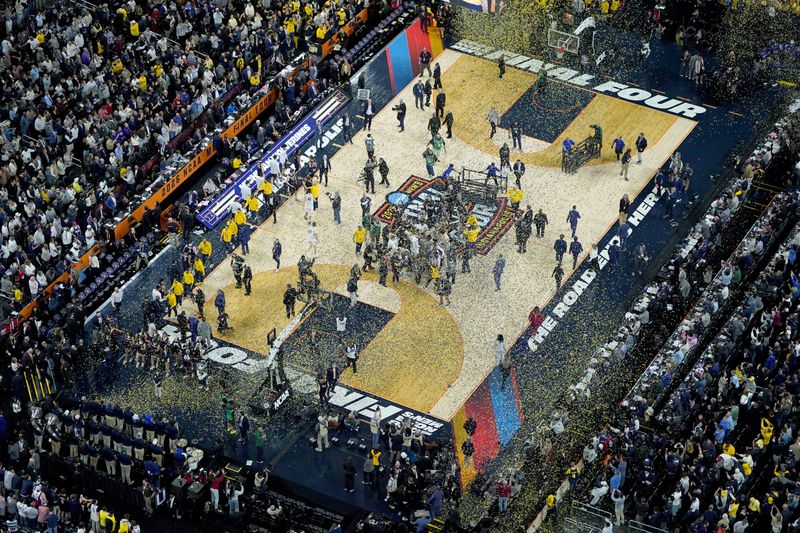
Michigan’s 69-63 victory over UConn on Monday wiped away the league’s long-lingering insecurity. For the first time in 26 years, a Big Ten team watched the “One Shining Moment” montage from a basketball court scattered with confetti of their school colors.
Dusty May needed only two seasons to flip an 8-24 team into a juggernaut. In the same time frame, IU’s Curt Cignetti flipped the losing program in college football history into undefeated national champions.
For the first time since 1997, one conference owns the national championship in the three biggest sports simultaneously. Indiana football — the Big Ten’s third straight national champ — kicked things off in January. Sunday night, UCLA snapped a Big Ten women’s basketball national championship drought which had started in 1999 — one year before the men’s.
Those are the headliners, but the Big Ten’s current dominance extends beyond big-ticket title games. As college sports transitions from the well-meaning strictures of amateurism to a free market system, as it evolves from regional alliances to conferences stretching coast to coast, one conference conquered both that period of turmoil and the best competition in the country better than any other.
“When you look at the coaching, the depth of our league, and the commitment to athletics in our conference, it’s pretty special,” Michigan coach May said.
“It’s a great time. The tide has turned in our favor.”
What a men’s basketball national champion means for the Big Ten
Kentucky men’s basketball and Tennessee women’s basketball won championships in the spring of 1996. Florida football followed up the next winter. That was the last time one conference held all three trophies at the same time.
That’s a nice footnote, but the Big Ten needed these two basketball championships, 24 hours apart. On the men’s side, seven different programs had lost in the national championship game since Michigan State last won one in 2000.
Those near-misses came from increasingly powerful contenders. Wisconsin’s back-to-back Final Four teams under Bo Ryan. Purdue following force of nature Zach Edey to the 2024 championship game, stopped only by another force of nature: Hurley’s repeat champions.
Some bad luck is involved when that many championship-caliber teams come up one win short. On the other hand, while no major American sports event is more subject to extreme variance than the NCAA Tournament, it’s hard to blame variance for an entire generation without a trophy.
Big Ten Commissioner Tony Petitti was in Phoenix on Sunday night when UCLA wrapped up a 37-1 season by beating powerhouse South Carolina. He was back in Indy on Monday, among those trudging through the confetti on the Lucas Oil Stadium court.
“It’s just hard – it’s hard to win,” Pettiti said. “There’s a lot of great teams out there, and this tournament is a real gauntlet. To get that first one for the conference after all these years – it means a lot.
“… It also means a lot for the whole league – everybody back home. All of our coaches, they’re really proud of this, because it’s not only for Michigan. It’s for the whole league.”
Michigan and UCLA won very modern basketball championships
Three of UCLA women’s coach Cori Close’s starters were transfers. Dusty May went two steps beyond that.
Yaxel Lendeborg came from UAB, putting off the NBA draft to instead win Big Ten Player of the Year in Ann Arbor. Aday Mara mostly came off the bench in one season at UCLA, then transferred to Michigan and became Big Ten Defensive Player of the Year. Final Four Most Outstanding Player Elliot Cadeau and fellow All-Tournament Team selection Morez Johnson Jr. played at North Carolina and Illinois, respectively, last season.
Nimari Burnett wrapped up his third Michigan season as a national champion. Yet he started his career at Texas Tech and moved to Alabama for one season before heading north. For the first time, a team started five transfers in the national championship game.
Some fans, purists, hate to see that. Their disdain is understandable and, to varying degrees, warranted. Yet constructing the nucleus of a roster through the transfer portal – and yes, through the enticement of revenue share and name, image and likeness opportunities – represents a big portion of the sport.
Plenty of coaches have tried to do what May achieved and come nowhere close. A Purdue championship in 2024, with only one graduate transfer in the starting lineup, would have been more aesthetically pleasing to many traditionalists around the Midwest and around the country.
Michigan proved, though, there is more than one way to win. It may not be the way May’s Wolverines win every year. But maybe we should not be surprised the first Big Ten national champion in 26 years came when a coach figured out the best mix of skill and chemistry – and, for lack of a better term, the best salary cap management.
“Resources matter – you have to be honest about it,” Pettiti said. “But you still need great coaching. You still need a commitment to winning and performing at the high level and building and developing players. I don’t think that’s ever going to change.
“Obviously resources matter, but the commitment to the coaching, and then getting the right people and the right student-athletes who believe in what their coaches are doing, I think you’re seeing that across pretty much everything we play.”
How the Big Ten grind helped Michigan win it all
Michigan made it look easy at times this season, even in a league responsible for five Elite Eight teams and two in the Final Four. It ripped off the first 19-1 Big Ten season, winning four games by 30 or more points.
It scored 90 or more points in each of its first five NCAA Tournament games. After pulverizing No. 1 overall seed Arizona in Saturday’s semifinal – a game many believed going in might as well have been the championship game – it was favored to make quick work of the Huskies, as well.
Then those teams combined to double the number of bricks contained in Lucas Oil Stadium. Michigan missed its first 10 from 3-point range and finished 2 of 15. UConn made only 4 of 18 in the second half.
So this game would be won in the basketball equivalent of the trenches. This was at times a jarring matchup of shoves and collisions. Frankly, it was the sort of game many expect any time they turn on a Big Ten basketball game.
That was one of the theories for the Big Ten’s fruitless championship chases. Teams endured such a beating from November through February they did not have enough left at the end of the season.
As easy as Michigan made it look at times, many forget the two-point win at Penn State. Or that home loss to Wisconsin. Or the two narrow victories preceding their Big Ten Tournament championship game loss to the Boilermakers.
“People said, ‘They’re going to slow it down, they’re tough,’” Michigan athletic director Warde Manuel said of the UConn matchup. “We played tough opponents in the Big Ten on a consistent basis. We are here and we won because of what the Big Ten brings in basketball, and I think UCLA (women) can say the same.”
Big Ten’s dominance extends beyond the big three
While this trifecta captures the most attention, the Big Ten’s excellence extends beyond the big money sports. With Michigan’s win, the conference added its eighth reigning national champion.
That includes men’s water polo (UCLA, beating USC in the final), men’s soccer (Washington, beating Maryland to make the Final Four), wrestling (Penn State, with a record team score and four individual champions), men’s gymnastics (Michigan, after two straight runner-up finishes) and women’s ice hockey (Wisconsin beat Ohio State in the final after beating Penn State in the Frozen Four).
The list could grow by the end of this week, with Michigan and Wisconsin playing on opposite sides of Thursday’s men’s hockey semifinals.
Oh, and Ohio State men’s tennis and UCLA baseball came into the week ranked No. 1.
Not that anyone’s counting, but USC women’s water polo, Maryland men’s lacrosse and Northwestern women’s lacrosse were all runners-up in the most recent national tournaments. The Big Ten could really be running up the score right now.
You can see the influence of expansion on these championship tallies. Those programs were chosen for two reasons – their ability to ramp up the league’s media rights revenue, and their prestige. Small sample size, but those four schools are coming through on both counts.
Some of the Big Ten’s biggest brands – Ohio State and Michigan included – went through periods of consternation after the introduction of NIL. The entire league needed to make cultural and structural adjustments to the new reality.
All three of these championships – IU in football, UCLA in women’s hoops and Michigan men Monday night – are testaments to the Big Ten not only adapting, but excelling.
Things aren’t always completely cordial in the Big Ten. Manuel and Pettiti know that better than anyone in the aftermath of the Michigan sign-stealing scandal coinciding with the 2023 football national championship.
And of course, they weren’t cheering for the Wolverines in Columbus on Monday night. Probably not in East Lansing, either, or Champaign, for that matter. Some rivalries run deeper than league pride.
That doesn’t change how the Big Ten broke through this week. It already made the most emphatic statement possible in football. Now, the league is working on a different sort of expansion.
Nathan Baird is IndyStar’s Purdue insider. Sign up for IndyStar’s Boilermakers newsletter for the best Purdue coverage.
This article originally appeared on Indianapolis Star: Michigan, UCLA basketball help Big Ten’s championship expansion, and it’s only widening
Reporting by Nathan Baird, Indianapolis Star / Indianapolis Star
USA TODAY Network via Reuters Connect