INDIANAPOLIS — Somehow, some way, the madness eluded Indianapolis for more than 40 years, never landing in the state known for basketball hysteria. From the first Final Four played in 1939 in Illinois, the NCAA Tournament moved to dozens of different cities throughout the nation to crown its champion.
Then came the 1979 Final Four in Salt Lake City featuring Indiana State’s Larry Bird versus Michigan State’s Magic Johnson in the final game, which drew an estimated 35.1 million television viewers — still the most-watched college basketball game in history.

“The 1979 Final Four was the watershed moment in terms of turning it into a television event transcending beyond just college basketball fans,” Jake Query, sports radio host of Query & Company on 93.5 & 107.5 The Fan, said. “And it was part of what then became the March Madness that we know today.”
The March Madness that was born in Indy.
As men’s college basketball exploded in 1979 and became a cultural phenomenon, the NCAA decided it was time to give Indy a try at Final Four host.
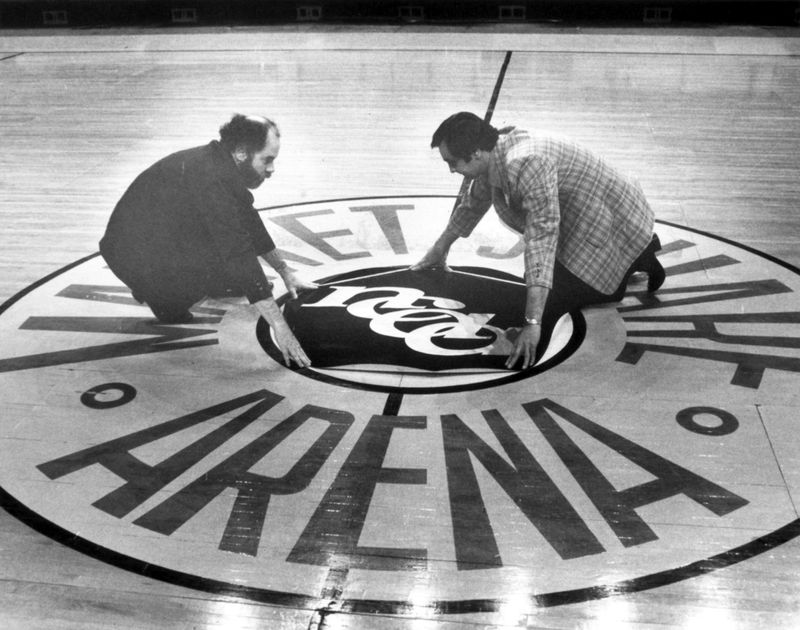
“We had worked hard to get the tournament to come to Indianapolis,” the late Jim Morris, a city leader in business, sports and philanthropy, told IndyStar in 2021. “It was a big deal to get it awarded to the city. It was nothing like it is today, but it was a big deal for Market Square Arena.”
In the spring of 1980, on the home court of the Indiana Pacers, with the city in the spotlight, the modern-day Final Four was born.
It would be the first of eight Final Fours Indy would host, with the last making history in 2021 during the COVID-19 pandemic when the bubble put the entire NCAA Tournament in Indiana.
As the Final Four descends on the city for the ninth time this weekend, featuring UConn, Illinois, Arizona and Michigan, Indy will be one Final Four shy of tying Kansas City, Missouri, which has hosted the most with 10.
More than 70,000 fans will congregate downtown, generating an estimated $400 million in economic impact. The blueprint the city will use to put on one of the greatest spectacles in sports will be a fusion of more than 46 years of tweaking and perfecting its role as Final Four host.
And if history repeats itself, there will be some unforgettable moments.
“It seems like every time the Final Four comes to Indianapolis,” Query said, “something iconic, something memorable or something incredible happens.”
1980: Purdue’s second Final Four, NCAA bracket changes
The Final Four: No. 2 Louisville, No. 5 Iowa, No. 6 Purdue and No. 8 UCLA
Venue: Market Square Arena
Semifinals: UCLA 67, Purdue 62; Louisville 80, Iowa 72
National championship: Louisville 59, UCLA 54
Inside Market Square Arena, the final stage was set with Purdue making its first Final Four appearance since 1969, being dubbed the “home team” with its West Lafayette campus just 68 miles from Indy.
The road to get there was an impressive one. Seeded sixth, Purdue took out second-seeded Indiana in the Sweet 16 and fourth-seeded Duke in the Elite Eight in the Mideast Regional in Lexington, Kentucky, to reach the Final Four.
UCLA turned out to be too tough an opponent, and Purdue lost in the semifinals 67-62.
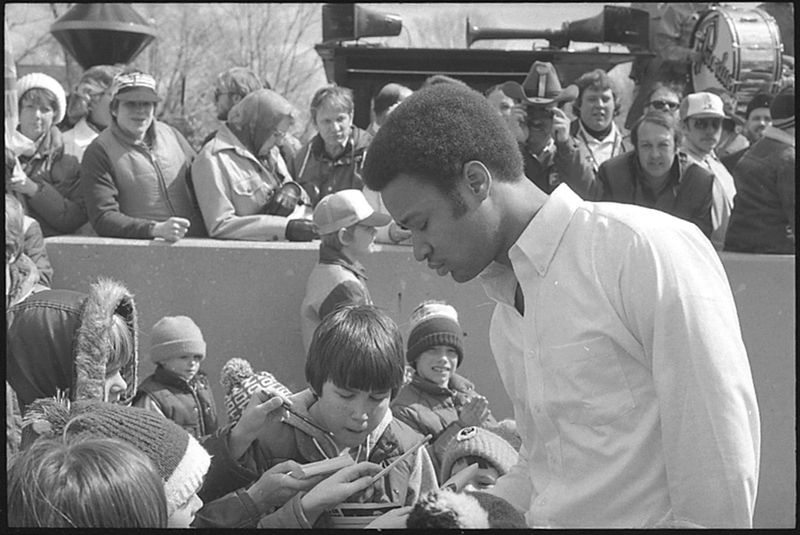
Looking back, 1980 was the turning point where the NCAA Tournament really took off, former Indiana Gov. Mitch Daniels told IndyStar in 2024. Daniels was at that Final Four in Indy. It was electric, and the city stepped up in one of its first major roles in sports hosting.
“Market Square Arena could never have it today. It’s not big enough. That was a real basketball gym, not a football arena,” Daniels said. “For sure it was packed, but it wasn’t the ridiculous, you know, kind of Super Bowl-type ticket it is these days.”
Tickets for the entire Final Four session in 1980 cost $30. To attend all three games this weekend will cost more than $1,000, and that’s for mediocre seats.
Noteworthy in 1980:
1991: IU threatened by UNLV’s perfect season, Coach K’s first title
The Final Four: No. 1 North Carolina, No. 1 UNLV, No. 2 Duke and No. 3 Kansas
Venue: Hoosier Dome
Semifinals: Duke 79, UNLV 77; Kansas 79, North Carolina 73
National championship: Duke 72, Kansas 65
The home state wasn’t happy — especially the Indiana faithful who had watched the 1976 Hoosiers, led by coach Bob Knight, become the last team to have an undefeated national championship season.
As the Final Four came to Indy in 1991, undefeated UNLV was ready to topple IU’s historic feat — on the 15th anniversary of that perfect season — and the odds in Vegas were heavily in UNLV’s favor.
UNLV was the NCAA defending champion, coming off a 1990 season marked with one loss and a 103-73 blowout of Duke in the final game, still the largest margin of victory in NCAA championship history.
In the 1991 semifinals, Duke just happened to be UNLV’s opponent again.
“And so it was, seemingly, a foregone conclusion that UNLV was going to complete an undefeated season in Indianapolis,” Query said. “And we were all going to have to watch the antithesis of Bob Knight’s Indiana teams, ideologically, basketball, stylistically, everything about it.”
Inside the Hoosier Dome, the magnificence of the madness, and the weight of what could happen, was on full display.
“There was this energy in the arena. You can hear it, you can’t see it,” Jim Nantz told IndyStar in 2021. “There’s this constant static level of energy that I was trying to cut my voice through, to pitch my words enough to be able to break through.”
In a twist that went against all oddsmakers, Knight’s disciple, Duke coach Mike Krzyzewski, ended UNLV’s perfect season in the semifinal, 79-77, one of the biggest upsets in tournament history. Duke, an eight-point underdog in that game, went on to secure Krzyzewski’s first NCAA title.
While the 1980 Final Four in Indy had ushered in a new era, 1991 was the first Final Four in the NCAA tournament’s dome-stadium era for Indianapolis, and it put the city on the map as host.
“Duke beating UNLV in Indianapolis? I mean, the two are forever linked,” Bill Benner, former IndyStar sportswriter, said in 2021. “That game is synonymous with Indianapolis’ evolution. That was an exclamation point, among many exclamation points, of Indianapolis as a sports capital.”
Noteworthy in 1991:
1997: Arizona’s first title, Dean Smith’s last game
The Final Four: No. 1 North Carolina, No. 1 Minnesota, No. 1 Kentucky and No. 4 Arizona
Venue: RCA Dome
Semifinals: Kentucky 78, Minnesota 69; Arizona 66, North Carolina 58
National championship: Arizona 84, Kentucky 79
The 1997 Final Four ending was what Ohio State coach Harold Olsen probably had in mind when he fought to establish the first NCAA tournament in 1939, a rival to the 1938 National Invitation Tournament.
In its first year, the National Association of Basketball Coaches organized the eight-team tournament, which the NCAA sanctioned with the caveat that coaches, not the association, would cover all financial risks.
Inside the Patten Gymnasium on Northwestern University’s campus in Evanston, Illinois, on March 27, 1939, Oregon defeated Ohio State 46-33 to become the first NCAA champ.
In 1997, the thrilling, heart-stopping victory by the underdog Arizona, in a Final Four with three No. 1 seeds, has been touted as one of the best Final Four games in history.
Arizona defeated the defending champion Kentucky 84-79 in overtime to win its first NCAA title and, along the way, it became the first team to defeat three No. 1 seeds (Kansas, North Carolina, Kentucky) in a single tournament.
“Miles Simon just completely took over that Final Four,” Query said. “He was a dominant player for Arizona. He was able to get to the basket at total will.”
To get to that championship game, Arizona beat North Carolina in the semifinals. No one knew at the time, but that game would be legendary North Carolina coach Dean Smith’s last, a 66-58 loss in Indy.
Smith didn’t announce his retirement until seven months later. After 36 seasons, 879 wins — the most in men’s college basketball history at that time — he walked away.
Not only had Indy given the NCAA some memorable moments, yet again, as Final Four host in 1997, but it was a turning point for the city, which got to showcase its recently-opened downtown shopping mecca, Circle Centre Mall.
“It was the social epicenter and the media center for everything having to do with the Final Four. I mean, TV stations set up studios in Circle Centre, everything was centered around Circle Centre Mall,” Query said. “So the ’97 Final Four, I think, really catapulted Indianapolis into the downtown destination point of sports within the city.”
At that Final Four, people recognized what a walkable city Indy was, how compact, how everything was connected, and now it had a glitzy shopping jewel anchored by Nordstrom and Parisian.
The sleepy downtown of the 1980 Final Four had been awakened, a significant step in Indy’s bid to host more Final Fours.
Noteworthy in 1997:
2000: Tom Izzo’s first title, Michigan State’s first since 1979, Big Ten’s last
The Final Four: No. 1 Michigan State, No. 5 Florida, No. 8 North Carolina and No. 8 Wisconsin
Venue: RCA Dome
Semifinals: Michigan State 53, Wisconsin 41; Florida 71, North Carolina 59
National championship: Michigan State 89, Florida 76
By 2000, Indy was becoming as much of a football city as a basketball city, thanks to the Indianapolis Colts, led by the offensive triple threat of Peyton Manning, Edgerrin James and Marvin Harrison. Its hosting accolades outside of basketball were piling up, too.
The city was getting a national reputation as a pro at pulling off major events. The 2000 Final Four added another notch to its belt.
Michigan State won its first national championship since 1979, defeating Florida 89-76 in the final game. It was coach Tom Izzo’s first and only title which, through the years, he has called one of the greatest moments of his career.
“I’ve never had a group of guys… better students, better guys,” Izzo said in 2000. “I mean, it sounds corny, but it’s true.”
Noteworthy in 2000:
2006: Florida’s first title, No. 11 George Mason’s tough road to Final Four
The Final Four: No. 2 UCLA, No. 3 Florida, No. 4 LSU and No. 11 George Mason
Venue: RCA Dome
Semifinals: Florida 73, George Mason 58; UCLA 59, LSU 45
National championship: Florida 73, UCLA 57
Cinderella came to this Final Four in the form of an 11 seed from the Colonial Athletic Association who had never won an NCAA tournament game in 40 years of playing.
To get to the Final Four in Indy, George Mason defeated 2005 Final Four contender Michigan State, defending champion North Carolina, Wichita State and No. 1 Connecticut, in a thrilling 86-84 overtime game.
While George Mason lost in the semifinal to eventual champion Florida, 73-58, the team turned a spotlight on mid-major programs and became an inspiration for future Cinderella teams.
Noteworthy in 2006:
2010: The shot that ended Butler’s fairy tale NCAA run
The Final Four: No. 1 Duke, No. 2 West Virginia, No. 5 Butler and No. 5 Michigan State
Venue: Lucas Oil Stadium
Semifinals: Butler 52, Michigan State 50; Duke 78, West Virginia 57
National championship: Duke 61, Butler 59
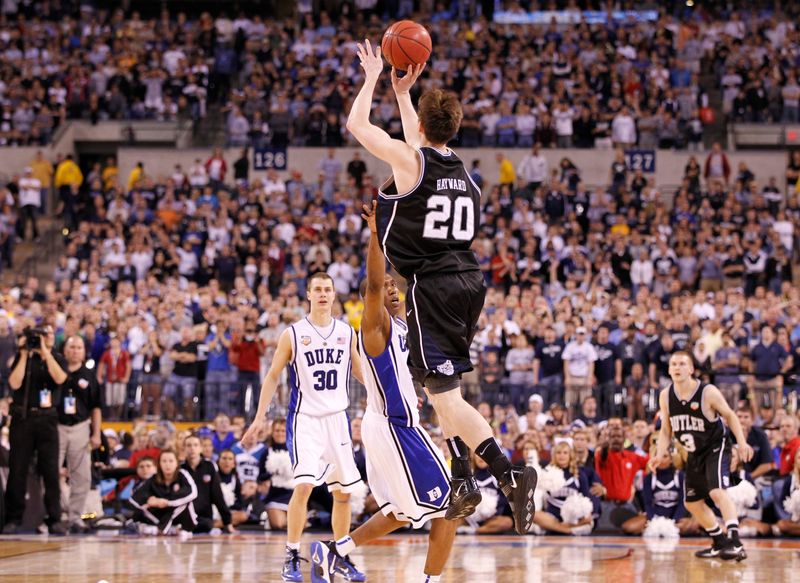
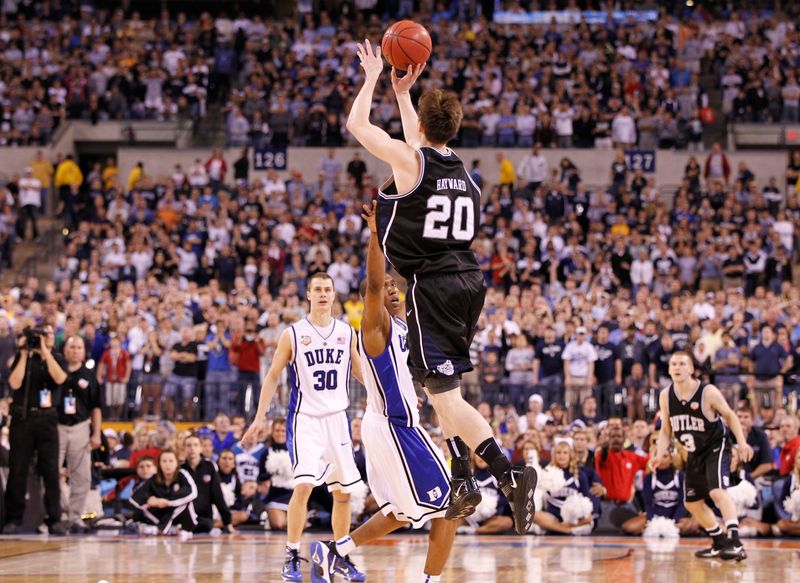
The ball left Gordon Hayward’s hands, just a couple steps shy of the half court line, heading toward the rim, an NCAA championship on the line as the clock ticked to nothing.
It would have been a storybook ending to the Final Four that Indianapolis was ready to claim as its own. Butler in its first NCAA title game inside Lucas Oil Stadium, located in the city it called home — playing for a national title against legendary basketball powerhouse Duke.
“It’s almost like time stood still. I just sat there, I’m sure my mouth was hanging open,” Jim McGrath, Butler’s sports information director at the time told IndyStar years after the game, “and when the shot went up, I immediately thought, ‘That’s got a chance. This could be the greatest finish in the history of college basketball.'”
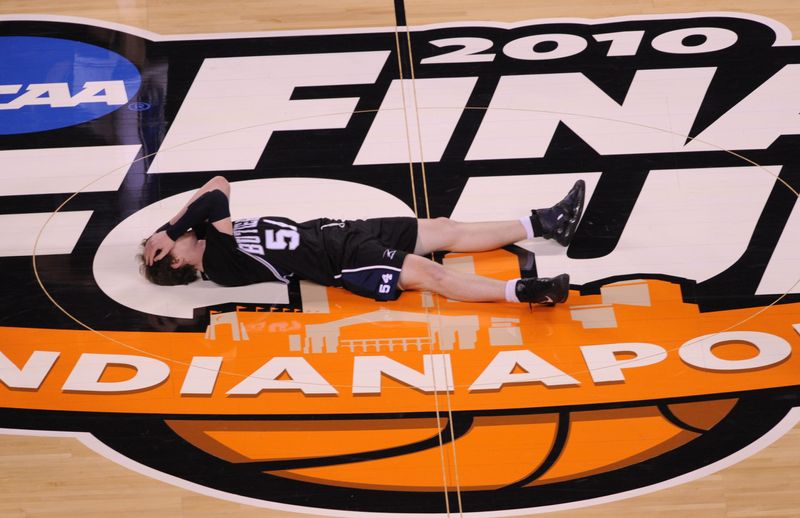
Instead, as the clock ran out on that game in 2010, Hayward’s shot bounced off the rim, by mere inches, and went somewhere other than through the net. His Butler teammates fell to the ground. Duke players rejoiced, staring up at the 61-59 scoreboard in exasperated relief.
“I’ll remember that play as much as any shot in any game my whole career,” Duke coach Mike Krzyzewski later told Sports Illustrated.
“You never wanted it to end. Our guys just thought they would win. They prepared like they were going to win,” Butler coach Brad Stevens told IndyStar in 2015. “One thing, when we talk about Butler and what was special about those teams that we can go back now and say, ‘They literally did not care who they were playing. Ever.'”
Because Butler always believed they would win. Until they didn’t.
While Butler’s Cinderella story didn’t get its happily ever after, Indy got what the city had become known for the past 30 years — the setting of college basketball’s most unforgettable moments.
Noteworthy in 2010:
2015: Indy sets attendance record, Kentucky’s 38-0 run ends
The Final Four: No. 1 Duke, No. 1 Wisconsin, No. 1 Kentucky and No. 7 Michigan State
Venue: Lucas Oil Stadium
Semifinals: Wisconsin 71, Kentucky 64; Duke 81, Michigan State 61
National championship: Duke 68, Wisconsin 63
With the 2012 Super Bowl under its belt, Indy was gaining national media attention as one of the greatest city’s to host major sporting events. When the Final Four came to Indy in 2015, the city showed it had earned every one of those accolades.
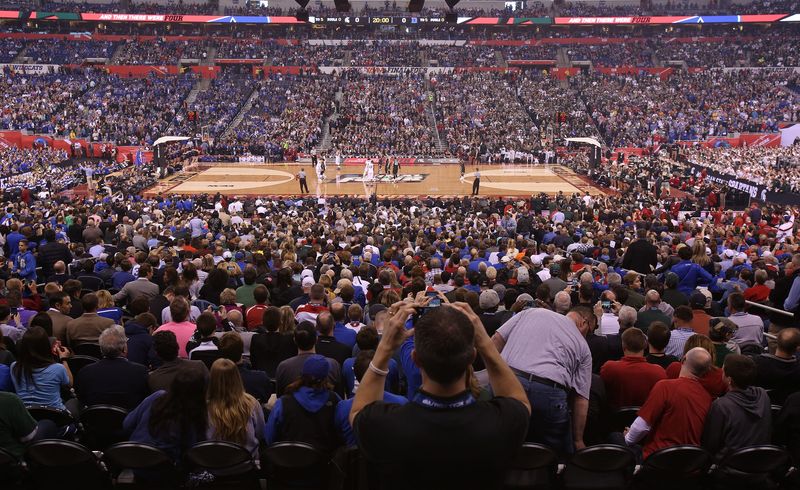
The Final Four inside Lucas Oil Stadium set attendance records for both the semifinals (72,238) and the weekend (143,387).
Fans descended on Indy to see if Kentucky’s undefeated season would end or if it would become the first team since Indiana in 1976 to have a perfect season and win the title.
Wisconsin dashed those hopes, beating Kentucky in the semifinals 71-64, then went on to lose to Duke in the championship game, which gave coach Krzyzewski his fifth NCAA title, and third in Indy.
Noteworthy in 2015:
2021: The iconic bubble, entire NCAA tournament in Indy
The Final Four: No. 1 Baylor, No. 1 Gonzaga, No. 2 Houston and No. 11 UCLA
Venue: Lucas Oil Stadium
Semifinals: Baylor 78, Houston 59; Gonzaga 93, UCLA 90
National championship: Baylor 86, Gonzaga 70
When the COVID-19 pandemic hit, with Indy set to host the Final Four in 2021, the NCAA made the decision to hold the entire men’s basketball tournament in a “bubble,” and it turned to the city that had pulled off seven other monumental Final Fours — Indy.
JoAn Scott, the NCAA’s vice president of men’s basketball, had a major task in front of her as the woman in charge of the tournament — from brackets to the Final Four and everything in between.
“I remember spending my Christmas break (2020) putting together a 250-page PowerPoint of how to do this,” Scott told IndyStar. She worked with dozens of other organizations and agencies, including the Marion County Health Department, the NBA, which held a bubble in Orlando, and Major League Baseball, which had used neutral-site bubbles for the 2020 postseason.
“We were calling everybody and anybody, gathering every bit of information we could.”
Scott isn’t sure if she slept in 2021. At the time, she said now, it didn’t feel like she did. And, in just three months, Indy had pulled off a plan for a first-of-its-kind, historic tournament amid a national pandemic.
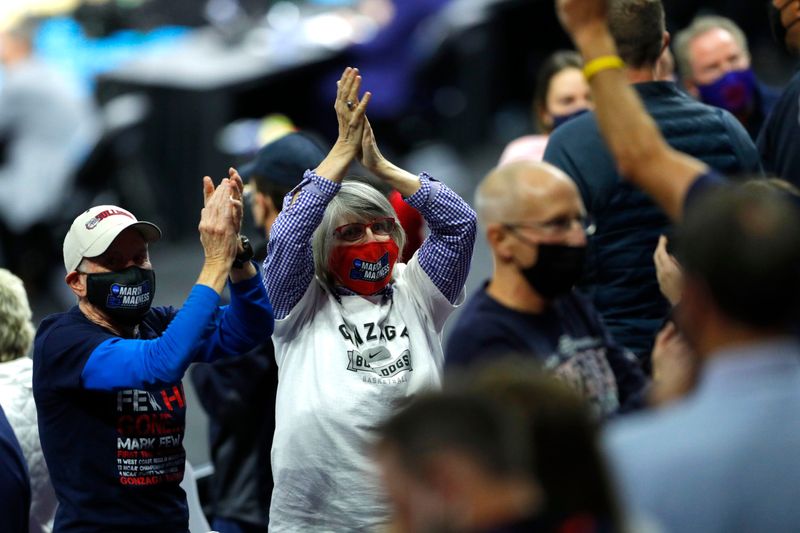
The NCAA allowed up to 25% capacity at all venues, including the Final Four, with social distancing, mask requirements and seating pods.
Five years later, Scott said the city wanted to honor that Final Four, in a big way. Leading up to this weekend’s Division I men’s basketball finals, Indy will host the NCAA Division II and Division III men’s Final Fours, plus the NIT title game.
On Monday night, four championship winners will have been crowned in one city.
“This is a unique year we’ve never had,” Scott said, “a big celebration of basketball that this city and state loves.”
Noteworthy in 2021:
2026: Get in on the madness
The 2026 Final Four is set for Lucas Oil Stadium in Indianapolis. The NCAA men’s basketball tournament March Madness games on Saturday, April 4, and Monday, April 6, will be shown on TBS.
Here’s what you need to know about the weekend, the 2026 March Madness bracket, odds, picks and predictions.
Follow IndyStar sports reporter Dana Benbow on X: @DanaBenbow. Reach her via email: dbenbow@indystar.com
This article originally appeared on Indianapolis Star: Madness in the city: Indy’s dominance as Final Four host took 40 years, basketball magic
Reporting by Dana Hunsinger Benbow, Indianapolis Star / Indianapolis Star
USA TODAY Network via Reuters Connect