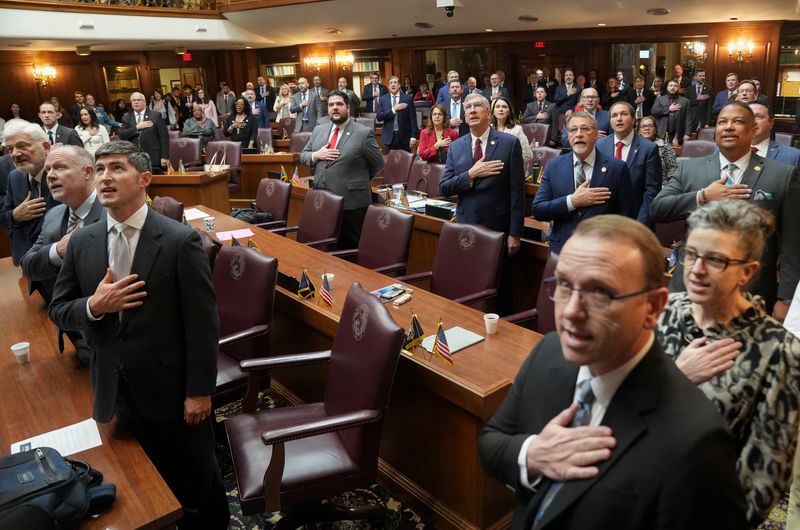
Some Indiana lawmakers are eying to get rid of at least a portion of the state’s 1,000-plus townships.
Two Republican-led bills that would substantially reduce the number of townships across the state using different methods — while not outright removing the arcane level of government altogether — are being seriously discussed in the Statehouse, putting more gas behind an idea that’s been floated by some government efficiency reformers across the political spectrum for more than two decades but never crossed the finish line.

Beyond poor assistance, township government is responsible for just a few other tasks such as noxious weed removal and abandoned cemetery care, leading many to suggest a larger level of government like cities or counties could easily take over their responsibilities. But that idea has been strongly pushed back on by advocates who say the state shouldn’t lose the level of government that’s closest to the people.
The new legislation comes after a 2025 IndyStar analysis that found Indiana taxpayers spent nearly $20 million on township trustee and board member pay alone in 2024, almost as much as the $25 million they doled out in poor relief assistance to residents.
In more than 75% of Indiana townships, taxpayers spent more on trustee and board member salaries in 2024 than they did on poor relief. There were nearly 150 townships listed as providing no assistance at all that year.
It’s early on in the legislative process, meaning it’s unclear if either of the bills will curry enough favor with the Republican-supermajority legislature, most of which so far has been reticent to do away with townships despite bills filed at least every few years that would accomplish that.
But one of the bills, authored by Noblesville Republican Rep. Alaina Shonkwiler, passed out of the House’s local government committee on Jan. 13 with a 9-3 vote, meaning at least one will move to the full House for consideration. The other bill, Senate Bill 270, is scheduled for a hearing on Jan. 15.
‘Deliver better value for taxpayers’
Shonkwiler’s bill would force certain smaller townships to merge with municipalities or counties, phasing them out by 2028. Townships can already choose to merge together under Indiana law, and Shonkwiler said the bill preserves their ability to do that.
House Bill 1315, is primarily about accountability, efficiency and a way to modernize Indiana government, she said. She said it’s a problem that two residents with the exact same struggles who are living in two different townships can have access to entirely different levels of support when it comes to poor assistance since some smaller townships don’t offer it.
“Hoosiers (should) receive equitable access and consistent outcomes regardless of which side of the township line they live on,” Shonkwiler said in committee. “The goal is straightforward: protect essential services, reduce unnecessary government overhead … and deliver better value for taxpayers.”
Shonkwiler’s bill had support from local chambers of commerce and municipalities like the cities of Carmel and Fishers. But it also had some vocal opposition from townships themselves, who say township government is imperative to preserving quality of life.
Most townships would remain under the bill Shonkwiler estimated that 200 would likely be removed as a result of the bill. It wouldn’t touch townships in Marion County, larger townships or those with fire departments.
But some influential townships — including Clay Township in Carmel — would be eliminated by the bill, leading to one Carmel City Council member coming to the legislature to testify against it even though a lobbyist for his city supported it.
Carmel council president Matthew Snyder called the proposal “about as anti-Republican as it gets.” Township government is “accountable to neighborhoods, not bureaucrats.”
“Eliminating it does not shrink government, it centralizes power,” Snyder said. “Clay township didn’t simply exist alongside Carmel. It built Carmel. Every single park that defines the city’s quality of life. Every single fire station that protects its families. … Township government never has held Carmel back. It has empowered Carmel to become one of the most successful cities in the world.”
Shonkwiler said though township government reform has been talked about for decades to no avail, there’s more incentive to do so now in the wake of the property tax reform bill that lawmakers passed last year.
“It did have us start looking at that from a meaningful perspective,” Shonkwiler said. “Township trustees are very passionate about their role, and I have nothing but compassion for them and the fact that many of them go above and beyond. When you look at it from an overhead (and) redundancy (perspective), why can’t they do that under the city? I think they can.”
Fishers Mayor Scott Fadness came to testify in support of the bill, saying that municipalities like his are equipped to take over township services. Fadness said most of Indiana’s population used to live in rural areas 50 years ago. Now, most live in urban areas.
“There’s logic in asking questions about (whether) our government structure is set up to provide services effectively given the fact that things have changed so much,” Fadness said. “It’s a higher-level conversation rather than whether I like my township trustees or not. The broader question is: can we provide a higher level of service … in a different structure?”
Shonkwiler’s bill was opposed by the Indiana Township Association which represents the state’s 1,000+ townships.
Dan Shackle, a Frost Brown Todd attorney representing the association, said townships understand the need for efficiency in township government but said the state should be interested in trying to reduce townships “based on performance and merit-based metrics,” not just looking at population size.
Another idea: Performance-based mergers
A Senate bill that would require township mergers takes a different tact.
Sen. Rick Niemeyer, R-Lowell, proposed a bill that would require the state to essentially rate townships based on performance, and require mergers for lower-performing townships. Marion County would also be exempted from Niemeyer’s bill.
Niemeyer’s bill is scheduled to be heard Jan. 15 in the Senate’s local government committee. He expects it to result in the elimination of 350 of Indiana’s townships.
Niemeyer said he believes regardless of size, some townships are doing good work and deserve to stay, particularly those that operate fire departments serving rural and unincorporated areas.
“I’m a strong supporter of township government,” he said. “They’re the closest government to the people. Once they merge together, they’ll be able to (do) more for their area.”
That bill requires the Department of Local Government Finance to compile township data and “assign points based upon the township government’s performance.”
Townships that are assigned a minimum number of points would be required to merge with nearby townships that have fewer points.
The bill would make all mergers effective in January 2028 and establish interim township governments until new trustees and legislative bodies are elected during the 2030 general election.
Shackle, the attorney representing the Indiana Township Association, said the group prefers Niemeyer’s bill over Shonkwiler’s bill. He said lawmakers shouldn’t rely primarily on population to make choices about which townships stay and which go.
Niemeyer’s bill also “clearly guarantees continuity of services,” Shackle said.
Contact senior government accountability reporter Hayleigh Colombo at hcolombo@indystar.com or follow her on X @hayleighcolombo.
Sign up for our free weekly politics newsletter, Checks & Balances, curated by IndyStar political and government reporters.
This article originally appeared on Indianapolis Star: Is this the year Indiana gets rid of some of its 1,000-plus townships?
Reporting by Hayleigh Colombo, Indianapolis Star / Indianapolis Star
USA TODAY Network via Reuters Connect