Brandon Schaaf traces his affinity for free stuff back to 2008 – and a used brass trumpet he found in a church.
Schaaf, 19 at the time, had recently moved to Woodruff Place with roommates and almost haphazardly fell into Indy’s emerging arts scene. Pretty quickly, Schaaf was collaborating on Optical Popsicle, a scrappy yet fantastical variety show that made shadow puppets, videos and performance art out of trash and up-cycled materials.

Earth House, a now defunct arts collective, occupied a church in Lockerbie Square when Schaaf first walked through its doors. About once a month, he ventured to the collective’s bustling free marketplace, where artists and neighbors would swap belongings they no longer wanted: musical instruments, household goods, clothing, computer hardware and more.
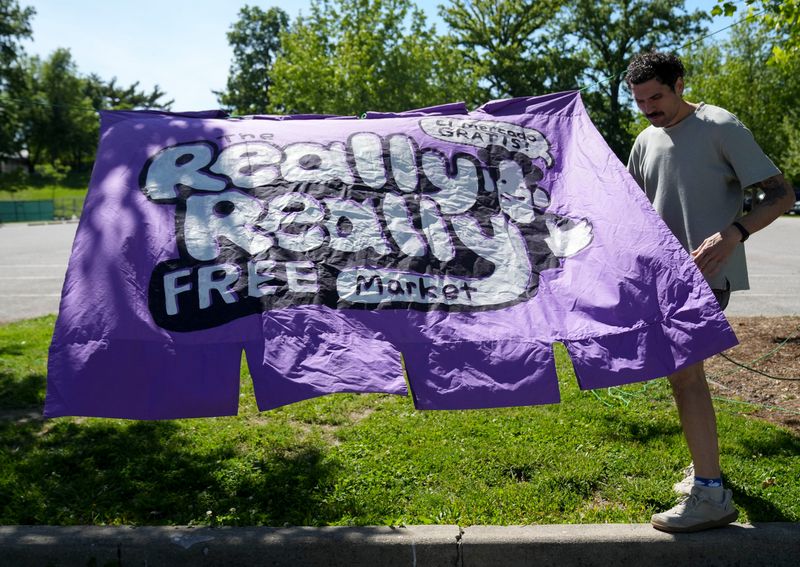
This “Really Really Free Market” offered more than just material goods: An on-site chef served up lunches in the basement, someone offered free legal assistance and an artist sketched free ugly portraits.
“I was totally in love with it,” Schaaf said. “I tried to go whenever I could.”
Earth House closed a few years later, and the swap fizzled away. But Schaaf never forgot about it. So two years ago, he revived the concept.
Schaaf and the new iteration of the swap belong to a local network of small-scale bring-and-trade circular economies. Multiple similar groups have popped up across Central Indiana in recent years, allowing Hoosiers the space to exchange clothing, trade home décor and borrow power tools – all for free.
The model has multiple environmental impacts, according to organizers: Participants learn to mend and repair goods, rather than buying new. And as long as the items live on, they are diverted from a landfill.
Then there’s the fiscal advantage. Hoosiers say these spaces filled with free goods offer solace as the cost of gas, groceries, rent and other life essentials continues to rise.
“There is a lot of insecurity about if [prices] will ever go back down,” said Carly Valentine, the founder of Swap Sesh, an Indianapolis-based clothing exchange that meets almost monthly. “This event is the one certainty that people can have where the prices aren’t going to go up. Everything is always going to be free.”
That is, if these groups survive.
Volunteer-run events like Really Really Free Market and Swap Sesh require venues to host them, people to staff them and volunteers with vision. Without momentum, organizations can disappear with nothing to take their place.
Free stuff for the people
Central Indiana is teeming with free stuff. Often, the goods are offered in the name of affordability, sustainability and a utopian dream for a city where neighbors take care of neighbors. The idea for many: Find an alternative to the country’s economic model.
A professional graphic designer, Valentine said people in creative industries are often the organizers of groups such as Swap Sesh that address climate and or affordability issues. Because artists draw inspiration from real life, they may be more attuned to the duress of those around them.
“Instead of losing hope, instead of feeling helpless about it, we are using the tools that we have to make the world better for our neighbors,” she said.
Three years ago, her friend Edith Conchas co-founded a book club that has evolved into Touch Grass Indy, an environmental group that hosts repair cafés, block cleanups and gift exchanges. Conchas sometimes feels hopeless about the future, and she heard her peers expressing similar sentiments.
“I think a lot of people are feeling kind of stagnant and feeling like there isn’t a way out,” she said.
Conchas wanted Touch Grass Indy to be a space where people could learn how to navigate a world that feels bleak with a sense of optimism. While Conchas said she sometimes still gets overwhelmed, now she has a place to focus her energy. The repair cafes are particularly special, said Conchas, who watched a tinkerer resurrect a broken family trinket box last year.
Touch Grass Indy, run by volunteers with full-time jobs, doesn’t currently have events planned for the immediate future, but Conchas hopes they will organize some in 2027.
For now, you can find free assistance elsewhere.
Butler-Tarkington’s Unitarian Universalist Church is hosting a repair café September 13. If you have the skills but lack the tools, free libraries like Bottom Level Tool Shop and the Indianapolis Public Library’s Library of Things loan out wrenches, power drills and jigsaws.
‘A treasure to somebody else’
Anne Schott, an Indianapolis resident, said her family doesn’t go shopping often; instead she reuses items and leans on hand-me downs.
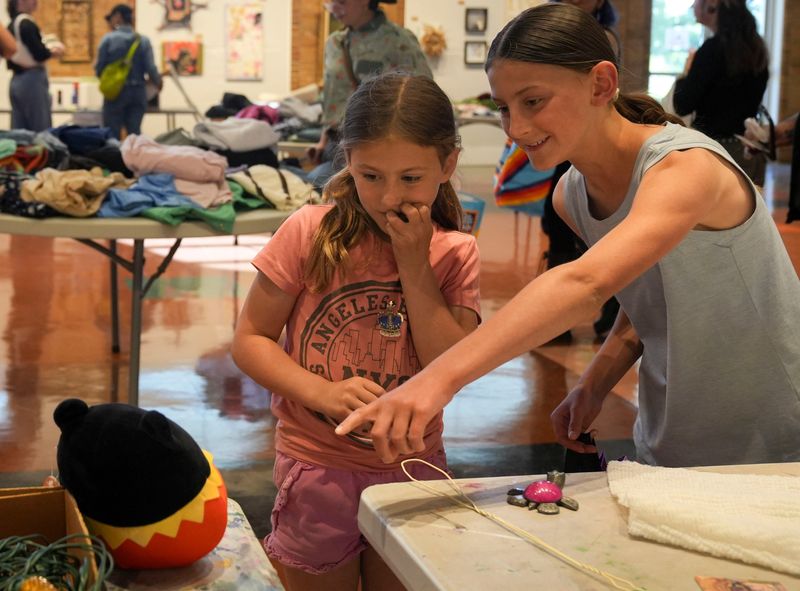
Along with her nine children, Schott attended the May Really Really Free Market. As the kids raced from table to table at the swap hosted at the Garfield Park Arts Center, one mulled over a scooter and another considered taking home an electronic version of the game Battleship.
Some decisions were easier than others: Schott watched the small hands of her five-year old snatch and stuff the very same pack of colorful markers they brought to get rid of into his tote bag.
New art supplies and toys aren’t the only reasons that Schott visits the market. She has stuff to get rid of and likes to see the spirit of reciprocity in action.
When she brought a pair of stainless steel mixing bowls to the May market, she witnessed a passerby happily carry them off.
“We acquire a lot of things that we don’t always need,” Schott said. “We might be bringing something that is a treasure to somebody else, but it’s not until we get there that they’ll find it.”
Something old, something new
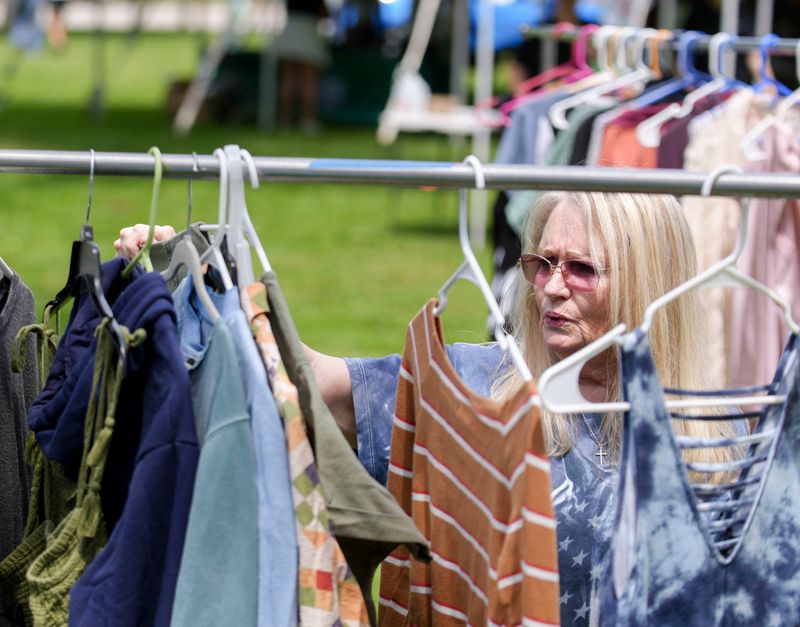
As hundreds of Hoosiers swarm Swap Sesh’s clothing exchanges and barter lamps and more at the free market, interest in circular economies is growing; programs have emerged across the city to provide ways to acquire new things without spending money.
Vintage stores offer free clothing swaps around town. Dozens of Little Free Libraries adorn the sidewalks and neighborhood streets of Central Indiana; the tiny shelving units offer individuals a spot to swap books, any time of day. Food fridges and garden stands feed neighbors free of charge, and for individuals in need of anything from diapers to housing assistance, Resources Towards Solidarity: Indianapolis lists hundreds of avenues to find support.
As Schaaf’s experience a decade ago proves, there’s nothing new about mutual aid. Hoosiers have been helping each other for decades.
Schaaf said the main appeal of the 2009 Earth House free market was that it was absolutely free, but it also felt joyous to be a part of a community where there was “no room for capitalism.”
Schaaf now lives in Irvington and a couple of years ago, he found himself wandering through his home, eyeing the slowly-growing mass of goods that had collected over the years.
He wanted to clear it all out.
“That was probably just a moment where I thought, I’m thinking about this Really Really Free Market like it’s something in the past, and I really wish somebody would do it again,” Schaaf said. He decided to be that somebody.
Schaaf and fellow organizers have hosted several events since the revival, and the market is growing in popularity. Last year, when Schaaf logged onto the Really Really Free Market’s Instagram account, the event’s principal mode of advertising, he found a message from a woman who helped run the original market at Earth House, way back when.
Kelsey Simpson, who now co-owns a record store in Garfield Park, helped organize the Really Really Free Market for about five years until Earth House shut its doors around 2013.
After that, she hosted sporadic swaps elsewhere, but faced numerous challenges.
“Venues are always an issue,” Simpson said, a sentiment the organizers of several similar groups share. Plus, planning and putting on the events takes an enormous amount of work.
These challenges take a toll. Touch Grass Indy has been on hiatus for several months due to difficulties finding volunteers. Swap Sesh is now deliberately planning to skip a few months each year to account for burnout. Swap Up, another local clothing exchange, stopped advertising new events in 2025 and did not respond to IndyStar requests for an interview.
“It’s like Indianapolis has a two-year lifespan for really good programs or things, and then it’s kind of like, Oh, what do we do now?” Simpson said.
But as one program folds, another often rises. People in the area crave this kind of economy, need assistance and want connection, Simpson said.
She hasn’t organized a swap in recent years, but the spirit of free trade persists in her life.
After Simpson’s store, HQ Books and Records, opened earlier this year, she stuck a shelf outside the front entrance. As pedestrians walk past, they can find art supplies, clothes and trinkets – free for the taking.
IndyStar’s environmental reporting is made possible through the generous support of the nonprofit Nina Mason Pulliam Charitable Trust.
Sophie Hartley is an IndyStar environment reporter. You can reach her at sophie.hartley@indystar.com or on X at @sophienhartley.
This article originally appeared on Indianapolis Star: Indy has free markets filled with free clothes & goods. Can they last?
Reporting by Sophie Hartley, Indianapolis Star / Indianapolis Star
USA TODAY Network via Reuters Connect
By Sophie Hartley, Indianapolis Star | USA TODAY Network