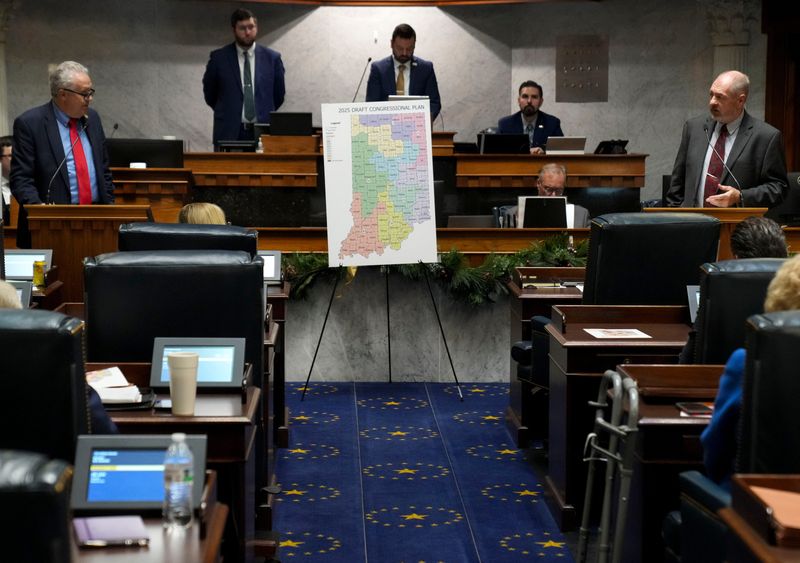
In a monumental rebuke of President Donald Trump’s wishes, Indiana’s supermajority Republican state legislature became the first to formally reject his push for mid-decade redistricting.
The Senate’s 19-31 vote caps months of anticipation and pressure from the White House and its allies, placing Indiana at the center of national intrigue and ire.

The vote total ended up being decisive, with even a majority of the members from Trump’s own party voting against it. The vote margin means the bill is killed once and for all.
Trump’s defeat in Indiana, a state he won by nearly 19 percentage points in 2024, has national implications, making it more challenging for Republicans to hold onto Congress in the midterm elections.
The proposed Indiana map would have given Republicans the advantage in all nine of Indiana’s congressional districts, chiefly by carving up Indianapolis voters into four new districts. The current congressional map has seven seats held by Republicans and two by Democrats.
The vote was immediately met by a rebuke from Gov. Mike Braun, who called the Republicans “misguided.”
“Ultimately, decisions like this carry political consequences,” Braun said in a statement. “I will be working with the president to challenge these people who do not represent the best interests of Hoosiers.”
Previously undecided state Sen. Greg Goode, R-Terre Haute, who has been subjected to threats revealed his “no” vote in a speech before the vote, saying he was “confident my vote reflects the will of my constituents.” Goode’s spokesman confirmed that a bomb threat was called into the Vigo County Sheriff’s Office as he was speaking against the bill.
“Indiana did this just four years ago,” he said referring to redistricting. “The map produced was celebrated by legislative leadership, and Indiana served as a national model for getting things right through Hoosier common sense.”
State Sen. Liz Brown, R-Fort Wayne, spoke before the vote against the dangers of Democrats being in charge of Congress in Washington if redistricting wasn’t passed.
“Redistricting is about who’s in charge,” Brown said before the vote, her voice straining to be heard above the shouts of protestors outside the chamber who were chanting “cheater” and “vote her out.” “It actually is about trying to predetermine political outcomes.”
There was more than two hours of testimony from senators on the bill before the vote, with many speakers in favor of redistricting framing the bill’s passage as a critical moment for the future of the republic.
Sen. Chris Garten, R-Charlestown, said senators were at a “crossroads” and could either guard the progress made under Trump’s administration or let it be trampled by Democrats if they come back into power.
Sen. Spencer Deery, R-West Lafayette, however, said the Senate should reject all of the pressure from Washington and vote according to conservative constitutional principles.
“”We the people of the United States are the only people who should decide an election,” Deery said. “It’s time to say no to HB 1032.”
As the vote board lit up with more red names than green names and it became clear that the Senate defeated the bill, cheers rang out outside the chamber in the hallway.
The mood outside the chamber after the vote was mostly jovial as most of the demonstrators present on Thursday were opposed to redistricting.
Mark Russell, a leader with the Indianapolis Urban League and redistricting opponent, was more reserved.
“I pray so,” Russell said when asked about whether he believed the outcome would be positive for democracy.
And a seemingly dejected Republican Sen. R Michael Young, a redistricting proponent, said he was ready to get some rest and enjoy Christmas with his family as he walked toward the Statehouse elevators to leave the building.
“I fear my country may be harmed,” he said.
How we got here
The vote follows months of intensity that began in earnest in August, when Vice President JD Vance made his first of two visits to the Indiana Statehouse to make Trump’s case for mid-decade redistricting. At first, a wave of Republican senators and representatives rebuffed the idea ― only attracting more fervor from Trump’s allies.
Soon various interest groups and Super PACs started texting and calling voters and buying television ads trying to convince lawmakers to change their minds. When Gov. Mike Braun finally called for a special session on the matter, Senate President Pro Tempore Rodric Bray nevertheless insisted that his caucus did not have the votes to make redistricting successful.
Trump began a series of posts on Truth Social lambasting Bray and “RINOs” who were pushing against it. He threatened, and still does, to support primary challenges against Bray and those who vote no. Groups like Turning Point Action have followed up with promises of spending millions of dollars in Statehouse races.
Despite initially resisting, the Senate ultimately agreed to meet this week in light of the intense “strife” surrounding the issue, Bray said, expressing a desire to put the issue to rest. Several of his members, as well as House members, have fielded threats of violence or swatting incidents at their homes ever since the legislature opened their 2026 session on Nov. 18. Those threats continued into this week.
For those in support, mid-decade redistricting was seen as necessary to combat moves by Democratic states to gerrymander more left-leaning districts. Indiana’s two seats could be crucial to this math.
“I don’t want to wake up the morning after the election in November and find out we lost the House of Representatives by one vote,” Sen. Mike Young, R-Indianapolis, told his colleagues Dec. 11, as protesters chanted “Hoosiers don’t cheat” outside the Senate chamber. “If I knew that I did that, I would feel horrible.”
For those opposed, the integrity of the institution was at stake, as Sen. Greg Walker, R-Columbus, put it tearfully in an impassioned speech during the Senate elections committee on Dec. 8.
“I fear for this institution,” Walker said. “I fear for Indiana and all states if we allow intimidation and threats to become the norm.”
The map previously had passed the Indiana House by a 57-41 vote, with 12 Republicans voting with Democrats against it.
Contact IndyStar Statehouse reporter Kayla Dwyer at kdwyer@indystar.com or follow her on X@kayla_dwyer17.
This article originally appeared on Indianapolis Star: Indiana lawmakers reject Trump’s mid-decade redistricting push
Reporting by Kayla Dwyer and Hayleigh Colombo, Indianapolis Star / Indianapolis Star
USA TODAY Network via Reuters Connect