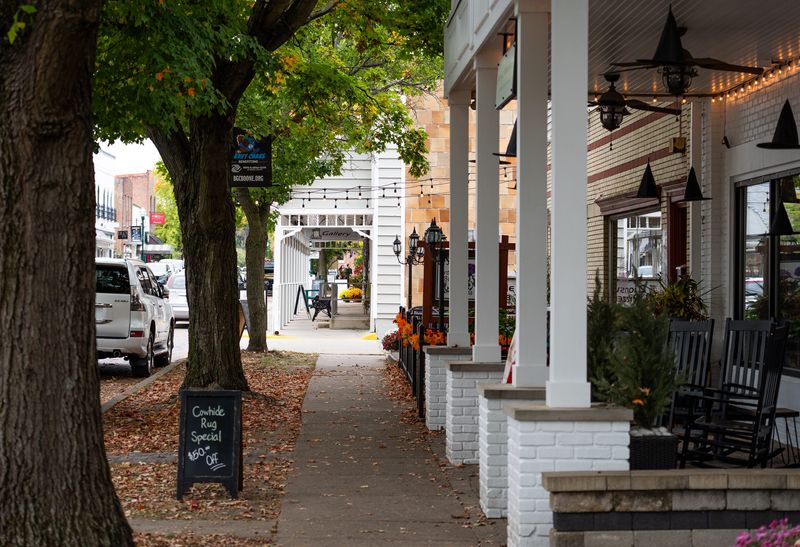
On Wednesday, Oct. 15, a team of IndyStar journalists traveled to Boone County, Indiana, for the fourth leg of our statewide reporting tour to hear about what issues matter to Hoosiers. The following is a dispatch from that visit. Read about our stop in Muncie, Daviess County and Perry County.
LEBANON, IN – Boone County is at a crossroads.

Thousands of acres of land sit in the hands of the Indiana Economic Development Corp., promised to one day become a bustling hub of “global innovation.” Whitestown, filled with warehouses and young families, is one of the fastest growing communities in the state. Zionsville is close to finalizing a comprehensive plan that will shape the town for decades to come.
But not everyone is on board with the pace of change, even as leaders pledge thoughtful development. Farmers mourn the paving over of productive farmland, to the tune of millions of taxpayer dollars. In Zionsville, citizens and leaders alike wonder how to grow in a way that is more than just borrowing blueprints from Westfield and Carmel.
Meanwhile, the area’s rapid growth is making a splash politically. State Rep. Becky Cash, a Republican, won the district by a little over 60 votes in 2024. Her Democratic opponent Tiffany Stoner, who’s launched another campaign for the seat, credits that thin margin to the county’s leftward trend. Boone County shifted 22 points left between 2012 and 2024, the 23rd largest in the country.
But, as several residents pointed out, growth is the opposite problem faced by much of the state: more than half of Indiana lost population between 2010 and 2020. Instead, the challenge Boone County faces is deciding how to grow, residents told IndyStar, and what they’re willing to sacrifice in return.
LEAP a shadow over farmers
When Boone County residents first heard in 2021 a firm was sending mysterious letters asking people if they wanted to sell their land, the planning and zoning officials who oversee unincorporated parts of the county thought they would have a hand in shaping the development, said Boone County Area Plan Commission President John Merson.
Soon, it would become evident this was no ordinary buyer. The state’s economic development agency, then overseen by Secretary of Commerce Brad Chambers and Gov. Eric Holcomb, was in the beginning stages of realizing a multimillion dollar project on thousands of acres of land, much of it owned by farmers. Once those land owners agreed to be annexed into Lebanon, there was nothing area plan officials could do.
“The LEAP project made most of us feel like we had no control over our destiny,” Merson, who also farms cattle, corn and soy, said. “It was, ‘This is the way it’s going to be and I sure hope you like it.'”
As one of the eight counties bordering Indianapolis, Boone County would inevitably see growth, Merson said. But it should be thoughtful, he said, something he believes in missing from LEAP.
“There’s an acute lack of understanding of exactly what the long-term impact is going to be,” he said. “All we see right now is a lot of dust and dump trucks.”
Retired farmer Brian Daggy, who lives near the LEAP District, said the project’s cost far outweighs its potential benefits. He worries its energy and water demands will strain resources and said the county will have to make infrastructure improvements to house construction workers and counteract the potential for increased road congestion. There’s a property tax impact, too: the longer the state holds the land, Daggy said, the longer the county goes without collecting taxes on those parcels.
Meanwhile, it’s politically risky to go after the agency spearheading the effort, he said. Lawmakers did, however, increase transparency in IEDC land purchases last legislative session by passing a bill from Lebanon’s own Sen. Brian Buchanan.
“(Legislators) are told not to rock the boat,” Daggy said, “or they’re going to get cut out of committee assignments if they start proposing too many changes.”
There’s now a new administration and new leadership at IEDC, but local residents’ concerns remain. Braun was critical of LEAP on the campaign trail but hasn’t made many significant changes to the project.
The recent audit of the agency, which revealed LEAP was the IEDC’s largest expense during the review period, is just more evidence of the project’s issues to Daggy. While he considers Gov. Mike Braun’s decision to audit the IEDC progress, he said the legislature should do more with the audit, including exploring whether to return the agency to its days of more traditional economic development.
The IEDC did not immediately respond to a request for comment.
Merson isn’t as optimistic. He remembers a time where he knew everyone who lived around him, he said, but now he has no idea who his neighbors are. It would be nice to return to such a time, he said, but it just isn’t possible.
“You’re not going back, so you may as well just work with the cards that you’ve been dealt,” Merson said. “You can complain all you want about the growth that’s happening, but maybe, maybe we can influence the future growth.”
Charting a path for Zionsville
When Mayor John Stehr first came to Zionsville more than 30 years ago, the town had 8,000 people.
Today, more than 30,000 people call it home.
With a median family income of $102,900, the town is mostly supported by the financial success of the people themselves, through property taxes on homes and their incomes. Only 13% of the town’s revenue comes from commercial properties, an imbalance local leaders and residents want to change.
“We’re a little out of whack in our tax base here,” said Mayor John Stehr, a Republican.
With 67 square miles of land, the town is well positioned to attract new business, Stehr said. Much of what makes up the third largest municipality in the state by land, however, is corn. Farmers in Lebanon didn’t seem keen on how recent developments had eliminated so much farmland, and several Zionsville residents emphasized how people living in rural areas of the town especially cherished their scenery.
The approach to development will have to strike a delicate balance, the mayor said.
“We don’t want to pave over the town,” he said. “That’s not in any way what anybody wants to do.”
It’s difficult to go backwards once something is done, Zionsville Village Residents Association President Mark Walters said. The neighborhood he lives in is full of historic homes that exist today because of a concerted effort to preserve them. He supports the town’s growth, he said, as long as it is done carefully.
“It feels like this crossroads has kind of come up a little faster than maybe we thought it would,” he said.
While it’s apparent many residents don’t want to be like Westfield and Carmel, people who spoke to IndyStar said, it’s less clear what the community wants Zionsville to be.
“(Former Carmel Mayor Jim) Brainard, love him or hate him,” said Larry Jones, a developer who formerly served on the plan commission, “he had a plan.”
That lack of vision, residents said, makes it difficult to direct development.
“Can we define what the Zionsville look is,” Brad Gressel, who serves on the town’s Pathways Committee, said, “instead of developers coming in and go(ing) ‘Here is the Zionsville look…you’re welcome.'”
The juncture Zionsville finds itself at comes as Braun has flipped the state’s approach to economic development. Both the mayor and residents IndyStar spoke with seemed open to Braun’s changes.
“It’s clear that the economic development strategy is changing from the last administration to this one, and what this one is trying to do is be hyper focused on local,” Stehr said. “Previous administration was trying to hit home runs and bring in the big national corporations and do these big, grand things.”
Property tax cuts throw a wrench in plans
Zionsville’s quest to define itself has only been complicated by reduced revenue projections from Senate Enrolled Act 1, legislation Braun signed in April in an attempt to provide property tax relief. The town has managed to adjust its budget this year without too many cuts, Stehr said, but the future is not quite so promising. In 2028, the town council will have the ability to approve a new local income tax to cover the costs, or consider cutting services.
But there are certain red lines that cannot be crossed, said Stehr.
“We have to have police, we have to pick up the trash. We have to plow the streets,” he said. “That stuff doesn’t happen for free.”
For others, the quality of the school system was a concern.
Hilary Heffernan, a sales director for a Fortune 100 company who also farms daylilies, said she was worried about how property tax cuts would impact the schools’ special education services in the years to come.
“If you’re cutting resources for schools and you’re expecting kids to thrive and do better,” said Heffernan, whose son has special needs, “where are you going to support them from?”
Zionsville Community Schools is the town’s largest employer and consistently ranks as one of the best public schools in the state. It’s a key reason why some people move to the community, residents told IndyStar, and maintaining its quality was a top priority.
Democrats see wins in battle for suburbia
While some Democratic strongholds buttressed by working class voters have grown redder, the suburbs north of Indianapolis appear to be trending in the opposite direction.
Boone County is no exception. As young professionals leave cities like Chicago and Indianapolis in search of a quieter neighborhood, many of them are finding a home in Boone County, residents told IndyStar.
That’s part of the reason why Boone County is growing bluer with each election, Stoner said.
The shift is part of larger political realignment, where college educated voters flock to Democrats as Republicans pick-up a diverse swath of working class voters. The chair of the Boone County Republicans did not respond to multiple interview requests, and another elected Republican declined to comment.
Many of these voters view suburban living as key to a good quality of life, offering strong schools, quaint streets and a sense of community. Chad Johnson, a former Salesforce executive, plans to open a dog-friendly tap room. Lauren Armington, a nurse, is part of a political book club: they’re workshopping the name, but one contender is “Civic Side Hustle.” Ellie Brown, a self-described advocate for the LGBTQ+ community who does real estate, started an all-girl rock cover band called The Janeways during the pandemic.
At the heart of their concerns was a sense of that Indiana government lacks balance, a worry Stoner said she has heard from Republicans she’s spoken to as well.
Daggy, who called himself a “Reagan Republican,” said he was concerned by Trump’s interpretation of the Constitution and his tariff policy, which he said is hurting farmers. In Indiana, there aren’t enough Democrats to force serious debate, he said, which sometimes results in bad policy.
“The Republican supermajority is one of the worst things to happen in Indiana in the last few decades,” he said.
For Brown, the supermajority contributes to legislation she views as extreme, such as restrictions on transgender children in sports or banning gender affirming care for minors. It’s waste of money and energy, she said, to focus on such a tiny sliver of the population.
Heffernan, who said she’s voted for both Democrats and Republicans and considers herself a moderate, said she’s never seen politics be so divisive.
“We’ve just become so fractured,” she said.
Contact Marissa Meador at mmeador@gannett.com or find her on X at @marissa_meador.
This article originally appeared on Indianapolis Star: In Boone County, growth is both a blessing and a curse
Reporting by Marissa Meador, Indianapolis Star / Indianapolis Star
USA TODAY Network via Reuters Connect