INDIANAPOLIS – After years of waiting, IndyCar’s new Dallara IR28 will be on a racetrack this weekend. Alexander Rossi and Alex Palou are set to test the new chassis on the Indianapolis Motor Speedway road course, with Rossi driving Saturday and Palou on Sunday.
Before the car debuts in 2028 along with a new 2.4-liter twin-turbocharged V6 engine and hybrid power unit, it’ll go through a series of tests and adjustments. Ahead of this weekend’s tests, IndyCar senior vice president of competition and operations Mark Sibla and vice president of competition and race engineering Mike O’Gara further explained how IndyCar finally arrived at the IR28 chassis, which will come after 16 seasons with the current DW12.

How the car was developed
Despite nearly a decade of working through a new car, most of the IR28’s development has come in the last 17 months, since Jay Frye was let go as IndyCar president in February 2025. After that shakeup, Sibla said the process for Dallara and the series producing a new chassis “really became a blank sheet of paper.”
Dallara came to IndyCar and initiated conversations about whether the series wanted to continue prior development or go a whole new direction. In March of last year, Dallara showed Sibla and others a 50% scale-model wind tunnel of the chassis. Nick Allen, who IndyCar Officiating hired as its technical inspection manager in February before promoting him to technical director in June, has worked with Dallara for the car’s assembly.
Sibla expects the internal monocoque to be “much shorter” than the 16 years it took to get from the DW12 chassis to the IR28. IndyCar will look into visual updates of the car in a three-year cycle to make changes as needed.
The IR28 is around 100 pounds lighter than the DW12, making the new car around 1700 pounds, although the weight differs depending on which configuration it’s in (road and street courses, ovals and superspeedways).
What to expect at this weekend’s tests
Speed is not the emphasis of the tests Rossi and Palou will do on the IMS road course this weekend. The goal on Saturday and Sunday is for Dallara to check initial boxes for the IR28 on track for the first time.
The IR28 will also have tests on the IMS oval and Sebring International Raceway road course before moving to short oval and street course-like testing that is to be determined. After these initial tests, Dallara will go into full production of the chassis.
The engine that Rossi and Palou will drive this weekend is what O’Gara called a previously developed “off-the-shelf mule engine” that isn’t what Chevrolet and Honda are developing for 2028. O’Gara said IndyCar is taking a “crawl, walk, run approach” to testing the IR28, which is why speed is the least of the series’ concerns this weekend.
“For a brand-new car, you really need to make sure it starts, it steers and it stops, and then you start looking at more and more data and measuring more things,” O’Gara said. “So if we get through these next couple days with a car that we know the braking system and the steering system work fine and the new damper system is doing what it’s supposed to, then it’ll be a good test.”
Four track tests are scheduled in this car, and IndyCar and IMS president Doug Boles stated in a social video that an IMS oval test is scheduled for September, after the 2026 season ends.
Where the new engines and hybrid unit will come in
After a series of initial tests, Honda and Chevrolet will receive cars in the fourth quarter of 2026 or first quarter of 2027. From there, engine testing in the IR28 will begin in 2027.
The two engine manufacturers will put their engines in the car for initial testing, then add engines and hybrid powertrains, which will begin testing in the second quarter of 2027.
IndyCar is aiming for a more reliable hybrid unit, now that the IR28 is built to contain the powertrains, while the DW12 had them added in the middle of the 2024 season. The current powertrains have an Energy Storage System (ESS) manufactured by Honda Racing Corporation (HRC) USA and Skeleton Technologies and a Motor Generator Unit (MGU) manufactured by Chevrolet and Ilmor in collaboration with Empel.
The IR28 hybrid will be provided by Helix, a UK-based company focused on building and delivering electric drive systems. The ESS will be supplied by BOLD Technology. Both Helix and BOLD have worked in Formula One, and IndyCar anticipates a smoother experience with these hybrids than the ones their engine manufacturers have done the brunt of the development on for the DW12.
“HRC jumped in, GM and Ilmor jumped in, but they jumped in really to help bring it to fruition,” Sibla said. “That’s not necessarily an area that they said, ‘Hey, this is really where we want to spend our time and our resources,’ right? You look at a group like Helix and all the work that they’ve done – whether it’s Formula One or any of those other areas, you look at BOLD as an energy storage solution – this is their focus. This is what they do.
“And so it allows folks like Ilmor to continue to focus on their internal combustion engine development and what they’re doing there, it allows HRC to focus on their areas. And it brings in this new element that’s with a group that’s been through hybrid developments, through building the MGUs and integrating the ESS.”
It won’t be until next year when the new engines and hybrids are tested inside the IR28, but both are expected to contribute to an even quicker car.
How the IR28 is built for more speed
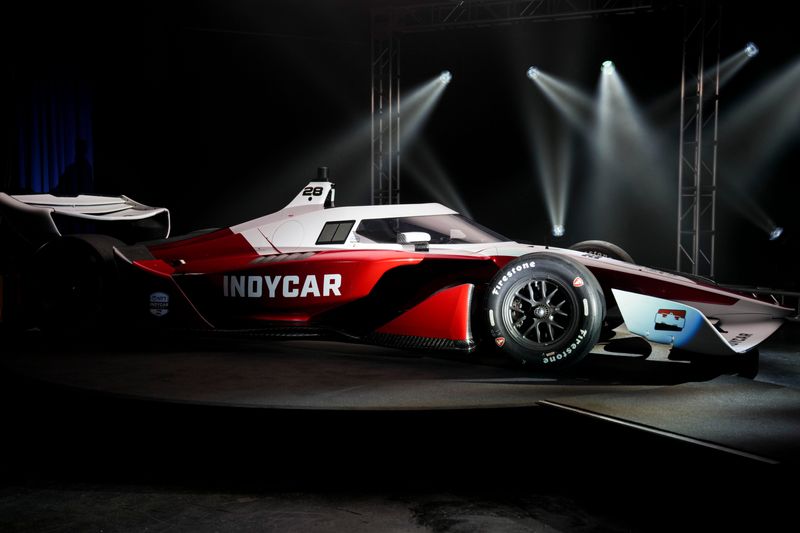
One of IndyCar’s stated goals for the IR28 is to break track records, and the chassis is supposed to do so in a multitude of ways. The car’s new curved rear wing is supposed to be one aspect contributing to the added speed of the car.
“The goal with all of the aerodynamics in the car, front to rear, is efficiency and making the wake that’s behind and beside the car more friendly for other cars around it,” O’Gara said. “One of the big goals that we gave Dallara when working on this car and designing the car is it has to race as good or better than what we have now.”
The car, with its rear wings, is built to make passing easier in the Indy 500 not only at the front of the field, but for other cars further back in the top 10. The engine will contain up to 760 horsepower, and the hybrid unit will have 14 times the energy that the current one does. The 100-pound reduction of the chassis and 20-pound reduction of the hybrid is expected to add a lot of speed.
IndyCar director of aerodynamic development Tino Belli helped Dallara develop and name the Tire Wake Conditioners, the structure behind the car’s front tires, which are meant to make passing on road and street courses easier.
“A lot of air comes off the side of the car from the front wing and front tires of open-wheel cars like this,” O’Gara said. “When that air comes off to the side, it makes it really hard for a following car to complete passes or to run side-by-side. So the purpose of this piece is to clean up the air coming off the sides of the car and help make it less turbulent and just to allow for cars to follow closer and complete passes better.”
With the added safety enhancements that have been made throughout the lifespan of the DW12, IndyCar felt it was time to make additions to the IR28 that would give it record-breaking speed. The series hopes that in 2028, the car does that at many of its tracks.
“We felt that was something that we were ready to do,” Sibla said. “We felt the technology was there where we could do this safely, responsibly. And it’s a good way to really continue the momentum that the sport’s under right now.”
What’s new inside the cockpit
The IR28 has a much wider cockpit which is built to accommodate more body types going forward. The enhanced cockpit will also make the protective aeroscreen, which was added in 2020, fit better in the car. The added padding in the wider cockpit should make it safer for drivers when crashes occur.
The pedals and steering wheel in the cockpit can move toward and away from drivers based on their size. IndyCar and Dallara brought Graham Rahal – the tallest full-time driver in the series – and Santino Ferrucci – the shortest full-time driver – to test their fit inside the cockpit to ensure that it was suitable for diverse driver sizes.
“The bigger cockpit opening is going to allow for drivers to run a bigger steering wheel and hopefully be more comfortable there,” O’Gara said.
The number of controls in the car will be limited from what they are in the DW12, as O’Gara said IndyCar is making a “conscious effort to remove that stuff and then to make more room.” The steering wheel itself will also be larger. O’Gara cited the crash Rossi got in during the penultimate practice for this year’s Indy 500, which led to Rossi getting procedures on his right ankle and left middle finger six days before the biggest race of the year.
“It’s going to allow the drivers to not pull their hand off the wheel when they’re making these adjustments for one,” O’Gara said, “but it’s also less stuff in the cockpit for them to hit their hands.”
IndyCar also hopes that the cooling within the cockpit will be more effective than it currently is. The air that moves through the inside of the cockpit will come from multiple areas to help with cooling drivers throughout races.
Why IndyCar changed to a spec damper
One technical concern that arose from Tuesday’s announcement was the fact that IndyCar was transitioning to a spec damper, rather than allowing for teams to use their own damper suppliers and engineering for shock absorption and spring movement. While dampers will now be built by the Custom AXIS Inertance Control Suspension System, IndyCar believes that won’t limit damper development within teams.
When asked for feedback from the series, drivers apparently expressed the same concerns about there being just one damper supplier. The series and Dallara decided to move inerters to both the front and rear third-element inertance systems, which the series believes will improve mechanical grip. The dampers supplied by Custom AXIS can also have up to 300,000 adjustments, with there being four dampers on the car.
“So the teams are going to get flooded with information,” O’Gara said. “And like any series, like any good engineering project, it’s going to be how you use the tools in your toolbox the best.”
O’Gara said he felt the current open damper development creates “a case of the haves and have-nots,” which leads to technical alliances among teams. Through the new regulations, O’Gara feels those so-called “have-nots” won’t need to enter alliances for dampers.
There are several elements of the IR28 to still be worked out, but for now, the chassis has been developed and is ready to go on track. The next 19 or so months before the start of the 2028 season will be full of testing for the IR28 to get it suitable for racing as IndyCar enters a new era.
Zion Brown is IndyStar’s motorsports reporter. Follow him at @z10nbr0wn. Get IndyStar’s motor sports coverage sent directly to your inbox with our Motor Sports newsletter. Subscribe to the YouTube channel IndyStar TV: IndyCar for a behind-the-scenes look at IndyCar and expert analysis.
This article originally appeared on Indianapolis Star: How IndyCar and Dallara turned ‘a blank sheet of paper’ into a new car in 17 months
Reporting by Zion Brown, Indianapolis Star / Indianapolis Star
USA TODAY Network via Reuters Connect
By Zion Brown, Indianapolis Star | USA TODAY Network