EVANSVILLE — Danny Kares hasn’t seen relief in the wake of Senate Enrolled Act 1, which aimed to lower the impact of property taxes on Indiana residents.
Kares, an Evansville resident and retired union pipefitter, said his personal property taxes went up 26% this year. He keeps reading about property tax relief, but he thinks it doesn’t exist.

“My home assessment has gone up $80,000 in two years,” he said. “All I’ve done is cut the grass.”
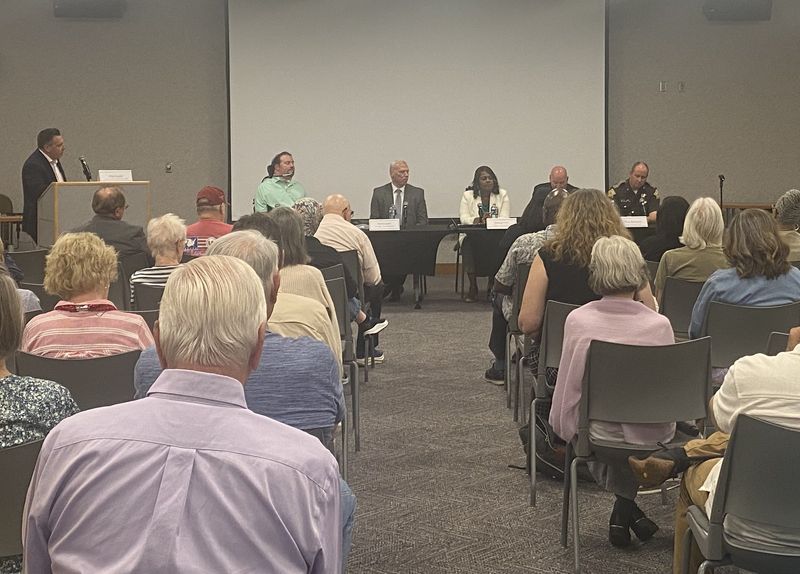
Kares shared this during Tuesday’s League of Women Voters of Southwest Indiana hosted “The High Cost of (Slightly) Lower Property Taxes” at Central Library. The event was co-sponsored by Indivisible Evansville and the NAACP Evansville Branch.
Attendees heard a presentation on SEA 1 from Clint Lamb with Accelerated Indiana Municipalities, before hearing more on the specific impact from Evansville Mayor Stephanie Terry, City Council President Ben Trockman, Vanderburgh County Council President John Montrastelle, Vanderburgh County Sheriff Noah Robinson and city controller Robert Gunter.
What is Senate Enrolled Act 1?
SEA 1 provided a maximum $300 property tax credit that homeowners can take off their property tax bill this year. While the goal of the bill was to lower the impact to taxpayers, it also lowered revenue for local government.
The bill also limited how much local governments and school districts can raise in property taxes in the future, with local income tax changes set to begin in a couple years that are meant to help communities make up those differences.
But those local income tax changes were already partly re-legislated during the 2026 legislative session. In SEA 1, local income tax rates were set to expire in 2028 and be reestablished.
House Enrolled Act 1210, pushed that to 2029.
Local income tax will be a large part of the conversation
Local income tax, a county-imposed tax on taxable income, is another revenue source for local units of government, as defined by the Indiana Department of Local Government Finance.
In 2024, local units of government in Indiana received over $3.7 billion in LIT.
In 2029, LIT rates will expire and they will be reestablished under the guidelines that the county can adopt a countywide rate, and cities with at least 3,500 people living in them can select their own rate.
Currently, LIT is a county-wide rate. Vanderburgh County residents local income tax rate is 1.25%. The overall rate is made up of individual types of LIT. Locally, this includes allocations like public safety and correctional facilities, as allowed under state law.
Under SEA 1, the maximum tax rate determined by residency is 2.9%. This allows for those larger cities and towns to have a LIT up to 1.2% and the county to have up to 1.7%.
HEA 1210 also laid out the ability for each county to create a Municipal Unit Strategic Taskforce before Oct. 1, 2026. The taskforce would include one representative from the county council, and each fiscal officer from cities or towns in the county.
This body would be meant to negotiate a local income tax distribution agreement relating to the county’s maximum rates. If an agreement is reached, it would need to be sent to the Indiana Department of Local Government Finance where it would be compiled for the legislative council before Dec. 1, 2026.
Public safety heavily impacted by SEA1
Controller Robert Gunter said about 42% of the city’s budget comes from property taxes. Around 21% of the budget comes from LIT.
About 75% of the general fund pays for public safety. This includes police, fire, central dispatch, animal control and building and code enforcement.
Breaking it down further, 80% of the money going to public safety is paying for personnel, covering salary, pension and insurance, Gunter said.
In the county, the sheriff’s budget is 27% of the general fund.
Sheriff Noah Robinson said law enforcement is having issues recruiting in 2026 like he’s never seen in his 25 year career. He acknowledged societal factors, and said amid an already hard time, the county is being handed lower revenue.
Robinson said he has to go fight for pay raises in front of county council, as its members don’t know what the future looks like.
Seeing politicians run on campaigns of “Back the Blue” and not defunding the police are almost hypocritical, he said, yet that’s the impact of SEA 1.
“… If you cap property taxes and reduce revenues, of course that’s going to defund the police,” he said. “How could it do anything but?”
This article originally appeared on Evansville Courier & Press: Here’s what to know from Vanderburgh County’s property tax forum
Reporting by Sarah Loesch, Evansville Courier & Press / Evansville Courier & Press
USA TODAY Network via Reuters Connect