BRISTOL — What is the probability of flipping a coin head side-up 49 times in a row?
According to University of Notre Dame associate professor of civil and environmental engineering and earth sciences Alan Hamlet, it has the same probability that the Earth has of increasing its average temperature 49 years in a row.

“The likelihood of that happening by chance is one in 560 trillion,” Hamlet said.
Every single year since the mid 1970s, the annual average temperature of the Earth has risen. According Hamlet, there is “absolutely no question that the climate is changing and that we are warming.”
If the Earth were left to chance, without human factors such as burning fuel, energy use and greenhouse gas accumulation in the atmosphere, the 20th century average would have shown global cooling, he said.
“Natural factors cannot explain this rise,” he said.
Before his high school graduation in 1977, the global average temperature fluctuated but remained below the 20th century average.
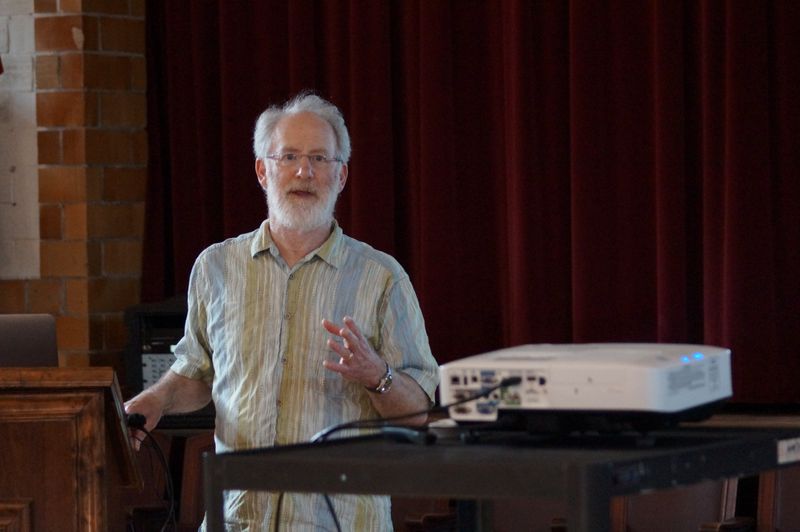
Hamlet hosted a public talk titled “An Overview of the Indiana Climate Change Impacts Assessment and Impacts to Midwest Water Resources” last month, at the Elkhart County Historical Museum.
Dueling possibilities
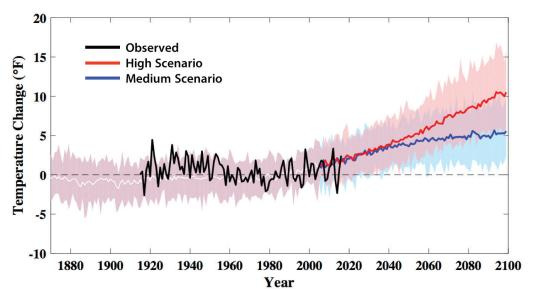
The Indiana Climate Change Impacts Assessment, which Hamlet co-authored, lays out two medium- and high- emission scenarios that offer insight into future climate possibilities. The high emission scenario is RCP 8.5, and the medium emission scenario is RCP 4.5.
The Representative Concentration Pathways (RCP) are based on different climate scenarios and serve as input for climate and atmospheric chemistry modeling, according to the International Institute for Applied Systems Analysis RCP Database.
In the first high-emission scenario, humanity does nothing to limit or mitigate emissions. Humans continue to burn intense fuel and populations rise.
In the medium-emission scenario, the model assumes there has been a lot of mitigation on the effects of greenhouse gases. This would include rapidly switching to renewable energy sources.
“By the end of the 21st century, you can see [a rise] of 10.5 degrees Fahrenheit of warming on average, which is a huge amount,” Hamlet said. “And if we get our act together and are successful at mitigating the climate to a certain extent and [we] maybe could possibly half that to about 5.5.
“But both of these numbers are very severe change for the climate.”
Under both scenarios, the graph shows that regardless of what humans do to alleviate the effects, there are about 20 years of guaranteed warming.
According to Hamlet, humanity should invest in climate change mitigation strategies despite the fact that there will not be immediate results.
“They’re going to be really angry,” Hamlet said. “They shouldn’t be angry. They should stay the course.”
Hamlet explained that there are a lot of reasons why “we are kind of locked in” to this guaranteed 20-year warming. But one important reason, he explained, is there is “a lot of inertia in natural systems.”
“There is also a lot of inertia in human systems,” Hamlet said.
The National Oceanic Atmospheric Administration shows a medium emission scenario online.
Seasons in Indiana
Overall, Indiana is going to get warmer across all seasons. However, winter and spring will see increased precipitation – less so in the form of snow.
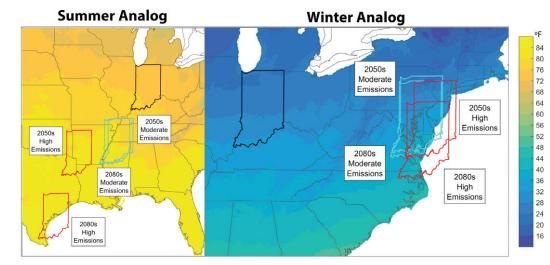
A tool that Hamlet explained is a spatial climate analog. Scientists use the projected future climate of Indiana and select a region of the United States that currently has that projected climate.
Under the high-emissions scenario, an Indiana summer may feel more like an east Texas summer by 2080 based on the current climate conditions of the region.
“The first question I have is, well, what about Houston? What is Houston going to look like?” Hamlet said. “I don’t think we know.
“It’s too far south. That’s about as warm as we have it in the United States and so we can’t make it [the scenario] any warmer.”
St. Joseph County has a historical average of three days per year with temperatures over 95 degrees. By the 2050’s, St. Joseph County may experience between 20 and 29 days over 95 degrees. But by 2080, that number rises to between 29 and 61 days per year.
An Indiana winter may feel more like a Maryland winter, according to Hamlet.
In St. Joseph County, the historical average of days below 32 degrees is 127. This number drastically decreases by 2050 with 91 to 99 days below freezing; and in 2080 there may be 71 to 94 days below freezing.
Despite more days of extreme heat, Hamlet said there will also be more days of extreme cold.
He described the instability with the polar vortex as “kind of wobbly.” Instability has caused the jet stream to dip down into southern states like Georgia, Texas and even Florida, causing unusual freezing temperatures and snow.
The arctic polar vortex circulates the northern pole, and it affects many countries across the globe, according to the NOAA National Weather Service.
Across the state, there will be increased levels of precipitation. The IN CCIA said Indiana is already seeing more precipitation, but by 2050 Indiana will see a 6% to 8% increase.
This precipitation will not fall evenly across the year, though, and in the traditionally snowy months, more snow will fall as rain.
In wintertime, rain instead of snow and quick snow melt will increase chances of flooding, Hamlet warned.
In 2018, during what Hamlet called a “2,400-year event,” more than 12 inches of snow fell and then melted over the next three days, soaking the soil.
“So basically, the melting snow primed the pump and then we had five inches of rain in three days which produced a monster flood in the St. Joseph River,” Hamlet said.
“This caused a lot of damage from the river backing up because the sewer was higher than the floor drains in most kinds of houses,” Hamlet said. “So basically, the river was coming right through the sewage system right into people’s houses.”
Other effects to watch for
Increased temperatures have already extended Indiana’s growing season, which Hamlet said may be good for some crops but stresses crops such as corn, soybeans and wheat.
“For example, corn does not like really warm temperatures, and the yield is suppressed,” Hamlet said. “So, we may see changes in crops to adapt to climate change.”
By 2050, the growing season is expected to increase by roughly 30 days. The northern Indiana region usually sees the first freeze in mid-October and the last freeze in late April, according to the IN CCIA. Under the extended growing season, the first freeze may happen in early November, and the last freeze is expected in early April.
While seemingly contradictory, Hamlet said, many plants need a freeze period to produce.
“Just because your average temperatures are higher, that doesn’t necessarily mean your delicate plants are going to make it through the winter,” Hamlet said.
As temperatures change and the timeline for seasons shifts, many fish and wildlife species may be affected.
“Migratory birds, for example, if the birds migrate at the same time, they might not find the food supply that they traditionally have had,” Hamlet said.
Alongside increased temperatures comes an increase in pests and diseases, including mosquitoes and ticks. Hamlet shared a story from January 2019 when on an unusually warm day, after a hike, he found many deer ticks on his dogs.
“I thought it had been quite cold prior to this, and I thought the ticks would have all been killed by the freezing temperatures,” Hamlet said. “But this is not the case. They have anti-freeze and they can last and just hide out in the leaves until it’s warm.
“As soon as the temperature warms up, out they come.”
Deer ticks are vectors and can pick up Lyme disease from mice and carry that disease to humans, according to the Global Lyme Alliance.
Hamlet warns that people may have more opportunity to be outdoors and explore recreationally, but it is important to be aware that there are ticks and mosquitoes coming from the south that are known to carry diseases.
Peer-to-peer interactions are the best way to encourage people to care about the changing climate, Hamlet believes.
“I think really what’s needed is just to consider that the climate will be different and we have a lot of capacity to adapt if we put our mind to it,” Hamlet said. “There’s a lot of brilliant people in this country and we need to put them to work to figure out what to do in a new climate.
“What I find really dismaying is that we are not doing that. Instead, we’re trying to pretend, well some people are trying to pretend that this is not real, and that is a recipe for disaster.”
Email Tribune staff writer Juliane Balog at jbalog@usatodayco.com.
This article originally appeared on South Bend Tribune: East Texas or Tennessee? ND research shows 2 possible Indiana climates
Reporting by Juliane Balog , South Bend Tribune / South Bend Tribune
USA TODAY Network via Reuters Connect
By Juliane Balog , South Bend Tribune | USA TODAY Network