Indiana University has earned a national reputation as one of the worst universities in the country for overstepping First Amendment freedoms.
Its forceful handling of a pro-Palestinian encampment in 2024 catapulted the campus into national headlines. Last month, a judge ruled a protest policy likely violates students’ First Amendment rights. And a campus free speech organization said the university has repeatedly punished students for expressing their opinions.

It’s all part of the mounting pressure the IU administration has faced for the better part of the last three years. While many universities have just now been put under a microscope, IU has already needed to compromise on a docket of “culture wars” topics, such as abortion, sexuality and academic freedom.
Now, an influential conservative lawyer joining the board of trustees is not only bringing 50 years of First Amendment litigation experience but also a swift change of pace to IU’s board of trustees.
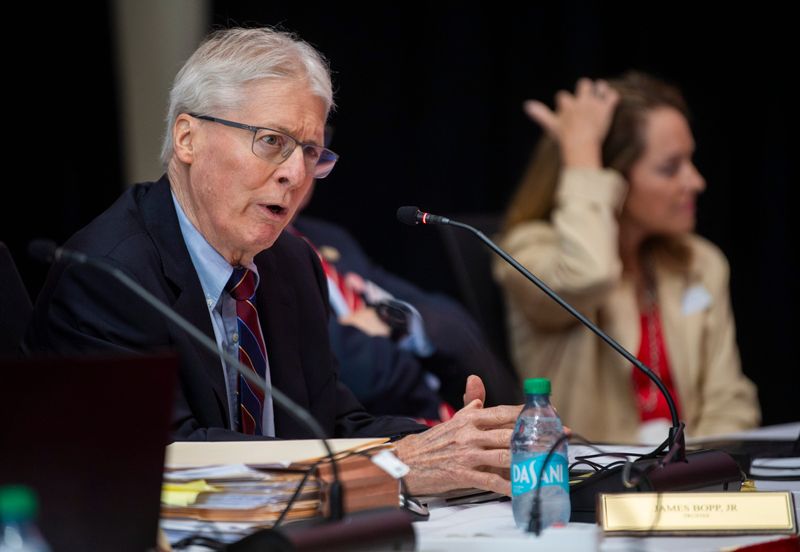
Terre Haute’s Jim Bopp, one of Indiana Gov. Mike Braun’s first university board appointments, is part of a new national wave of trustees who don’t mind making contentious decisions as university politics are growing more high profile.
Bopp told IndyStar that he will seek to “nurture” a respect for First Amendment freedoms that allows debate and expansive viewpoints — which conservatives say has not been the case. Braun said he tapped Bopp for that reason.
“I have a very robust view of the First Amendment, and I’ve won a lot of cases where the courts have adopted my position, and so I’m going to want to see that,” Bopp said. “We have to nourish that. We have to cherish that. We have to make sure that that can occur because that’s critical to the mission of IU.”
Bopp has been considered one of the most influential First Amendment lawyers in the country and has won nine of his 14 cases in the U.S. Supreme Court. He is also heavily involved with the National Right to Life Committee and has drafted model abortion-ban legislation.
He is most widely known for drafting the complaint in the 2010 Citizens United v. Federal Election Commission case, which paved the way for companies and unions to spend unlimited amounts of money supporting political candidates.
‘Intense’ influence over universities
University boards are growing in profile, and in turn, have higher-stakes issues to decide on, said Isabel McMullen, a Ph.D. candidate at the University of Wisconsin who researches how state politics influence public institutions of higher education.
Across the country, university boards are increasingly taking larger roles in developing curriculum, molding the circumstances of student expression and retaining faculty.
“No actual student in their right mind can name any (trustees),” IU graduate student Eli Beaton said. “But the level of influence they have over universities’ decisions is really intense. All these sort of shared governance procedures all live and die at the board of trustees vote.”
University boards are increasingly evaluating and deciding whether their decision-making is proper and in line with the law, said Bradley Smith, founder and chairman of the Institute for Free Speech. Many boards don’t understand their obligations to protect such rights, he said, so Bopp’s extensive work defending the First Amendment will likely be a north star.
“We’re also in a period in which a lot of people express real misunderstandings about the First Amendment,” Smith said. “In this day and age and more than there was in decades past, Jim would be very valuable.”
Jim Bopp ‘not a firebrand’
Part of his motivation to join the board, Bopp said, is to impart his broader interpretation of the First Amendment at IU. He also wants to ensure the university is on line with the state and federal laws — which have seen several major changes related to higher education.
With such a heavy emphasis on staying on the right side of the law, Bopp said he is approaching the position in a similar regard to his work as a lawyer.
“He’s not a firebrand who goes in pounding the table and yelling,” Smith said. “He goes in prepared with facts and law and a very calm, rational basis for thinking about what ought to be done and what the law ought to protect.”
Bopp declined to provide details on what policies and changes could look like. He said he needs to study the issues more closely before deciding on an appropriate approach.
“Everything I do is going to be researched and really come to a very considered opinion on what is the situation and what should be done about it,” he said. “You don’t win nine cases in the United States Supreme Court because you just fly off the handle.”
Defining antisemitism
One area of the First Amendment where university leaders have yet to find a solution is what constitutes antisemitism. It’s a definition that decision-makers across the country, including Indiana, have struggled to word.
Following the flood of pro-Palestine protests across U.S. campuses in spring 2024, university leaders and lawmakers have sought to identify what constitutes antisemitism, so it could be used to quell hate speech. However, others argue a broad definition could limit speech critiquing Israeli leadership during the war in the Gaza strip.
It’s debate that could resurface at IU, where police and pro-Palestinian protesters clashed last year, resulting in dozens of arrests, a lawsuit and praise from conservative U.S. Sen. Jim Banks. A host of students said the university’s response to pro-Palestinian protests stifled their freedom of expression.
When asked his opinion about the university’s handling of the situation and what he’d do differently, Bopp reiterated he still need to study the issues. But, he did say the antisemitism seen on some college campuses is “rampant” and “appalling.”
He specifically pointed to the phrase “From the river to the sea,” a expression with several connotations and a long history. Bopp considers it to mean a call for a Jewish genocide, while others say it advocates for Palestine to exist without Israeli occupation.
Bopp said speech can be “pretty radically offensive” and still be protected under the First Amendment. There is a narrow category of speech that can be restricted, Bopp said. The university has a right to step in during instances of obstructing access to public spaces and provoking violence, he said.
That’s where threading the needle was important in the university’s expressive activity policy amended earlier this month, he said. Bopp agreed with the American Civil Liberties Union’s complaint that the previous policy violated the First Amendment.
Jim Bopp and the GOP
To say Bopp is heavily intertwined with Republican politics is an understatement.
He’s served as the national party’s vice chair for six years and has represented a bevy of conservative causes from the National Republican Party and the National Rifle Association to U.S. Sen. Mitch McConnell and a dozen state Republican parties.
Bopp filed lawsuits challenging 2020 election results, was an influential voice in crafting Indiana’s abortion ban and represented students who sought to overturn the university’s vaccine mandate.
He also was also the architect of Hoosiers for Opportunity, Prosperity and Enterprise, a young nonprofit that has developed policy for Braun and lobbies for conservative legislation at the Indiana Statehouse.
So when Bopp’s appointment was announced, many in the left-leaning campus community said they felt uneasy with Braun’s selection of such a partisan figure.
Beaton, who is a part of the vocal Indiana Graduate Workers Coalition, said he’s worried that the free-expression environment won’t improve with conservative figures like Bopp on the board.
The First Amendment could be used as a vehicle to justify and establish conservative positions on campus, Beaton said. He fears this could result in changes such as fewer multicultural spaces and programming and limited access to health care, that could make students feel less welcome.
“The thing that stands out to me, at least, is free speech for him always seems to be connected to some other goal,” Beaton said. “Free speech is the mechanism by which all of this is moving through.”
People shouldn’t be surprised that Braun is bringing his conservative policies to IU, Bopp said. Public universities are subject to government control, he said, so when Hoosiers voted Braun into office, he said “that’s democracy in action.”
“The attitude that I see in some of them is conservatives are not welcome on the liberal IU campus,” Bopp said. “That’s outwardly advocating suppression of certain views. They’re just not welcome, should not be allowed. I shouldn’t be allowed to be a trustee because I’m a conservative.”
Still, Bopp said, politics will not play a role in his decision-making but instead he will be guided by his philosophy and morals. Smith, who has known Bopp for a quarter of a century, agrees.
“I don’t know that his politics will influence his work so much,” Smith said. “It’s more the other way around: that his dedication to defending free speech has shaped some of his politics.”
Politics have always been immersed in university boards, McMullen said, but boards are dealing with higher-stakes issues than they previously had. Boards of trustees are altering curricula and shifting staffing levels in ways they hadn’t in the past, she said.
“It’s fair to say it’s always political, and if that’s who you elected to the governor’s seat, then I guess you should have expected that this will happen. But who thinks about that when we’re in the voting booth?” McMullen said. “We sort of expect our public bureaucracies to just run themselves as opposed to really being manipulated in partisan ways.”
It’s largely unclear, she said, if and how this new injection of starkly partisan appointments across the country could change the makeup of public institutions and the student experience.
“There’s a lot of arguments to be made on both sides,” she said. “This could be extremely detrimental. This could be completely revolutionary.”
The USA TODAY Network – Indiana’s coverage of First Amendment issues is funded through a collaboration between the Freedom Forum and Journalism Funding Partners.
Have a story to tell? Reach Cate Charron by email at ccharron@indystar.com or message her on Signal at @cate.charron.28.
This article originally appeared on Indianapolis Star: IU has wrestled with free speech issues. New Trustee Jim Bopp may be a game changer
Reporting by Cate Charron, Indianapolis Star / Indianapolis Star
USA TODAY Network via Reuters Connect