SOUTH BEND — Seven days.
That’s how long it took the City Clerk’s office to send The Tribune a copy of the South Bend Reparatory Justice Commission report. But some residents haven’t been as lucky.

Formed in 2023 by the South Bend Common Council, the Reparatory Justice Commission spent nearly three years compiling historical data, anecdotes and records into one, 138-page report to document evidence of decades of redlining, discrimination and racism again Black residents in South Bend.
Four subcommittees were used to create the report: economic opportunity, housing, education and health. Together, the subcommittees documented how “systematic discrimination caused poorer economic and health outcomes” as well as denied equal access to housing, jobs and education for the Black residents of the city, according to the report.
The commission also provided potential policies that could be implemented to lessen those negative outcomes.
In the end, the research led to potentially startling discoveries, such as census tract data in LaSalle Park, a historically Black neighborhood in South Bend, showing the neighborhood has the lowest life expectancy in St. Joseph County.
The report was filed with the clerk’s office on May 4, so why has it suddenly become possibly one of the hardest public documents for residents to get their hands on? And why is one public official being called untrustworthy by the mayor for sharing it?
On May 15, a Tribune reporter entered City Hall with a plan to visit the clerk’s office and request the document after hearing from Common Council member Oliver Davis that residents had approached him with concerns over being denied access to the report.
After walking up to the front desk and alerting city staff that they’d like to visit the clerk’s office to request a filed document, the city employee immediately asked, “Is it for the report?”
As it turns out, multiple residents had also tried to obtain a copy of the report by visiting the clerk’s office, and each were met with the same response: to email the clerk for the document. In fact, the response was typed and printed for the person at the front desk to read.
The city staff member was unaware of whether the clerk’s office would provide the report but ensured that it would, at the very least, respond. The Tribune reporter requested the report from a personal email in hopes of tackling the situation the way that any regular citizen would.
It took seven days.
Clerk’s office’s response
When the clerk office’s response finally arrived on May 21, less than 30 minutes before City Hall closed, it read as follows:
“Thank you for reaching out to the City Clerk’s Office. The report is now available on our website and can be accessed with the following link.”
But, upon further examination, other Tribune staff members had trouble getting the reparatory report to load, although the loading issue has since been fixed. Multiple Tribune journalists were also unable to find it by searching the city’s website, and other members of the public reported the same difficulty.
According to Indiana’s public access laws, in-person requests and those made by phone must be acknowledged within 24 hours; for requests made by mail, email or fax, the response time is within seven days.
Since the report came to light in May, council member Davis said, residents have continuously reached out to him about the difficulty of getting it.
“The biggest thing is the closed environment that has been caused by our mayor, the council and the clerk’s office,” Davis said. “It’s a public building, paid by tax dollars, yet you cannot get the documents, or you have a rough time getting them. They say it’s not there, and if someone of us have it, and we send it, then they say we leaked it.
“I do not like that, because it creates [the idea] that the government is a part of a cover-up. When cover-ups happen, I get upset.”
Originally, controversy began to surface when the report was filed with the clerk and mistakenly posted to the Reparatory Justice Commission’s website, The Tribune previously reported. The report was then taken down from the commission’s website, Reparatory Justice Commission Chair Trina Robinson said, because it had yet to receive finalization.
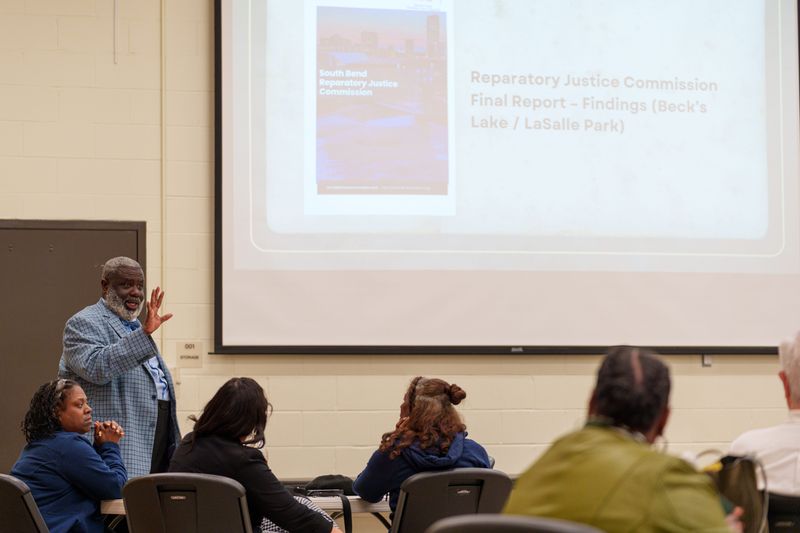
That didn’t stop people, like Davis, from sending it to curious citizens, and it didn’t stop organizations, such as Black Lives Matter and the LaSalle Park Neighborhood Alliance, from holding meetings to discuss the commission’s findings with residents.
Despite the clerk’s office stamp on the top right and the words “Final Report” typed on the first page, the reason given, through official and unofficial channels, for withholding the report is that it still needed to be approved by the Common Council. However, according to Indiana’s Access to Public Records Act, that excuse isn’t legitimate.
An editorial written by Tribune staff cited a 1998 official opinion by then-Indiana Public Access Counselor Heather Willis Neal, who wrote that “it is important to note that an agency may not deny access to a record on the basis that it has not yet been approved.”
As a council member, Davis said he believes pressure has been placed on the clerk’s office to not release the report, but he refuses to squash the information.
“I’m a public official, and they’re saying, ‘You’re talking too much. You’re leaking [the report], and we can’t trust you,’” Davis said. “No, I can’t trust them, because they’re squashing.”
Disapproval from Mayor Mueller
Mayor James Mueller texted Davis himself and said, “That’s why we can’t trust you,” for sharing the report with the community.
“So, if he’s saying, ‘We can’t trust you to hide information,’ no you can’t,” Davis said. “You cannot trust Oliver Davis as a public official to hide information. That’s not my job.”
When asked about the text message, Mueller’s director of communications, Allison Zeithammer, said the mayor’s office does not discuss embargoed content or personal exchanges. Mueller would neither confirm nor deny sending the text when asked to do so in a follow-up message May 29.
The report has since been finalized by the Common Council at its May 26 meeting, and the council has invited the reparatory commission to present the report on June 8. But the document still hasn’t been added to the clerk’s website despite what the office told The Tribune on May 21, nor has it been added to the Reparatory Justice Commission’s website.
Residents are also informing The Tribune that they have yet to receive the report. One local who emailed the clerk’s office on the same day as The Tribune had heard nothing back from the office as of noon June 4.
Without any answer of when they may get it, Davis said, the issue of transparency between elected officials and residents is becoming larger every day.
“Let’s have a discussion. Let’s let the people in the building and let them up to get the documents,” Davis said. “Let’s not keep the information away. … I don’t need to be trusted to hide information, [and] I don’t want to be trusted like that. If the people in South Bend can’t trust me to give the information out, then I’m no good.”
Email South Bend Tribune business reporter Jessica Velez at jvelez@usatodayco.com.
This article originally appeared on South Bend Tribune: Clerk’s office allegedly withholds report from residents, not media
Reporting by Jessica Velez, South Bend Tribune / South Bend Tribune
USA TODAY Network via Reuters Connect


By Jessica Velez, South Bend Tribune | USA TODAY Network