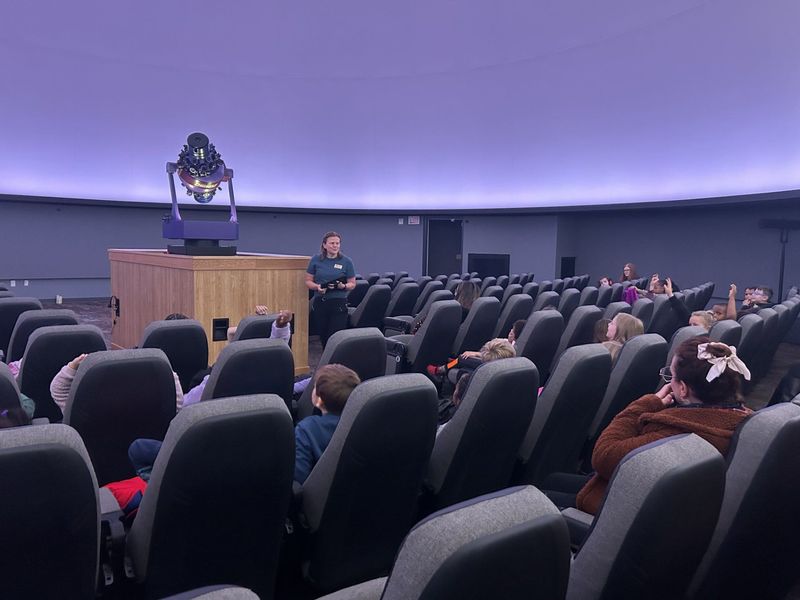
MUNCIE, IN — On Saturday, Nov. 8, the planetarium will hold its annual Astronomy SLAM, featuring four students who have prepared presentations focusing on their interests. Their work will be displayed across the “night sky.”
Register online for $4 a ticket.

Planetarium Director Dayna Thompson invites people to come learn from these students and enjoy refreshments.
This year, the topics include exoplanets (planets outside of our solar system but in the Milky Way) and extreme exoplanets, dark matter and dark energy, and farming on Earth with lunar patterns.
The four presenters will have 10 minutes apiece to compete by using the planetarium visuals, explaining a part of the universe to the audience. Voted on by the visitors, the presenters will be awarded for astronomy SLAM champion, best visuals, most thought-provoking, and best energy.
Some of the students work at the planetarium, while others participate just because they are interested.
“We’re hoping to get a full house. The students are putting a ton of work into this,” Thompson said.
The largest planetarium in the state, the Charles W. Brown Planetarium at Ball State University, aims to inspire Muncie through education and public engagement.
The planetarium hosts more than 400 events every year and receives more than 20,000 visitors annually, funded by donations to the Ball State University Foundation.
Inviting all ages, the planetarium’s public events typically last about 45 to 60 minutes. Doors open 30 minutes before showtime and are usually first-come, first-served, no tickets or reservations needed.
Be sure to keep a lookout for other upcoming events. Some include “Water Worlds Live,” which will search for water in our solar system and begins showing Nov. 14, and “The Christmas Star,” which will explore possible explanations for the Star of Bethlehem, which begins Dec. 5.
All other planetarium events this semester are free, hosting school groups during the week and public events on the weekend.
“Financial accessibility is a big part of what we do and what Ball State is about, providing free opportunities for anyone who wants to come and enjoy what we have here. Beyond that, there is the astronomy and science components, but we are not just teaching people science. We are hopefully teaching them to love science or really just to be inspired,” Thompson said.
Thompson has worked at the planetarium since she attended Ball State as a graduate student in 2010. And since then, the program has seen changes.
One of the biggest was the move from the basement planetarium, a 16-meter dome created in 1967 during the space-race age, to the 30-foot dome upstairs, built in 2014.
Seating doubled, and technology skyrocketed into the future, with the installation of a brand-new star projector with digital projectors that transformed the experience.
“In the old planetarium, we could just put up pictures and videos and little square rectangles with digital projectors that you would see in a normal classroom. When we got this new facility, the Brown planetarium, we went to full-dome technology,” Thompson said. “We have full dome projectors, each with a fisheye lens on them, two of them, and they create a seamless image on the entire dome, so the whole dome basically becomes a movie screen.”
The planetarium also has an optomechanical projector that can recreate the night sky anywhere on planet Earth, any time of day, plus or minus 10,000 years. Its star projector maps about 4,000 of the brightest stars, and fills in the Milky Way, in a band of light that reaches across the domed ceiling with about a million points of light that represent stars.
Just like the real sky, Thompson said, you can use a pair of binoculars, point them at the dome, and see things in greater detail without losing quality.
“The priority coming in focused on keeping it astronomy education-based. Teaching people the components and characteristics of a scientist is a big part of that, and it can be many different characteristics or traits of a scientist that then influence them in other ways,” Thompson said.
Among the learning and inspiration that happen here, Thompson also recently became certified in yoga instruction, which allows her to teach in the planetarium and engage new groups of people. Programs like the recent Halloween show, “Halloween: Celestial Origins,” do the same.
Co-written with a professor on campus, Thompson said the show was a good way to hook people and get them to try something new.
Collaborations are a big part of reaching new audiences. Next semester, the planetarium will partner with the Levi and Catharine Coffin State Historic Site, based out of Fountain City, Indiana, to explore how people traveled to freedom in the north by studying the North Star.
In addition to reaching new audiences, the planetarium also wants people to keep coming back for live shows.
From as young as Pre-K students who enjoy the “Sesame Street” program to a magic Treehouse Show for older kids, to shows about advanced concepts, like searching for life on other worlds and spectroscopy for kids-at-heart and adults: More than pressing a button, the shows are engaging and share live information. Thompson said shows talk with the audience, not at it.
People also tend to be interested in the unknown, like black holes and other elements.
Thompson said that whatever she is studying at the time is the most interesting part of astronomy.
“Sometimes students will ask what my favorite planet is, and we’re never supposed to have favorites, because they’re like children, but it’s always whatever I’m studying at the time,” Thompson said.
This article originally appeared on Muncie Star Press: Ball State’s planetarium offers Nov. 8 ‘Astronomy SLAM,’ other events
Reporting by Katie Siedenburg / Muncie Star Press
USA TODAY Network via Reuters Connect