EVANSVILLE — In the early morning hours of Nov. 6, 2005, an F3 tornado carved a path of almost unspeakable destruction through the Tri-State, killing more than two dozen people and leaving a tangled, twisted mess of homes – many of them mobile homes – in its wake.
That tornado was one of nine confirmed twisters spawned across the Mississippi Valley and the Midwest by a thunderstorm that would strike Evansville around 2 a.m., when most of the city was asleep and unaware of the approaching danger.

Among the hardest-hit areas was the Eastbrook Mobile Home Park, where 20 of the tornado’s victims perished, including 2-year-old C.J. Martin, whose death became a catalyst for a successful drive to reshape safety standards for mobile homes across Indiana and the country.
The movement, which pushed for mandates requiring weather radios to be installed in manufactured homes, was led by C.J.’s mother, Kathryn Martin, who in the storm’s aftermath discovered that although the National Weather Service had issued a tornado warning, many residents didn’t know about it.
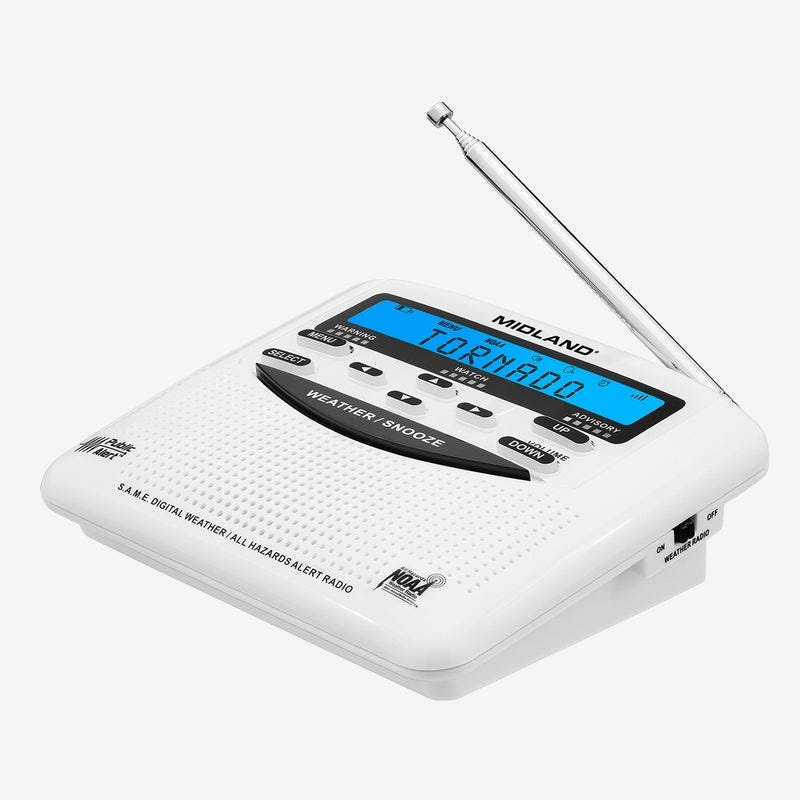
Part of the reason? Many mobile homes lacked a NOAA weather radio.
Martin turned her grief into advocacy and fought for legislation that would require weather alert radios in all newly manufactured or mobile homes, culminating in 2007 with the passage of “C.J.’s law” in Indiana, which mandated that new and relocated manufactured homes in the state be equipped with the devices.
Then-Indiana Gov. Mitch Daniels signed the mandate into law during a visit to the Eastbrook Mobile Home Park.
Times and technology have changed
But 20 years after the devastating 2005 tornados, nine out of every 10 Americans owns a smartphone with a near-constant internet connection. How important are weather radios when the vast majority of people own a device capable of tapping into the web at any time?
Advocates, including Martin, say advances in technology have led to significant breakthroughs in weather safety, but even in 2025 they still argue that weather radios have an important role to play — particularly for mobile home residents.
Mobile homes face an increased risk during tornadoes because the structures prioritize lightweight construction and lack permanent foundations. Being able to receive real-time weather alerts even when the power is out, or when cellphone service is down, can be the difference between life or death, according to advocates and federal officials.
That argument is bolstered by a sobering statistic: The National Weather Service has found that mobile home residents are 15 to 20 times more likely to die in a tornado than those residing in permanent structures. CJ’s Law was crafted to address that disparity in risk by ensuring that anyone residing in a mobile home receives timely weather alerts.
NOAA-approved weather radios utilize batteries, hand-powered cranks and operate on dedicated frequencies to receive alerts that are specifically designed to wake sleeping residents with loud, unmistakable alarms.
Advocates acknowledges that with smartphones in nearly every pocket and weather apps offering real-time updates, some may question whether weather radios are still necessary. But meteorologists and emergency response planners caution against relying solely on digital, cellular or wifi-based devices.
With regard to smartphones, Martin and others argue that a range of risk factors can increase the likelihood that a tornado warning or weather alert slips through the cracks: power outages, network congestion and “do not disturb” modes that mute notifications can all prevent warnings from getting through.
“Smartphones are great, but they’re not foolproof,” said Jeff Masters, a longtime meteorologist and co-founder of Weather Underground. “Weather radios are still the gold standard for overnight alerts.”
Not everyone keeps their phone volume on at night, and in rural or low-income areas, cell-tower-based internet access may be limited. Weather radios fill these gaps, offering a reliable, low-cost solution that doesn’t depend on user behavior.
Martin points to the fact that a weather radio simply requires an outlet, or batteries, to stay tuned in to alerts rather than a costly cellphone service subscription as evidence enough that the devices still have an important role to play.
Twenty years after a tornado permanently altered Martin’s life and that of dozens of Tri-State families, Martin says CJ’s Law still stands as a testament to the power of grassroots advocacy and argues that even in a digital age, analog solutions still save lives.
Emergency managers across Indiana continue to promote weather radios as essential tools, and community centers in Evansville regularly host preparedness workshops that cite the 2005 tornado as a case study in what can go wrong — and how to reduce risk moving forward. County governments across the Tri-State still hand out free weather radios each year, often citing the 2005 tornado tragedy as justification for the continued outreach.
This article originally appeared on Evansville Courier & Press: A 2-year-old’s death in 2005 tornado led to law reshaping mobile home safety standards
Reporting by Houston Harwood, Evansville Courier & Press / Evansville Courier & Press
USA TODAY Network via Reuters Connect