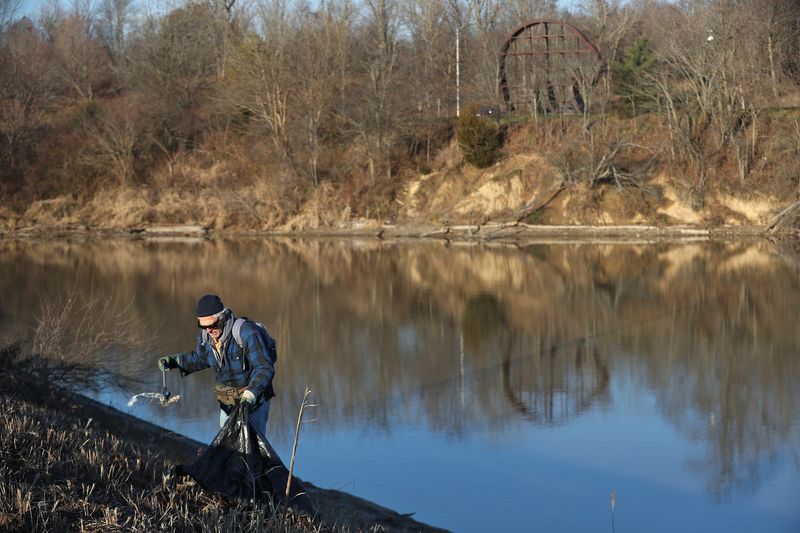
Indiana’s shiny new technology park in Lebanon, often described as a desert due to its lack of water resources, could soon see an influx in the realm of 25 million gallons of water a day, some of which could come from the Eagle Creek Reservoir.
Citizens Energy, a utility that services much of the Indianapolis area, formally began the $700 million dollar water project at the beginning of 2025 to supply Boone County’s so-called LEAP district. Scrutiny increased this fall as homeowners whose properties overlay the pipeline route began receiving letters informing them they needed to sell property easements to Citizens Energy — or legal action might ensue.

When members of the Eagle Creek Park Advisory Committee heard about the letters, they realized some of the project’s water supply would be drawn from the reservoir. This plan sparked outcry among residents and local consumer advocacy groups who feared tapping the reservoir for water would affect the health of the park’s ecosystem.
The concerns were not necessarily new. For the past year, residents and others have cited numerous concerns about the project, including its cost, wastewater plan and the general lack of information available to the public.
More recently, however, as Citizens Energy has increased its outreach to organizations like the Eagle Creek Park Advisory Committee, some fears have been alleviated while concerns about transparency linger. Some also still question the utility’s water usage plan for Eagle Creek Reservoir and how it will impact nearby wildlife.
“Our conversation with Citizens was a really good start,” said Lou Ann Baker, who sits on the committee. “But there were some deeper dive questions that we would still like to see some scientific information on, regarding flow, regarding capacity, regarding potential impacts on the reservoir.”
How we got here
Citizens Energy, a non-profit utility, said the state of Indiana approached the company “a couple of years ago” to ask if they could provide water for a large economic development project in Boone County.
The Limitless Exploration/Advanced Pace (LEAP) Innovation District is the state’s up-and-coming technology park, populated by companies like Eli Lilly. The state hopes to attract more industry to the park, which would necessitate even more water in Lebanon, whose current daily water supply maxes out near 5 million gallons.
After some back and forth with the state, Citizens Energy eventually agreed to service 25 million gallons a day to Lebanon Utilities. The Lebanon based utility will then provide water to the city and the LEAP district.
But before Citizens Energy signed on officially, the company had two conditions.
“The first condition was it couldn’t compromise a water supply for Central Indiana. We had to be able to meet the water supply use for our customers and communities, not just for today, but in the future,” said Michael Strohl, the senior vice president & chief customer officer at Citizens Energy. “The second condition is Citizens water customers couldn’t pay for our project in Boone County.”
Instead, the project will be financed through the State Revolving Fund, loans typically reserved for projects that improve drinking water infrastructure for Indiana communities. Citizens Energy said the project cost will likely fall somewhere between $550 and $560 million, with a cost ceiling of $700 million. Despite the hefty price tag, Citizens Energy said that one of the stipulations of the contract is that the utility is not expected to pay the loans back.
Kerwin Olson, the executive director of the Citizens Action Coalition, was initially skeptical of the project but said some of his concerns were alleviated after he sat down with Citizens this week.
“It actually could be somewhat beneficial to Citizens’s customers in the long run with respect to a significant amount of infrastructure being built at no cost to citizens ratepayers,” he said. “ That’s not necessarily a bad thing.”
Olson added that while he feels better about Citizens’s plan to supply water to Lebanon today than he did a year ago, he still has reservations about the LEAP district in general and its seemingly voracious appetite for water and energy.
Water, pipes and pumps
The Citizens — Lebanon Water Supply Program is an umbrella term for several projects Citizens will undertake to deliver water to Lebanon, and the utility said construction will likely push forward in earnest in 2026.
Construction plans include tweaks to two existing water treatment plants in an effort to expand their daily capacity. Citizens will also install 53 miles of water mains, hence the letters sent to property owners northwest of Indianapolis, adding four new boosters and seven new storage tanks.
The company aims to deliver up to two million gallons a day to Lebanon by 2027, up to 10 million gallons by 2028 and finally, a maximum delivery of 25 million gallons daily by 2031. Typically, the system will only be delivering half of that maximum capacity, said Jeff Willman, Citizens’s vice president of water operations.
The water itself will be derived from multiple sources because Citizens’s 10 water treatment plants run concurrently, Willman said.
But when the TW Moses Treatment Plant near the Eagle Creek Reservoir was flagged for expansion under the project, the utility’s plans for the popular reservoir drew special interest.
Willman said the plant’s capacity will expand by six million gallons in daily treatment capacity, from 24 to 30 million gallons, but the plant will likely shift from actually treating an average of 10 million gallons a day to 12. Some of this extra water could be pulled from Eagle Creek Reservoir, which is owned by the city of Indianapolis and already used as a water source for many Hoosiers.
Baker and her colleague on the Eagle Creek Park Advisory Committee, Martin Risch, have spent the last several weeks digging into how the project might impact the reservoir.
“We’d like a little more than, ‘Oh, trust us, it’s all gonna be okay,'” Baker said.
A key sticking point is the amount of water in the reservoir. In an old water utility pamphlet, Baker and Risch read that Eagle Creek holds about 5.5 billion gallons of water. Citizens officials say the capacity is closer to 8 billion based on a water survey from 1975 and a more recent evaluation by consultants.
Risch, a retired hydrologist, said that clarifying the discrepancy is important before Citizens Energy begins to pull more water for the district. He worries that draining too much water could harm the ecosystems on which migrating birds. The utility, on the other hand, says water levels will not be impacted.
One way to resolve this, Baker and Risch say, would be with an updated water survey with publicly accessible results.
“We are hopefully optimistic that (Citizens’s) transparency pledge is going to continue as we’re asking and seeking additional information on the projects that impact the park and the reservoir,” Baker said, adding “this lack of transparency causes trust issues with information that is eventually provided.”
IndyStar’s environmental reporting is made possible through the generous support of the nonprofit Nina Mason Pulliam Charitable Trust.
Sophie Hartley is an IndyStar environment reporter. You can reach her at sophie.hartley@indystar.com or on X at @sophienhartley.
This article originally appeared on Indianapolis Star: $700 million project will send millions of gallons of water from Indy to LEAP district
Reporting by Sophie Hartley, Indianapolis Star / Indianapolis Star
USA TODAY Network via Reuters Connect