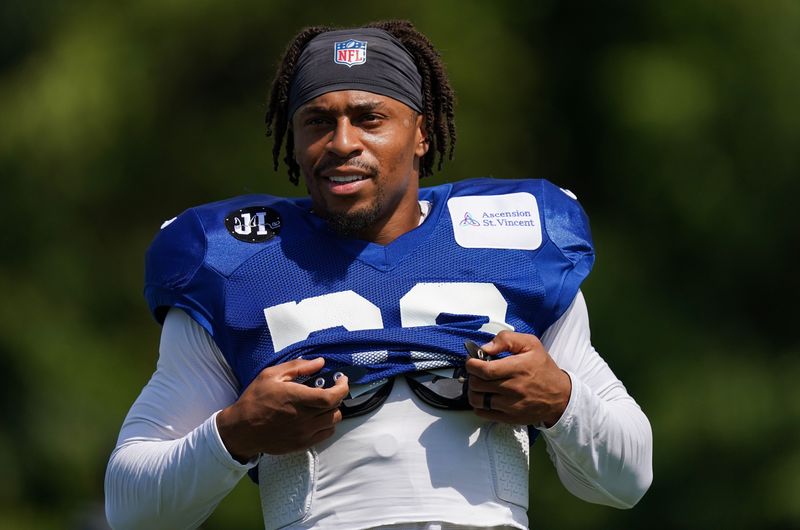
INDIANAPOLIS — There is a number Colts running back Jonathan Taylor is chasing.
Twenty-three.

Twenty-three miles per hour, to be precise, a milestone no NFL player has hit in a game since running back Raheem Mostert cracked it with the 49ers on an 80-yard rushing touchdown in 2020.
Taylor’s routinely near the top of those lists, and he took the top spot by hitting 22.13 miles per hour on his signature touchdown against the Patriots in 2021. But the Colts superstar has long been chasing the 23 miles-per-hour milestone on the practice field, a mark former Badgers teammate — and Avon High School grad — Isaac Guerendo hit during his time at Wisconsin.
Taylor taught Guerendo, a 49ers back now, how to play the position.
But Guerendo’s 23 miles-per-hour haunts him.
“I’m trying,” Taylor said. “If Isaac’s watching this, listen, I’m still grinding.”
Taylor’s goal carries far more significance than mere bragging rights.
The Colts, like most NFL teams, track everything about a player’s physical output on a daily basis through sensors that can be worn underneath their shoulder pads, on their chests and under their pads.
All of the analytics have a purpose, and the primary purpose is to track how a player’s body is holding up under the rigors of the NFL schedule. Indianapolis opens its season at 1 p.m. Sunday against Miami. For most Colts, Sunday’s kickoff will be the best they feel all season; the players will spend the entire season trying to maintain their speed and strength as much as possible.
Taylor might have his sights set on 23, but just about every player is keeping a close eye on a different number.
Ninety.
“For me, a guy who’s had soft-tissue stuff in the past, we always try to hit 90% of your max miles-per-hour,” tight end Will Mallory said. “I’m a 21 mile-per-hour guy, so I have to hit high-19 to 20 per week. That’s a range I try to go for.”
No NFL player hits his top speed on every play.
The NFL scouting combine measures a player’s speed in the 40-yard dash, but that’s the maximum output possible; few plays require a player at any position to run flat-out in a straight line without resistance.
Play speed is far more important. When a player has a chance to run flat-out, he establishes the top end of his play speed, and it’s important to keep that number consistent over the course of a long season.
Veteran linebacker Joe Bachie headed out to the practice field on Thursday knowing that he needed to get into the 90th percentile to stay on track.
“As long as you can hit that twice a week, you can maintain your speed, according to science,” Bachie said. “During the season, if you don’t hit that mark, then all of a sudden, it’s Week 9, you’re sore, you haven’t hit that mark in two weeks, that’s when your speed can drop, your overall speed.”
A player’s top-end speed isn’t the best mark for every position group.
An offensive lineman rarely runs long enough in any direction to hit top speed. Colts center Tanor Bortolini keeps track of a different number.
“For me, it’s my explosive numbers in the weight room,” Bortolini said. “You can see your week to week. Did it get better? Did it get worse? OK, if it’s worse, what do I need to do by game day to improve it.”
The specific lifts Bortolini tracks likely will not surprise anyone. The Colts typically lift two to three times per week during the season, and Bortolini pays close attention to his capabilities on the squat rack and the bench press.
How those numbers are tracked, though, is more intense than mere numbers.
Indianapolis can measure the velocity a linemen is hitting as he lifts a weight, and the Colts do a lot of their weight-room work on hydraulics, capable of measuring their explosive numbers.
“It’s a different way to approach it than what you’d think 15 years ago, just moving a bunch of heavy weight for no reason,” Mallory said.
Even a player’s weight is critical.
Most NFL players lose weight as the season progresses, and the Colts, like all NFL teams, keep close track of how they’re progressing. When NFL prospects go to the scouting combine, every prospect undergoes a dual-energy X-ray absorptiometry, or DEXA, scan that measures a player’s bone density and tells teams how much muscle mass a player’s frame can carry.
A handful of players, players like Mallory, have trouble keeping weight. Based on their DEXA scans, the team’s target weight and how a player is handling the season, the Colts tailor a player’s nutrition plan to the numbers they’re seeing.
Not only the weight, but the speed and strength numbers as well.
“You want that number to remain constant or go up,” left tackle Bernhard Raimann said. “You don’t want to see a decline in output.”
The numbers can be critical to a player coming off a major injury.
Third-year safety Daniel Scott lost the first two seasons of his NFL career to a torn ACL and a torn Achilles tendon, a pair of injuries that can make it difficult for a player to regain lost athleticism.
“It’s always good to check top-end speed, especially people like me coming back from an injury,” Scott said. “You always kind of want to see where you were before the injury, where you’re at now, but you don’t want to overthink it.”
Scott’s top-end speed, in his own words, remain a work in progress as he gets ready to play the first regular-season game of his NFL career on Sunday.
As the season progresses, the Colts keep track of his speed, using the numbers to assess how much a nagging injury is limiting a player’s ability to contribute.
“Am I a little sore, do I need to put a little more into it?” Scott said.
For some players, guys like Taylor who obsess over ways to get better, the numbers are a way to improve.
“It’s more for feel,” Taylor said. “You may have a rep at practice, and you just go to find out, ‘Hey, what miles per hour did I hit on that?’ so you know, ‘When I’m feeling like this, I know these are the speeds I can hit.’ It helps you stay in tune with your body.”
Taylor is still chasing 23.
But he knows he won’t get there by trying harder. What the numbers have taught Taylor about speed is something of a paradox — more effort does not mean more speed.
“The thing is, it’s not that you strain more,” Taylor said. “It’s usually when you feel relaxed, when you didn’t feel like you ran as fast, is when you hit those times.”
In Taylor’s case, the times that leave everybody else in the dust.
Joel A. Erickson covers the Colts all season. Get more coverage on IndyStarTV and with the Colts Insider newsletter.
This article originally appeared on Indianapolis Star: 23 miles per hour. That’s Colts RB Jonathan Taylor’s goal. Why might surprise you
Reporting by Joel A. Erickson, Indianapolis Star / Indianapolis Star
USA TODAY Network via Reuters Connect