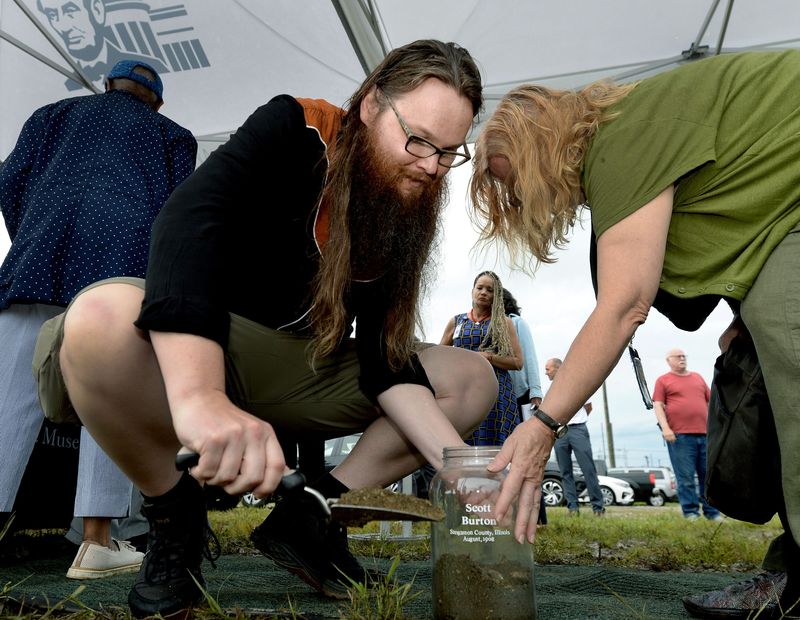
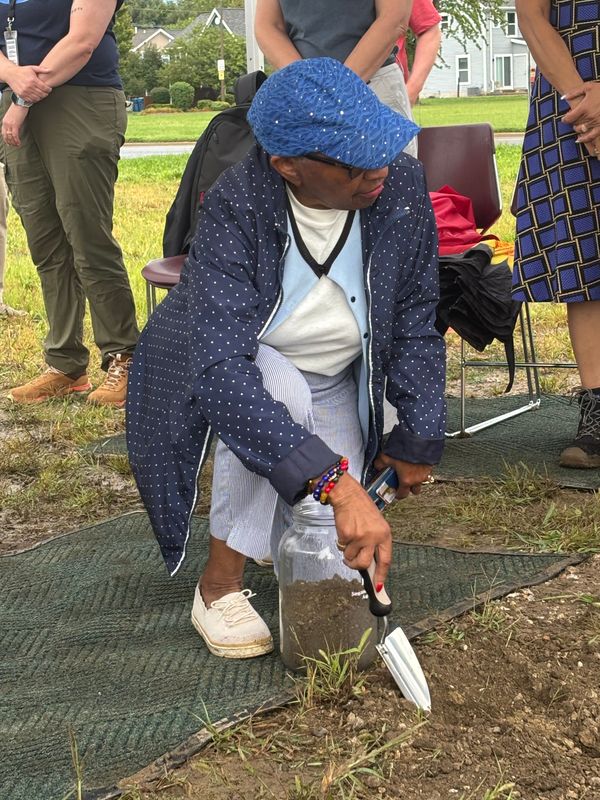
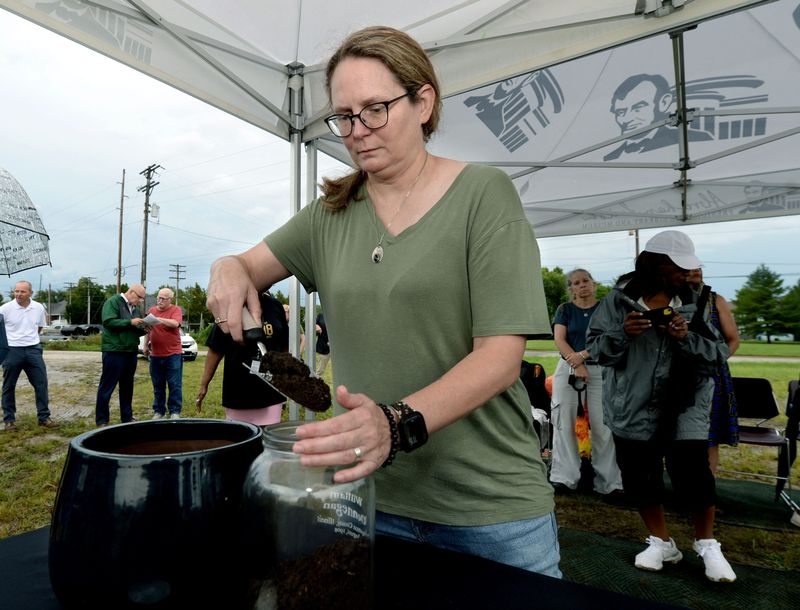
SPRINGFIELD, IL – Kathryn Harris admitted it was an emotional moment for her, scooping soil and putting it into a 5-gallon jar labeled “Scott Burton, Sangamon County, Illinois, August, 1908.”
Burton and William Donnegan were both Black men lynched by white mobs during the Springfield 1908 Race Riot.

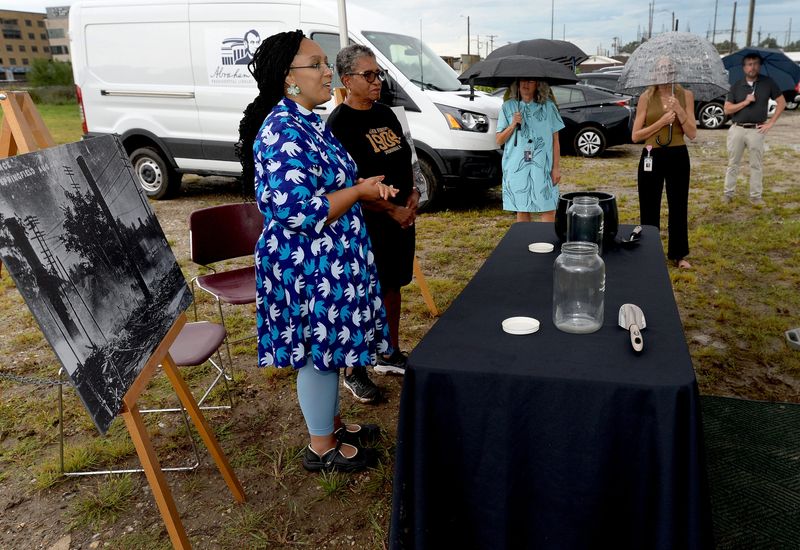
The added drama was that the Aug. 14 soil commemoration ceremony was near the very spot–11th and Madison streets–where Burton was lynched.
“Who would have thought that in Mr. Lincoln’s hometown especially, plus being in the North, that something like (the race riot) could happen?” Harris said afterwards. “But hate is everywhere and (the lynching) was a demonstration of it.”
The event was coordinated by the Abraham Lincoln Presidential Library and Museum (ALPLM), which will display the jars through January as part of a special exhibit, “The Second American Revolution.”
The jars then will go to the Equal Justice Initiative Legacy Museum in Montgomery, Alabama, which has collected about 800 soil samples from lynching sites across the U.S.
The ceremony was part of “Three Hot Days in August,” a series of events Aug. 13-16 that commemorates the riot.
In addition to the soil ceremony, the weekend included a visit to Springfield by Preston Jackson, who sculpture, “Acts of Intolerance,” sits in Union Square Park downtown, and the staging of Tim Crawford’s original play on the race riot, “Outraged.”
Two years ago, President Joe Biden, through the Antiquities Act, designated the area along Springfield’s 10th Street railroad tracks the Springfield Race Riot National Monument.
The monument takes in the remains of five homes destroyed during the riot. Those structures were unearthed during research related to railroad work in the area done in 2014.
The riot began as thousands of people descended on the county jail where two Black men, Joe James and George Richardson, were being held in the county jail.
James was accused of murdering Clergy Ballard, a white man, and attempting to rape his daughter, Blanche, in a home invasion. Richardson was accused of raping Mabel Hallam, a white woman.
The situation was heightened when the mob learned that James and Richardson had been escorted out of town to Bloomington.
Burton was lynched trying to defend his barbershop from the rioters. Donnegan, who was at least 80 years old, was probably targeted at his home at Spring and Edwards streets because of his wealth and because he was married to a white woman.
Both Burton and Donnegan have ancestors who live in Springfield.
The violence in Springfield–stories vary, but it is believed 11 died in all–led to the founding of the NAACP.
Harris, The State Journal-Register First Citizen Award winner in 2020 who worked for both the Illinois State Historical Library and ALPLM, noted that 11th Street carries the honorary name of Reconciliation Way, “but we still have a lot of reconciliation to do because we still have not addressed it.
“W.E.B. DuBois said, ‘The problem of the 20th century is the problem of the color line.’ And it’s still the problem of the 21st century, because we haven’t dealt with it and until we do, we aren’t going to move forward. There’s always going to be something that isn’t quite right, with history trying to be erased, museums being challenged by stories that they’re telling, stories that are true.
“Just because you don’t like it don’t mean it didn’t happen and you can make it go bye-bye.”
While Illinois history is full of moments to celebrate, said ALPLM Executive Director Christina Shutt, “there are also moments to mourn. We must remember Burton, Donnegan and the violence of 1908 so we understand the hard work required to build a nation of justice,”
“Keeping our history before us is important for all generations,” said Candice Trees, vice chair of the Illinois State Museum Society Board. “Knowing our past will help us navigate our future so we can live together peacefully.”
Harris said the gathering of the soil was a small step towards reconciliation, “but the longest journey begins with the first step.”
Contact Steven Spearie: 217-622-1788; sspearie@sj-r.com; X, twitter.com/@StevenSpearie.
This article originally appeared on State Journal-Register: Earth moving: Soil commemoration ceremony honors 1908 lynching victims
Reporting by Steven Spearie, Springfield State Journal-Register / State Journal-Register
USA TODAY Network via Reuters Connect
By Steven Spearie, Springfield State Journal-Register | USA TODAY Network