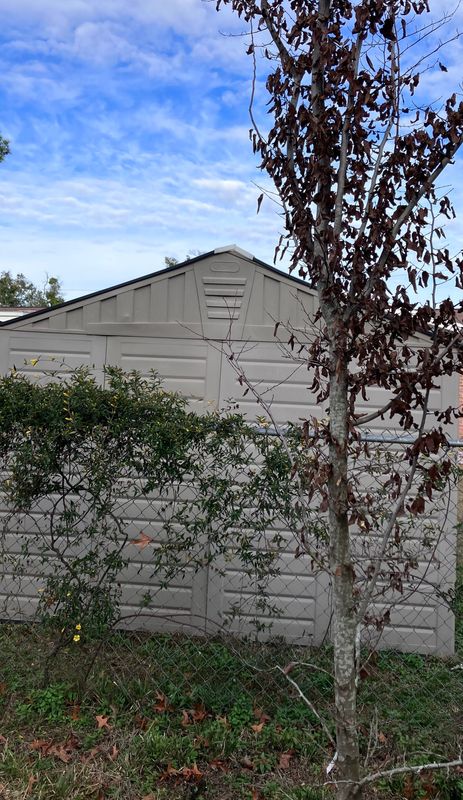
Surprise! Florida can have freezing temperatures. A lot of people new to Florida Gardening want a tropical-looking landscape and even assume everything is evergreen. I knew someone who cut down a beautiful mature Japanese magnolia and fringe tree because they had “died” and lost their leaves. They didn’t know Florida has deciduous trees. North Florida has seasons with deciduous plants and herbaceous plants. They are not dead but dormant, sleeping through the cold winter. Some other plants will also go dormant to survive drought or because they evolved with a resting period.
Don’t assume your brown, bare garden will need to be completely replaced. You probably saw the “laundry” draped over plants in yards. A lot of people will use old sheets and blankets to protect tropical plants. You can also buy frost blankets. They should be draped to the ground to trap radiating soil heat. Do not prune dead plant material yet. Wait to prune until mid-March when the chance for frost or freezes is over. Early spring growth and flowers could still be caught by another cold spell. Don’t be caught by freeze and frost surprises, follow local weather reports: set your phone for local weather, watch local news and weather on TV or subscribe to the local paper, there’s a page with weather forecast, tides, etc. There is also a big difference if a hard freeze is predicted. Pay attention.

Now for some specifics. Fruit trees may not fruit this year if their early flowers were frozen. Those dead leaves clinging to dead stems and mushy mounds of foliage on the ground are actually protecting growth buds. Don’t remove them yet, wait until you see spring growth. Dead wood is brittle and not flexible when it’s bent. Also, if you scrape the bark of a small branch with your thumb nail, there should be a green layer showing it’s still alive. Many of the tropical shrubs will sprout from lower unfrozen limbs or from their roots, so be patient. Tropical plants can act like northern herbaceous plants and sprout from their roots or bulbs. Those dead leaves in the center of a tropical bulb are protecting the heart from water freezing there.
Some specific plants merit a mention. Walter’s viburnum, Viburnum obovatum, is semi-deciduous in north Florida and will sprout more leaves and flower in the spring. Firespike, Odontonema cuspidatum and Firebush, Hamelia patens, are tropical and will freeze back to the lower stems or root. Bananas need about 18 months of non-freezing temperatures to produce fruit. Wait to see if the trunk grows new leaves after a freeze. Hard freezes, below 28 degrees for several hours, can kill bananas to the ground, but the rhizome can resprout. A machete works better than a saw to remove a frozen banana pseudostem trunk. Citrus vary in their freeze tolerance, with limes, lemons and grapefruit and young trees being most susceptible. Citrus fruit gets sweeter in cool weather, but hard freezes can kill them to the sour thorny rootstock. You need to protect the graft union and some of the desirable variety scion wood above the graft when a hard freeze is predicted. Traditionally that was done with dry sand mounded up around the trunk. My citrus trees are too big to cover, so I either use pipe insulation or wraps to protect the trunk’s graft and desired scion. There’s lots more information on plants and freezing in Florida on the University of Florida’s IFAS website at https://ffl.ifas.ufl.edu/.
If protecting tropical plants from freezes sounds like too much trouble, you can embrace north Florida’s subtle seasons with native plants or hardy evergreens. The University of Florida IFAS website will give native plant status and appropriate zone. North Florida is zone 9, and zone 8 dips down in the panhandle. The Florida Native Plant Society also has information on native plants at https://www.fnps.org/plant. Enjoy Florida’s brief winter season, summer’s long season will be here soon enough.
Brenda Daly is a Master Gardener volunteer with the Duval County Extension Service and the University of Florida/IFAS. For gardening questions, call the Duval County Extension Office at (904) 255-7450 from 9 a.m. to noon and 12:30 to 3:30 p.m. Monday-Friday and ask for a Master Gardener volunteer.
This article originally appeared on Florida Times-Union: Yes, Florida gets cold. Here’s what it means for your garden
Reporting by Brenda Daly, For the Jacksonville Florida Times-Union USA TODAY NETWORK / Florida Times-Union
USA TODAY Network via Reuters Connect