You won’t need special glasses to see the lunar eclipse coming to Florida and North America next week.
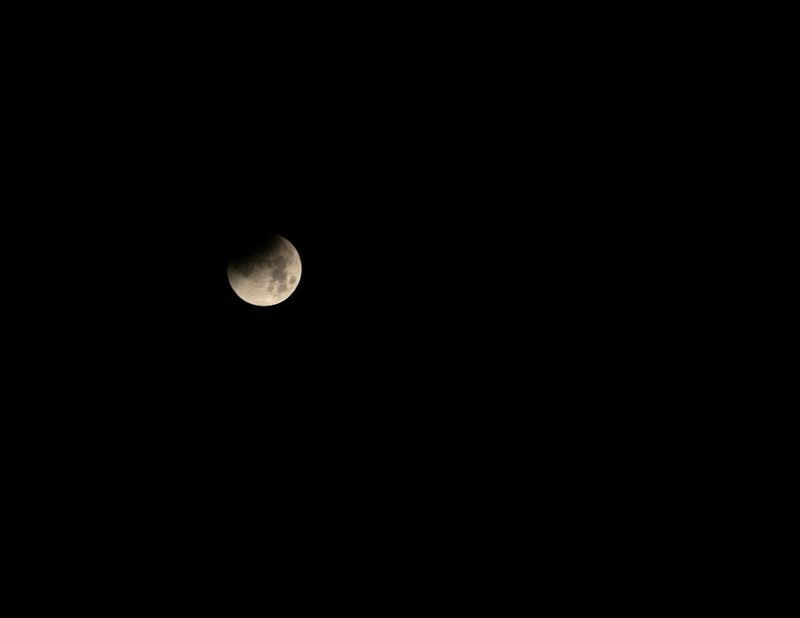
While Florida residents won’t see a total lunar eclipse, the Earth’s shadow — known as the umbra — will cover almost 94% of the moon.

You’ll have to stay up late if you want to see the peak of the eclipse, which will happen shortly after midnight, but most people should be able to see the start of the eclipse earlier in the evening.
Astronomy products for beginners on Amazon
Of course, the best viewing will be away from lights and with no clouds.
The view should be spectacular; the lunar eclipse coincides with the next full moon — known as the Sturgeon Moon — on Aug. 28.
Here’s what you should know.
Partial lunar eclipse coming Aug. 27-28, 2026
A partial lunar eclipse will occur Aug. 27-28, 2026, and will be visible from Florida.
Lunar eclipse 2026 viewing times. When you should head outside
Times will vary by location, but in Florida, here is what to expect in Miami, according to timeanddate.com. All times are ET.
Will the Sturgeon Moon lunar eclipse be visible in Florida?
It will be visible in Florida, although residents along the east coast may miss some of it since the moon may be too low on the horizon.
Florida residents can expect to see about 93% of the moon in the Earth’s shadow, according to timeanddate.com.
➤ See view and timing from where you live
The eclipse will be visible across Europe, Africa, the Americas and parts of western Asia, though exactly what you’ll see depends on your location, according to space.com.
What is a lunar eclipse?
A lunar eclipse happens when the Earth passes between the Sun and the Moon, creating a shadow across the lunar surface.
During a partial lunar eclipse, the sun, Earth and moon aren’t lined up exactly. So the “moon passes through only part of Earth’s umbra. The shadow grows and then recedes without ever entirely covering the moon,” according to NASA.
How much of the moon will be covered during August eclipse?
“At maximum eclipse, about 93% of the moon’s diameter will be inside Earth’s dark central shadow, called the umbra,” according to NASA.
“The moon will not be completely covered, but it can look dramatically darkened, with a rusty, coppery tint along the covered edge.”
“At maximum eclipse, only a thin sliver of the moon will remain outside Earth’s darkest shadow, creating an ‘almost blood moon’ with nearly the entire lunar surface glowing a deep reddish-orange,” according to space.com.
“Because 96% of the moon (for some viewers) will pass through Earth’s central dark shadow, known as the umbra, this eclipse is expected to look remarkably similar to a total lunar eclipse or a ‘blood moon’ lunar eclipse.”
Will we see a ‘blood moon’? Why does moon appear red?
“When the Earth is positioned precisely between the moon and sun, the Earth’s shadow falls upon the surface of the moon, dimming it and sometimes turning the lunar surface a striking red over the course of a few hours.
“During a lunar eclipse, the moon appears red or orange because any sunlight that’s not blocked by our planet is filtered through a thick slice of Earth’s atmosphere on its way to the lunar surface. It’s as if all the world’s sunrises and sunsets are projected onto the moon,” NASA said.
The August partial lunar eclipse won’t be a “true blood moon” because at no point will there be lunar totality — when the entire lunar surface falls under Earth’s shadow, according to space.com.
Solar, lunar eclipses come in pairs
Solar and lunar eclipses come in pairs, and there are typically “two eclipse seasons” each calendar year, according to space.com.
A total solar eclipse took place Aug. 12, with the path of totality over Greenland, Iceland, and northern Russia.
What is an eclipse season? It only happens during syzygy
“An eclipse season is a period of 31 to 37 days, during which eclipses become possible,” said space.com.
“These seasons occur about every 173 days, or roughly twice per year — and every solar eclipse and every lunar eclipse you’ve ever heard about has taken place within one. Outside these windows, eclipses cannot occur.
“Eclipses can only happen at new moon (solar eclipse) and full moon (lunar eclipse), when the Earth, moon and sun line up in space — an alignment astronomers call syzygy.”
When are 2026 eclipse seasons?
The first eclipse season happened in early 2026:
The second eclipse season is taking place now:
August lunar eclipse will be the best one on Earth until New Year’s Eve 2028
The partial lunar eclipse happening Aug. 27-28, 2026, will be “the best lunar eclipse anywhere on Earth until New Year’s Eve 2028,” according to space.com.
A total lunar eclipse will occur on Dec. 31, 2028, rolling over into Jan. 1, 2029. Unfortunately for Florida residents, it won’t be visible.
But if you want to ring in the new year in Hawaii, at least part of the total eclipse will be visible in Honolulu.
Cheryl McCloud is a journalist for the USA TODAY Network-Florida’s service journalism Connect team. You can get all of Florida’s best content directly in your inbox each weekday day by signing up for the free newsletter, Florida TODAY, at https://floridatoday.com/newsletters.
This article originally appeared on Florida Today: Will I be able to watch August lunar eclipse in Florida?
Our editors independently choose our recommendations. Some content is produced with paid support from a third party, however our editorial decisions remain independent. If you buy through our links, the USA TODAY Network may earn a commission. Prices and availability may change.
Reporting by Cheryl McCloud, USA TODAY NETWORK – Florida / Florida Today
USA TODAY Network via Reuters Connect
By Cheryl McCloud, USA TODAY NETWORK – Florida | USA TODAY Network