Events are planned nationwide for America 250, which commemorates the signing of the Declaration of Independence on July 4, 1776. USA Today, the parent company of the Naples Daily News and The News-Press, has extensive coverage with its series USA 250, including stories online now and more to come this year.
The steamer was off Captiva Island so she decided to try meeting one of the most famous people in America.

Margaret Mickle heard former President Theodore Roosevelt was aboard the boat in Gulf waters so she rowed out to him.
“I came to see Teddy Roosevelt,” Mickle told a guard on the steamer’s gangway, The News-Press reported in April 1917, “and I’m just going to see him and that’s all there is about it.”
Roosevelt appeared in a cabin door, approached the Captiva woman and greeted her cheerfully, telling her he liked to be called “Teddy.” The larger-than-life Roosevelt then snapped a photo of Mickle then took one of them together.
Scenic views and superb fishing were just a few reasons why Roosevelt enjoyed visiting Southwest Florida. He fell in love with the island beauty and creatures, the kind of place Roosevelt for years worked to preserve.
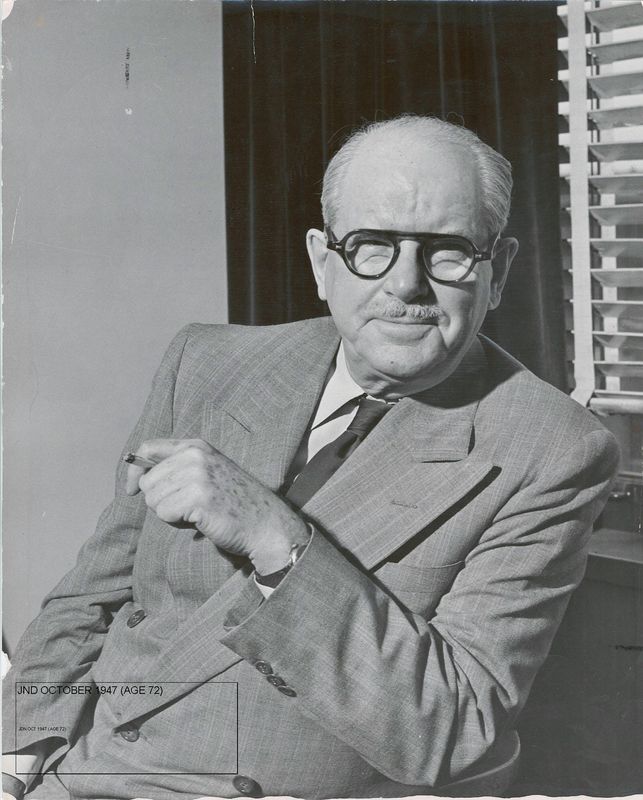
Many took note of that passion, including a newspaper editorial cartoonist Jay Norwood, who struck a friendship with Roosevelt and whose name forever is connected to Southwest Florida.
Roosevelt enjoyed life of adventure
Roosevelt began traveling with his family as a child and that wanderlust never left him.
The future 26th president headed west to Dakota Territory after the simultaneous deaths of his mother and wife in 1884.
Before, during and after his presidency Roosevelt explored the globe including the “River of Doubt” trip to the Amazon in South America in 1913-14 that nearly killed him.
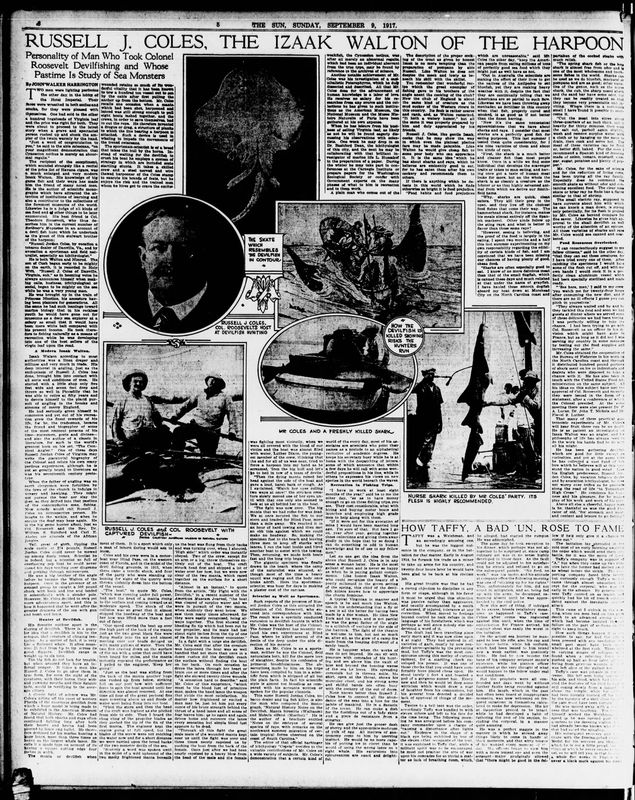
Roosevelt eventually landed in Southwest Florida in 1917 and wrote about his reason why in an issue of Scribner’s Magazine later that year. Killing devilfish or devil rays “with the harpoon and the lance had always appealed to me as a fascinating sport,” Roosevelt said in the story.
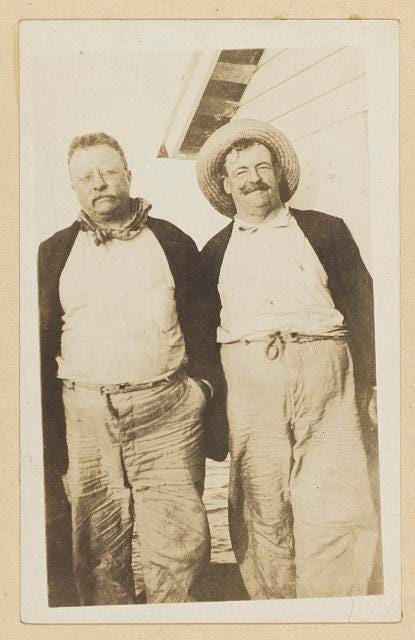
Roosevelt fell in love with Southwest Florida, writing in Scribner’s that he read about Russell J. Coles, a sportsman, naturalist and Virginia tobacco trader.
A photo captures the pair fishing, side by side, tilting slightly to the left.
“It looks like a couple of guys who didn’t care what they looked like on the beach,” said Joe Wiegand, who travels the country impersonating Roosevelt.
In Scribner’s, Roosevelt wrote how Coles was “a man who, in addition to being a successful hunter of the big game of the sea, was also engrossed in their study from the standpoint of the biologist.”
“I entered into correspondence with him,” Roosevelt wrote.
“The result was an invitation to me to come down the following spring for a month’s work with the harpoon and the lance off the coast of southwestern Florida.”
Friendship formed over conservation
Norwood was better known and created cartoons under the name Ding Darling. While the two became friends, Darling and Roosevelt never were together on Sanibel and Captiva.
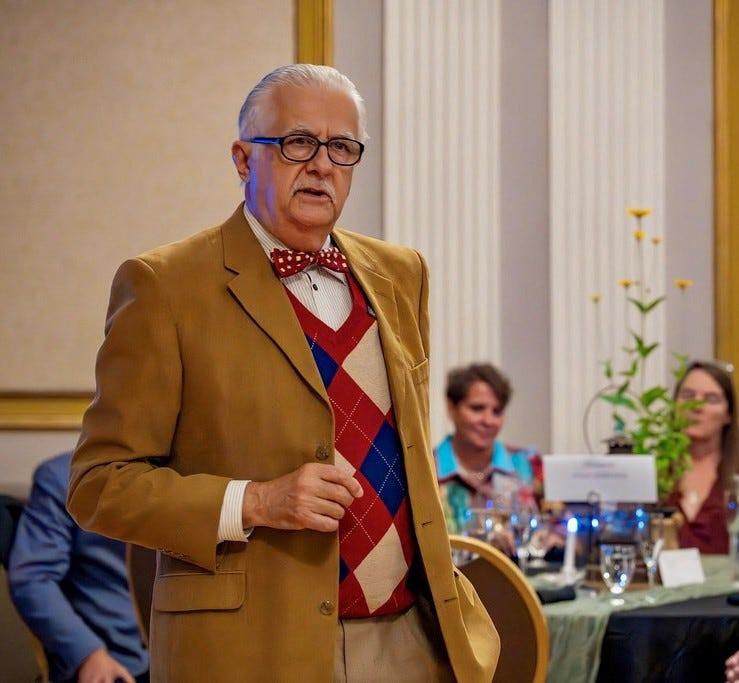
“It was a very rough secluded area both there and Captiva and that is what drew him to the remote area,” said Tom Milligan, who performs across the U.S. as Darling, of Roosevelt, in an email.
Darling first was on Sanibel 1936-1937 as part of a car trip with his wife and another couple from Des Moines, Iowa. That trip is chronicled in a book Darling wrote called “The Cruise of the Bouncing Betsy: A Trailer Travelogue,” in 1937, Milligan said.
“The book was not much of a success but it’s a good intro to what finally pulled him to the island as a second vacation home in what became known as The Fish House on stilts in the water,” Milligan said of Darling, referring to the cartoonist and conservationist’s Captiva vacation home built in 1942 on the water along Roosevelt Channel.
Roosevelt and Darling met several times, Milligan said, including horseback riding on Oyster Bay where Roosevelt lived in New York.
Darling also spent two years working in New York at the Herald Tribune newspaper, and they visited several times in Roosevelt’s office, Milligan said.
“Darling became very admiring of Roosevelt and his shared feelings about conservation at a very early age and that remained a guiding light for him throughout all of his life-long work,” Milligan said.
Both Teddy and Franklin Delano Roosevelt, the 32nd president and Teddy’s fifth cousin, appeared in some of Darling’s 15,000 political cartoons, Milligan said.
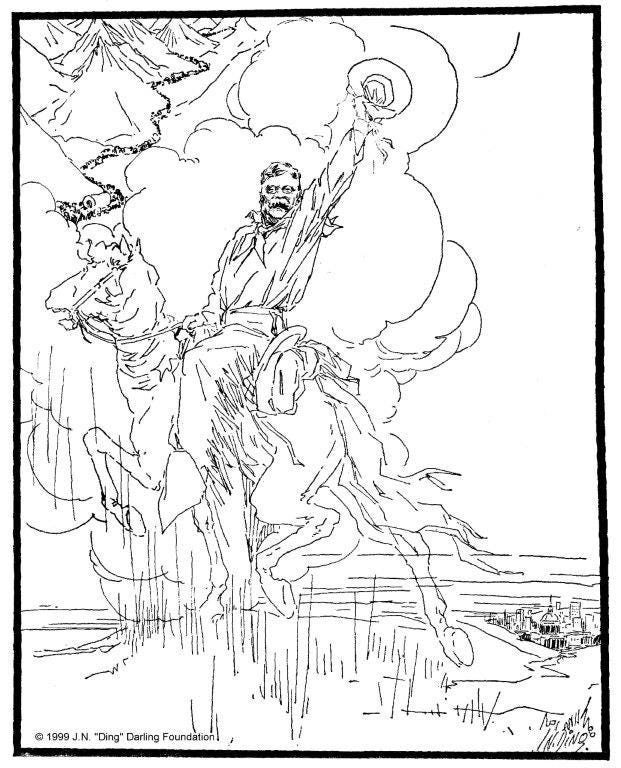
Darling’s most famous cartoon is the one he made after Roosevelt died in January 1919. Called “The Long, Long Trail,” it shows Roosevelt waving his hat atop a horse and ran in newspapers across the U.S.
Sea fishing trip a national story
Just days after Roosevelt and his fishing crew launched from Blind Pass and harpooned manta rays off Captiva. Roosevelt summed up the trip in the Scribner’s story.
“From the western side of Captiva Island the sunsets were wonderful, across the Mexican Gulf,” Roosevelt wrote.
“There was a growing moon and the nights were very lovely. The soft, warm water lapped against the side of the boat, while the soft, warm night air was radiant in the moonlight. It was a thoroughly enjoyable trip.”
The adventure didn’t take long for newspapers to run the story nationally.
“Col. Theodore Roosevelt has been having his usual luck on his trip to Florida and the Gulf in search of devilfish,” the New York Herald reported April 1, 1917, “for the news dispatches last week told of his success in harpooning these marine monsters.”
And a newspaper in Vancouver, Washington, reported April 5, 1917: “Roosevelt hunting devilfish will work himself up to the point where he will be eager to tackle a submarine. The worst enemy of the Colonel will not impugn his courage.”
While Roosevelt enjoyed hunting, he also focused on the scientific part of creatures as a lifelong naturalist who wanted to preserve nature.
In 1908, Roosevelt signed an executive order establishing the Pine Island National Wildlife Refuge in Lee County and a month later the Island Bay Wildlife Refuge in Charlotte County. Both were originally created to protect wading birds and brown pelicans.
The Pine Island refuge years later would become administrated by the J.N. “Ding” Darling National Wildlife Refuge, established in 1945 with Darling’s name added to it in 1967.
SWFL venture among Roosevelt’s top post-presidency trips
Like Milligan, Wiegand travels the country as a historical impersonator, even performing as Theodore Roosevelt in fall 2008 at the White House after then-first lady Laura Bush invited him to celebrate Roosevelt’s 150th birthday.
The two also are scheduled to speak in October at the Ding Darling refuge. Wiegand, who talked there last year, said he began portraying the former president after his sister-in-law gave him a book 25 years ago titled “The Rise of Theodore Roosevelt” by Edmund Morris that won the Pulitzer Prize for Biography or Autobiography.
“He’s certainly Mount Rushomore-worthy in the sense that he changed the country and he changed the nation,” Wiegand said.
The Theodore Roosevelt Presidential Library even named Teddy’s 1917 Southwest Florida visit in its top five of his post-presidential adventures. The visit left a permanent mark on Southwest Florida; there’s Roosevelt Channel between Captiva and Buck Key along Roosevelt Place, a street on Sanibel.
“There’s really nothing after Captiva,” Wiegand said of Roosevelt’s wildlife adventures. “Captiva should be seen as a capstone of his life.”
‘The president saved me’
In later years, Mickle would tell the tale of how she met Roosevelt off Captiva in 1917.
Born in a small house off McGregor Boulevard at the turn of the 20th century, Mickle recalled what life was like when she was a child in a 1992 News-Press story.
“Fort Myers was nothing more than a little ‘ole fishing village,” she said in the story, interviewed when she was 90 years old.
“We moved to Captiva when I was 8 or 9. There was just a few houses and a hotel. I’d raise tomatoes and sell ’em to the yankees. Met old Teddy Roosevelt on his boat anchored near Captiva.”
She shared details of the encounter as a teen, how a friend sent a camera with her begging for a photo of Roosevelt.
“I talked a boy into paddling me out to the boat and, on the way, our boat sank,” she recalled in 1992. “He swam back to shore, but I just stuck my hand with the camera up in the air and kept going. I got near the boat and started yelling, ‘Teddy!’ “
She said she heard Roosevelt say, ” ‘Anybody that calls me Teddy can come aboard my boat.’ I got on his boat and ate dinner with Roosevelt and Dr. Russell Coles,” Mickle said, grinning, reported the News-Press, where she went on to work as a reporter for more than two decades.
“I stayed for dinner and then they took me home. The president saved me from getting a whipping ’cause nobody knew where I’d been. Got several pictures for my friend, too.”
Dave Osborn is the regional features editor of the Naples Daily News and The News-Press. Contact him at dosborn@usatodayco.com and follow him on Instagram @lacrossewriter.
This article originally appeared on Fort Myers News-Press: Teddy Roosevelt made splash at Captiva, Sanibel for final adventure
Reporting by Dave Osborn, Fort Myers News-Press & Naples Daily News / Fort Myers News-Press
USA TODAY Network via Reuters Connect
By Dave Osborn, Fort Myers News-Press & Naples Daily News | USA TODAY Network