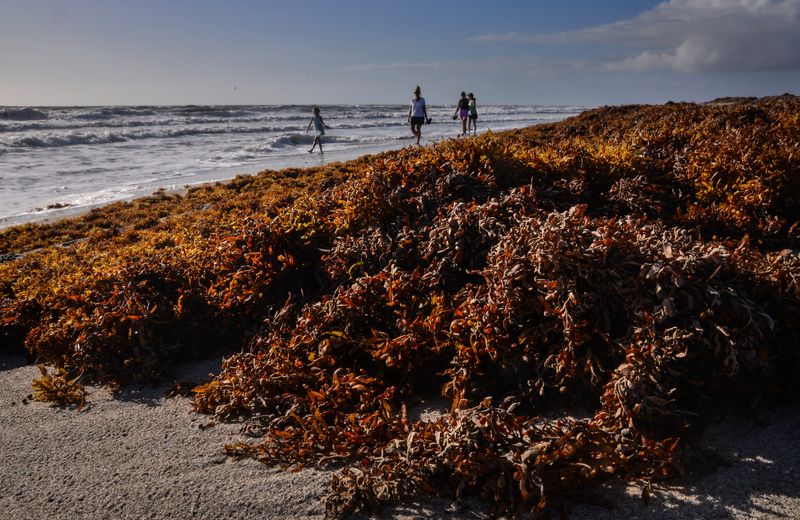
There’s only one word a beachgoer would use to describe sargassum seaweed: Bleah!
Raise your hand if you saw a big blob of sargassum seaweed on the beach and avoided it by stepping on hot pointy shells rather than set foot on the springy, crunchy, brown clusters of seaweed.

Should the sargassum seaweed stop you from a beach visit? Definitely not. Florida beaches are still postcard-worthy when it comes to natural wonders, despite the dry brown crusty blob.
Beneficial for the Atlantic but irritating to many who set foot on the beach or hop in the water – sargassum is set to pile up across Florida’s beaches again this summer.
The Southeast coast and the Florida Keys are usually most heavily impacted by clumps of sargassum washing ashore, and the stenchy seaweed has already cropped up in places like Cocoa Beach and Miami Beach.
Around this time last year, the amount of sargassum in the Atlantic set a new all-time record for the month of April, with clumps washing ashore on beaches throughout the region. For 2026, it’s set to be another “major sargassum year,” meaning the amount exceeds 75% of the historical values, according to a March bulletin by the University of South Florida. The report adds, it’s likely to be a “record year” by the summer.
The Florida Fish and Wildlife Conservation Commission and the Florida Department of Environmental Protection are currently monitoring a large sargassum bloom.
What is sargassum, and is it harmful?
Sargassum includes pelagic species of brown seaweed that have their origin offshore in the Atlantic Ocean and float on its surface, according to the FWC.
A floating mass of sargassum can provide habitat for an array of marine life, according to the National Institutes of Health or nih.gov. Sargassum is a species of large brown seaweed, a type of macroalgae that floats in large masses. On some beaches in Florida, the “blobs” of crunchy, dry, brown stinky seaweed are fairly large.
It’s a vital marine resource, and provides habitats for animals like shrimp, crabs, sea turtle and fish. Species like mahi mahi, jacks and amberjacks also use it as a primary nursery area.
Rotting sargassum, however, causes the production of hydrogen sulfide gas, which smells like rotten eggs. It can irritate the eyes, nose and throat.
Can you touch sargassum at the beach in Florida?
While sargassum is generally safe to touch, it can play host to small organisms that can sting you, so it’s best to try and avoid swimming near it.
How bad can sargassum get in Florida? What does the seaweed blob look like?
Is it sargassum seaweed or sargassum?
According to the National Oceanic and Atmospheric Administration (NOAA), “Sargassum is a genus of large brown seaweed (a type of algae) that floats in island-like masses and never attaches to the seafloor.”
While it is a type of seaweed, it’s typically referred to as “sargassum” and not “sargassum seaweed.” Calling it “sargassum seaweed,” though common, would be like saying “spaghetti pasta” − it’s spaghetti or pasta. Similar to the age-old debate of “is it daylight saving time,” “Daylight-Savings Time” or “daylight savings?” (It’s daylight saving time, no S, no capitalization and no hyphen.)
Environmental sites call the brown stinky crunchy seaweed sargassum, just sargassum. However, there are multiple searches and search results for “sargassum seaweed.”
Sangalang is a lead digital producer for USA TODAY Network. Follow her on Twitter or Instagram at @byjensangalang. Support local journalism. Subscribe to the free Florida TODAY newsletter.
Sarah Perkel is a South Florida Connect Reporter for the USA TODAY Network’s Florida Connect team. You can get all of Florida’s best content directly in your inbox each weekday day by signing up for Florida TODAY.
This article originally appeared on Florida Today: Summer is coming, and so is brown seaweed season in Florida. About sargassum
Reporting by Jennifer Sangalang and Sarah Perkel, USA TODAY NETWORK – Florida / Florida Today
USA TODAY Network via Reuters Connect