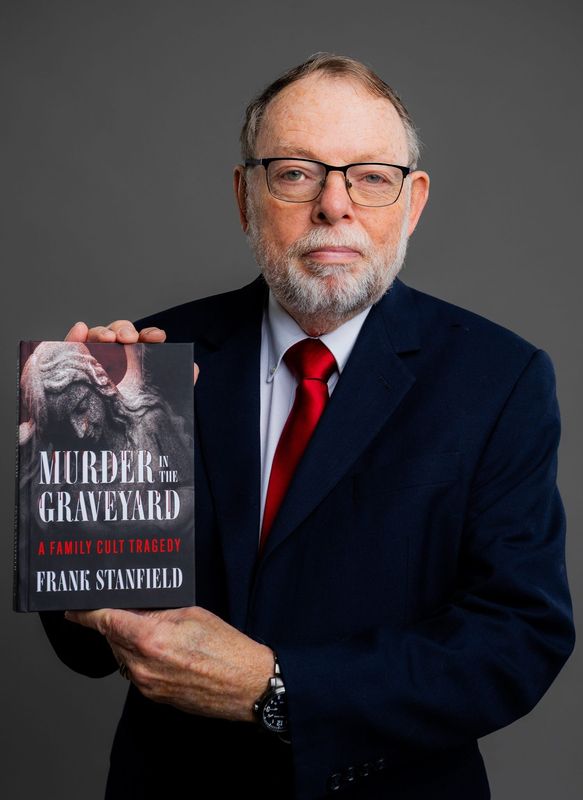
Frank Stanfield’s latest book, “Murder in the Graveyard: A Family Cult Tragedy,” explores the complex intersection of crime, psychology and local history, drawing on insights gained from a prolific journalistic career that included writing and editing for the Daily Commercial.
Published by WildBlue Press, the book is now widely available in multiple formats, including hardcover, paperback and digital editions.

Its narrative is shaped by the grit and experience forged in an era of journalism when shoe‑leather reporting was the only way to get at the truth.
Stanfield’s Amazon Author Page serves as a digital archive for a writer who has truly seen it all.
A storied career
For more than five decades, Stanfield worked the crime beat behind some of Central Florida’s most harrowing headlines. From the newsrooms of the Daily Commercial to the Orlando Sentinel, he documented the region’s evolution — not only through growth and politics, but through the darker undercurrents of its crime lore.
Susan Smiley-Height, a lead editor and writer with the Ocala Gazette weekly newspaper, worked with Stanfield when she served as local news editor at the Ocala‑Star Banner.
“He was our night editor, which meant he juggled numerous reporters filing on deadline, breaking news and final approval of page proofs at a late hour,” she recalled in an email.
“All of that required diligence, patience and attention to detail. A good writer needs all of those, plus the ability not only to ‘smell’ a good story but also to do due diligence, dig, research, probe, prove and more. Frank brings all of that to the table (keyboard).”
Stanfield has shifted to writing books over the past two decades, including Unbroken: The Dorothy Lewis Story (2011), a true story that spotlighted Dorothy Lewis’s strength and faith after a harrowing carjacking by two teenagers. Cold Blooded: A True Crime Story of a Murderous Teenage Vampire Cult (2014), and Vampires, Gators, and Wackos: A Florida Newspaperman’s Life (2021), have already established him as a premier voice in Florida true crime, blending investigative rigor with a dry newsroom-honed wit.
Over the past two decades, Stanfield has shifted his focus to writing books. Those include “Unbroken: The Dorothy Lewis Story” (2011), which spotlighted Lewis’ strength and faith after a harrowing carjacking by two teenagers; “Cold Blooded: A True Crime Story of a Murderous Teenage Vampire Cult” (2014); and “Vampires, Gators, and Wackos: A Florida Newspaperman’s Life” (2021). Together, these works established Stanfield as a leading voice in Florida true crime, blending investigative rigor with a dry, newsroom‑honed wit.
In “Murder in the Graveyard,” Stanfield revisits a case that stunned the community of Eustis and beyond, taking readers inside a family’s unusual dynamics and the traumas that led to the March 18, 2019, murder of Sue Ellen Anselmo.
It began with a 911 call from Greenwood Cemetery
The narrative begins with a harrowing 911 call from Ian Anselmo, who confessed to strangling his pregnant stepmother, Sue Ellen Anselmo, while sitting in a car inside Greenwood Cemetery.
Through Stanfield’s account, “Murder in the Graveyard” is more than a simple crime report; it is an exploration of a “family cult” stained by allegations of total patriarchal control and brainwashing and a complicated insanity defense that pitted top psychiatric experts against one another.
A bone-chilling coincidence: The eerie backdrop of the graveyard that had already seen a horrific crime story documented by Stanfield, the murderous vampire cult initiation two decades before.
A natural-born storyteller
Stanfield’s career and family life in Leesburg sprang from a childhood in the Midwest, where he grew up among relatives who spun both gripping and humorous yarns.
His latest book exemplifies his evolution as a true crime writer. “Murder in the Graveyard” resonates at another level beyond the details of the case. Stanfield’s informed perspective, faith and wisdom lead him to conscientiously dance the line between journalistic detachment and compassion, telling the victim’s story as well as the perpetrators’, highlighting the circumstances preceding Sue Ellen Anselmo’s death and, perhaps, most poignantly, the aftermath endured by their loved ones.
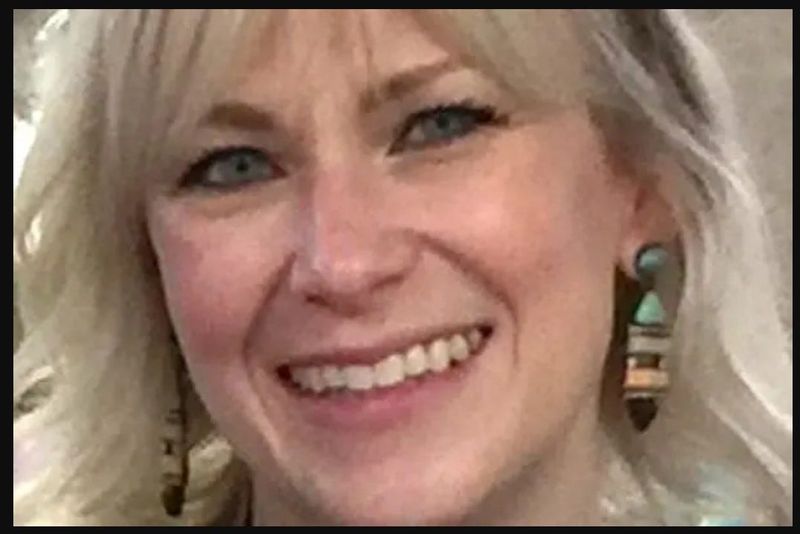
Stanfield depicts Sue Ellen as a caring, hard-working woman who was “isolated” within a deeply dysfunctional cult-like household.
Five children were born to John and Sue Ellen Anselmo, all aged 10 or younger at the time, including a son with Down syndrome. Three children were from John Anselmo’s previous marriage, including the eldest son, Ian, and his siblings Eric and Nico. Dejah-Thoris Waite (formerly Chloe), Sue Ellen’s biological child, was born from a previous marriage and later adopted by John.
Sue Ellen was the product of a deeply Christian upbringing. “Cindy Miller, Sue Ellen’s mother, gave a victim impact statement in the court, and that was very, very powerful,” Stanfield told the Daily Commercial, recollecting Ian Anselmo’s murder trial.
“To be able to stand up and say, ‘I forgive him’ after what he did to her daughter, as a Christian, what a testimony. And then she basically urges everybody in the courtroom to turn their lives over to Jesus. I was like, ‘Wow, what a statement.’ Because a lot of people would just want to pinch his (Ian Anselmo’s) head off, you know?”
Though necessarily objective, Stanfield is not bulletproof to the tragic quagmires he investigates. A man with a quiet fortitude, his voice trembles when we discuss victim shaming.
It’s what upsets him most about the murder story that started in a graveyard.
Exposing victim shaming
Based on his reporting and interviews. In “Murder in the Graveyard,” Stanfield provides witness accounts portraying the Anselmo family patriarch, John Anselmo, as using psychological manipulation to discredit Sue Ellen.
The book includes excerpts from family letters, such as one from Sue Ellen’s daughter, Dejah, who writes: “You are not crazy, and you don’t deserve to be told you are because you get mad or fight back when you are provoked.”
Stanfield shows that labeling Sue Ellen as “crazy” was a deliberate tactic to justify the abuse she endured.
“He showed up with this big thick notebook of stuff that he said proves that Sue Ellen was crazy and all this kind of stuff,” Stanfield recalled.
“I never liked blaming the victim. I never liked it. For one thing, she’s not available to defend herself, you know? And then when I checked with Dejah and with Eric, they refuted his take on it. … I’d always try to talk to the other side in fairness and also to get some perspective on whatever’s going on, the big picture.”
During the trial of Ian Anselmo (Sue Ellen’s stepson), the defense focused heavily on the “crazy” atmosphere of the home and Ian’s mental health challenges. In his book, Stanfield shows how the narrative can inadvertently shift the focus away from the victim’s suffering and onto the “instability” of the household, often minimizing the victim’s reality. He exposes the rule that “you cannot tell anybody what happens outside this family.” By breaking this code through his investigative writing, Stanfield validates the victims who were shamed into silencing alleged sexual assault and domestic violence.
An incomplete outcome?
Through “expert” testimony, Stanfield scopes out what he describes as the “soft science” of the trial’s psychological experts, pointing out how conflicting testimony often muddies the waters of accountability, burying the victim’s perspective under clinical jargon.
Despite the testimonies, Ian Anselmo was sentenced to life in prison on October 18, 2024, for the 2019 murder of his pregnant stepmother. Circuit Judge Brian Welke imposed the maximum possible sentence. Anselmo was convicted of second-degree murder and killing an unborn child by injury to the mother. In addition to the life sentence for murder, he received a 30-year concurrent sentence for the death of the unborn baby.
His father, John Anselmo, has not been convicted of any crimes related to the case.
Poring over the case, you can’t help but wonder, how does Stanfield keep his faith through such harrowing investigations?
“God’s been good to me, really good to me,” Stanfield shared. “I just want to tell the truth. If you just tell the truth and do the right thing, it works out.”
In addition to Amazon, Frank Stanfield’s Murder in the Graveyard: A Family Cult Tragedy, along with other Stanfield books, is available in various formats, including hardcover, paperback, and digital editions.
This article originally appeared on Daily Commercial: Stanfield brings journalistic truth-telling to ‘Murder in the Graveyard’
Reporting by Julie Garisto, Leesburg Daily Commercial / Daily Commercial
USA TODAY Network via Reuters Connect