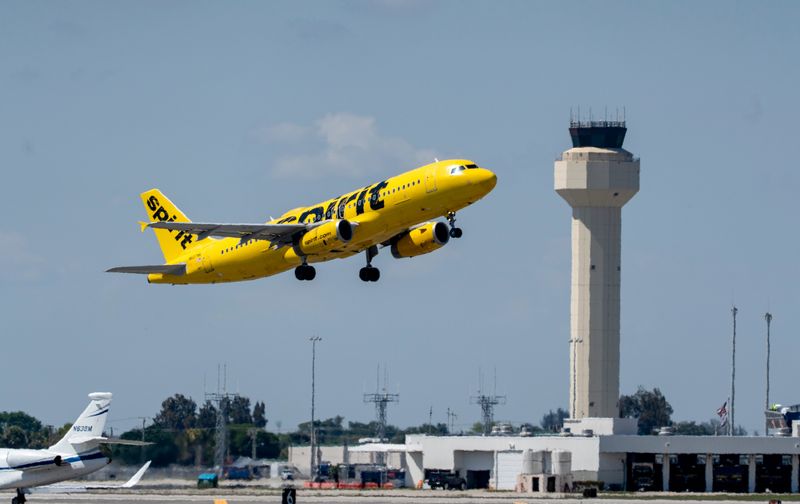
Florida-based Spirit Airlines, the often-copied carrier that proved budget air travel could be profitable, may be shutting down within days after talks of a Trump administration bailout reportedly fell through on May 1.
Spirit is currently the ninth-largest airline in the U.S., according to data site OAG, a drop from its glory days when it was the largest ultra-low-budget carrier in North America. But a failed merger with competitor JetBlue, two bankruptcies in the space of a year, and spiking jet fuel costs from the Iran war put the airline in a tailspin.

Here’s a look at the rise and fall of Spirit Airlines.
1964: Started as Clippert Trucking Company
The company changed its name to Ground Air Transfer Inc. in 1974, and founded its airline service, Charter One Airlines in 1983 in Detroit, Michigan. At first, the carrier offered flights to popular entertainment destinations such as Las Vegas and the Bahamas.
May 1992: Charter One becomes Spirit Airlines
After Charter One added jet planes to the fleet, it rebranded itself as Spirit Airlines and began scheduling more flights, adding Orlando, Fort Lauderdale, St. Petersburg, and Fort Myers in 1993.
December 1999: Spirit moves to Florida
After considering several new homes, Spirit relocated its headquarters to Miramar, Florida, near Miami.
Over the next few years, Spirit expands services in all of its markets and adds Puerto Rico, Cancun, Mexico, and Washington, D.C.
2004-2005: Spirit becomes a budget airline
Spirit changed its business strategy after an investment by Indigo Partners. The carrier moved to an ultra-low-cost model, closed several underperforming domestic routes, and expanded its Caribbean and Latin American routes.
Spirit also established Fort Lauderdale-Hollywood International Airport (FLL) as its main base of operations. Spirit also began its conversion to an all-Airbus, more fuel-efficient fleet.
2005-2011: Spirit expands to more countries
Over the next few years, Spirit added flights to the Bahamas, Jamaica, the U.S. Virgin Islands, Haiti, Aruba, St. Maarten/St. Martin, Costa Rica, Guatemala, Honduras, Nicaragua, Peru, Panama, Colombia, and the Dominican Republic, as well as increased service to domestic routes.
In 2010, Spirit became the first U.S. airline to charge passengers for carry-on bags, and other ultra-low-cost airlines followed.
November 2017: Spirit’s on-time performance named 2nd in US
Forbes ranked Spirit as one of the most punctual carriers in the country, just behind Delta Air Lines but ahead of major carriers American Airlines and United Airlines.
May 2018: Spirit 1st ultra-low-cost carrier to offer high-speed Wi-Fi
All of Spirit’s aircraft offered high-speed Wifi by 2019.
2020: Spirit gets $335 million aid package
During the COVID-19 pandemic, when air travel dropped dramatically, Spirit recieved $334 million in grants and loans from the Coronavirus Aid, Relief and Economic Security Act (CARES) to cover salaries. By October, the carrier had put nearly 30% of its employees on leave of absence.
2021: Spirit moves headquarters to Daria Beach
The 6-story headquarters was around 180,222 square feet, equipped with flight simulators, down from an original plan of 500,000 square feet.
February 2022: Frontier tries to buy Spirit
Frontier Airlines announced plans to acquire Spirit, which would have created the fifth-largest airline in the country at the time. In July, Spirit shareholders rejected the offer.
April 2022: JetBlue tries to buy Spirit
JetBlue offered the equivalent of $3.6 billion for the company, but Spirit initially turned it down, saying the U.S. Department of Justice’s Antitrust Division would block it. JetBlue came back a few months later with a higher bid, which Spirit accepted.
The DOJ blocked it, saying the merger would result in “higher fares, fewer seats, and harm millions of consumers.”
Spirit’s stock plummeted, but the company said it had no plans to file for bankruptcy.
September 2024: Spirit furloughs pilots
Spirit furloughed 186 pilots in September 2024 and works on reducing its workforce and selling off nearly two dozen older Airbus planes.
November 2024: Spirit files for bankruptcy
Spirit announced it was preparing to file for Chapter 11 bankruptcy protection, citing rising operation costs, the failed mergers, increasing debt and high competition. Stock plummeted again.
January 2025: Frontier tries again, Spirit lays off employees
Frontier made a second offer, but Spirit rejected it as the $2.1 billion in stock and cash was less than the first offer and would have required Spirit’s creditors to invest $350 million.
The carrier laid off 200 employees to cut costs and furloughed about 350 pilots.
March-April 2025: Spirit exits bankruptcy, names new CEO
Spirit emerged from bankruptcy and named Dave Davis as its new CEO. Spirit was named Best Airline for 2025 by WalletHub.
June 2025: Spirit reinvents itself as premium budget airline
The carrier marketed itself as the premium option among budget airlines with a new ticket lineup, an updated loyalty program, and extra legroom seating for the “Go Comfy” ticketholders (now called “Premium Economy”).
July 2025: Spirit announces pilot furloughs
Spirit announces plans to furlough 270 pilots in November. “We are taking necessary steps to ensure we operate as efficiently as possible as part of our efforts to return to profitability,” the company said.
August 2025: Spirit files for bankruptcy again
After restructuring didn’t work, Spirit filed for bankruptcy again, reported a net loss of about $246 million from March through mid-June.
The carrier was also locked in a dispute with aircraft lessor AerCap Holdings over a deal covering 36 Airbus planes due for delivery between 2027 and 2028.
September 2025: Spirit cuts flights, announces furloughs
Spirit Airlines filed notices with Florida officials saying the airline would be furloughing 730 flight attendants at three Florida airports in the state, starting Dec. 1. Another 334 were to be furloughed in Atlanta and 64 in Chicago, according to the low-budget airline’s mandatory WARN notices.
“This furlough is expected to be temporary,” Nick Bartlotta, senior vice-president for Guest Experience and Crew Operations, said in the filings, “however, we are unsure as to the duration.”
The carrier also dropped 11 cities from its route map — Albuquerque, New Mexico; Birmingham, Alabama; Boise, Idaho; Chattanooga, Tennessee; Columbia, South Carolina; Oakland, California; Portland, Oregon; Sacramento, California; Salt Lake City; San Diego; and San Jose, California — to refocus on key markets. Frontier Airlines capitalized on Spirit’s struggles by announcing 20 new routes including several at Fort Lauderdale and other Spirit hubs.
By the end of the month, Spirit announced it was dropping two more airports in Connecticut and Missouri, and suspending about 40 routes.
October 2025: Spirit gets OK for $475 million financing
Spirit announced the bankruptcy court approved financing for $475 million with its existing bondholders. The carrier also reached an agreement with AerCap to reject 27 outstanding aircraft leases and pay Spirit $150 million.
December 2025: Spirit announces pay cuts
Spirit reached an agreement with the Air Line Pilots Association and the Association of Flight Attendants-CWA for pilots and attendants to accept salary reductions. Spirit said as part of the agreement, executives would also be taking cuts.
February 2026: Spirit gets debts reduced
Spirit said it reached a deal with its lenders to reduce its total debt and lease obligations from $7.4 billion before the filing to roughly $2.1 billion post‑emergence. The carrier said it would tighten its network around higher‑demand periods, boosting aircraft use on peak days while scaling back off‑peak flying and adjusting capacity to seasonal swings.
March 2026: Spirit announces end to bankruptcy
Spirit filed a Restructuring Support Agreement and Plan of Reorganization with the court, and announced plans to further reduce its fleet, focus on Fort Lauderdale, Orlando, Detroit and the New York City area, add more premium choices, and continue to reduce its cost structure.
The carrier said it expected to emerge from Chapter 11 bankruptcy by “early summer.”
April 2026: Jet fuel prices soar
In February, the United States and Israel launched an attack against Iran. Iran retaliated with its own strikes,m and also closed the Strait of Hormuz, blocking about 20% of the world’s oil from passing.
Since then, jet fuel prices have skyrocketed. Jet fuel is approximately 40% of an airline’s operating costs.
By the end of April, Spirit was meeting with members of the Trump administration and the Department of Transportation, reportedly asking for a $500 million bailout in exchange for a majority stake in the company.
May 2026: Bailout talks break down
As of May 1, final talks seem to have fallen through.
“We’re looking at Spirit. If we can help them, we will, but we have to come first,” Trump told reporters before leaving for an appearance in The Villages. “If we could do it, we’d do it, but only if it’s a good deal this weekend, because they haven’t gotten a deal looking at it,” adding that he expected an announcement sometime Friday.”
Some of Spirit’s creditors objected to the terms of the bailout, The New York Times reported, since the government would control 90% of the company and they would be left in a worse financial position if Spirit eventually failed.
“Some Republican lawmakers were also opposed to a government bailout of Spirit,” the Times said.
C. A. Bridges is a journalist for the USA TODAY Network-Florida’s service journalism Connect team. You can get all of Florida’s best content directly in your inbox each weekday day by signing up for the free newsletter, Florida TODAY.
This article originally appeared on Palm Beach Post: Spirit Airlines timeline: How did we get here?
Reporting by C. A. Bridges, USA TODAY NETWORK – Florida / Palm Beach Post
USA TODAY Network via Reuters Connect