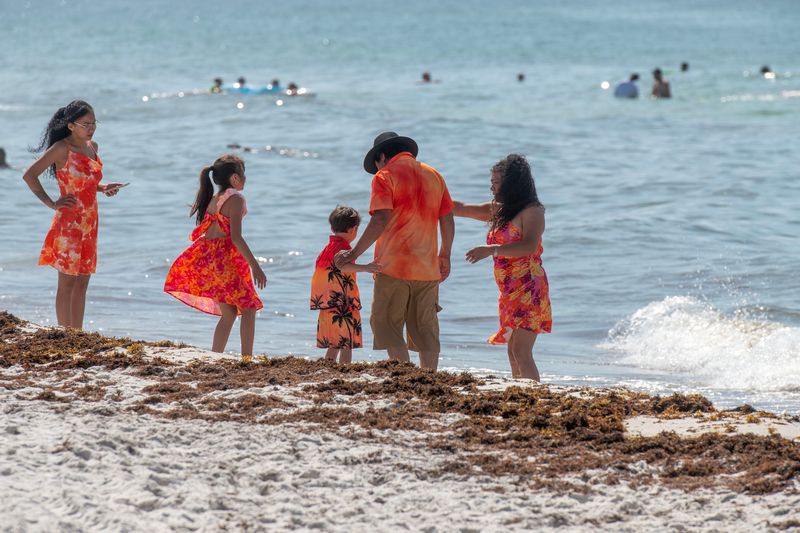
From Navarre Beach to Perdido Key, sargassum has become a stinking scourge of area coastlines.
Vast amounts of the macroalgae, a type of seaweed, had been seen by satellites floating in the Gulf of Mexico in mid-April, but Tim Day, Escambia County’s deputy director of natural resources, pinpointed June 8 as the day he began receiving emails reporting sargassum washing up along area beaches.

Though it is basically harmless—and in the water is a very important resource that serves as a nursery for fish, shrimp and crabs and a shelter for sea turtle hatchlings and bigger fish—sargassum can become a real headache for beachgoers, and in some cases the coastal tourism industry.
When the brown algae washes ashore and begins to break down, it releases hydrogen sulfide and ammonia and gives off a rotten-egg smell.
“It does get to stinkin’,” said Steve Luppert, a Pensacola Beach resident and newly elected member of the Santa Rosa Island Authority board of directors.
Additionally, hydrogen sulfide can impact people with breathing issues.
Sargassum growth peaks around June, and the Florida Department of Environmental Protection issues permits to counties and entities like the SRIA that allow them to utilize machinery to remove it from the coastline.
But during sea turtle nesting season, which runs from March until October, machine operators must receive an all-clear from turtle monitors who walk the beach each morning before moving in to scrape off what arrived the night before.
Rest assured though, in a shoreline invasion of the magnitude battering Northwest Florida now, there will be more to clean up the next morning.
“We’re using the machinery and scooping it up every morning, but it washes right back up the next day,” said Chips Kirschenfeld, head of Escambia County’s Natural Resources Department.
It is not illegal for everyday citizens to remove sargassum that washes up on local beaches by using a tool such as a rake or shovel, Kirschenfeld said. Only the use of machinery must be permitted.
What is unknown about the most recent sargassum invasion is when the stuff will stop washing ashore on area beaches. Day said wind and currents will eventually move the seaweed back offshore.
“This tends to be the worst month for it,” he said. “My hope is that we see a change in the winds and the tides.”
Michael Schmidt, the public works director for Santa Rosa County, confirmed that some sargassum had washed up on Navarre Beach, and the county was abiding by turtle watch mandates before removing the stuff each day.
The SRIA has been actively removing seaweed from Casino Beach, Luppert confirmed. But on Perdido Key, where beach access is privately owned, Day said extra steps are being taken to assist residents.
“We’re working primarily with beach vendors, particularly in the more densely populated areas,” he said. “There are mechanisms by which they can remove it.”
Day said in some cases the sargassum is being scooped up and trucked out to area landfills, but in other instances property owners are moving the organic material up the beach to the edge of the sand berms or dunes.
“It’s kind of tough to do more than bury it or haul it off,” he said. “But it really does degrade quickly and serves as a wonderful fertilizer for the dunes. It does have a pretty bad odor, so you want to get it buried or otherwise taken care of.”
Many years, when the amount of sargassum washing ashore is less than what is being seen this summer, it is a best practice to leave the seaweed where it comes in, Day said, to “self bury” with the ebb and flow of the tides, degrade naturally and enrich the beaches on which it has arrived.
Scientists began noticing an enormous growth in the amount of sargassum floating about the world’s oceans around 2011, and media outlets began reporting on massive mats of it beaching along Florida’s east coast and in the Florida Keys.
Researchers identified what is now known as the Great Atlantic Sargassum Belt in 2019. This massive seaweed cluster stretched from off the coast of Africa into the Gulf of Mexico, which the U.S. government now refers to as the Gulf of America.
This year the sargassum crop has grown to record proportions from the eastern Atlantic into the Gulf, and in May a mass of nearly 30 million metric tons was spotted by the University of South Florida Optical Oceanography Laboratory.
It was reported floating across the Atlantic toward Florida and the Caribbean.
The continued spread of the sargassum prompted the National Oceanic and Atmospheric Administration to upgrade a Sargassum Inundation Risk Tool “to offer daily reports on location and risk that brown floating algae could wash ashore,” a NOAA website said.
Kirschenfeld said he is often asked what has made sargassum so much more prolific now than it was 20 or 30 years ago.
“Algae, like any plant, utilizes nutrients, water and carbon dioxide for photosynthesis. If you increase the carbon dioxide in the atmosphere, which from the data I’m seeing, we’re doing, you speed up photosynthesis,” he said. “So one could say we humans are exacerbating the algae growth by releasing all this excess carbon dioxide into the atmosphere.
“Maybe we’re responsible for this,” Kirschenfeld said.
This article originally appeared on Pensacola News Journal: Sargassum has invaded area beaches. Keeping up with it is impossible
Reporting by Tom McLaughlin, Pensacola News Journal / Pensacola News Journal
USA TODAY Network via Reuters Connect
By Tom McLaughlin, Pensacola News Journal | USA TODAY Network