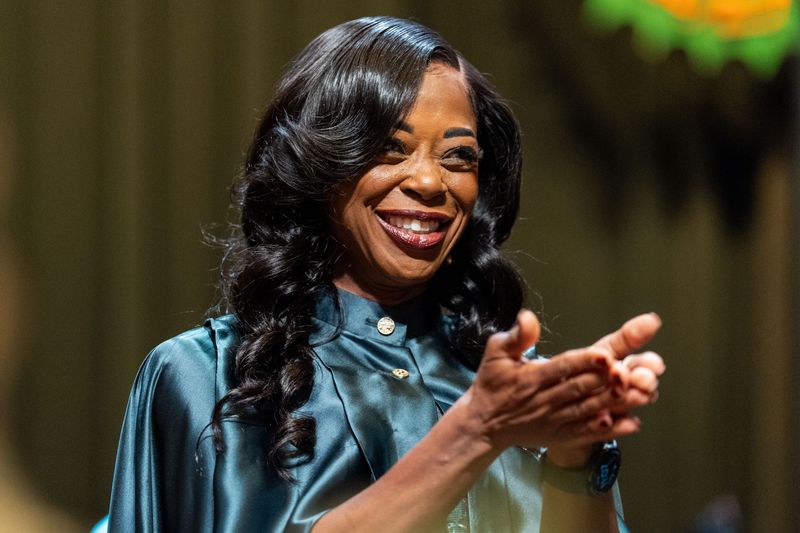
A year ago, Florida A&M University President Marva Johnson stepped foot onto FAMU’s campus − positioned at the helm, all while finding herself in the face of critical pushback.
But a year into the job, she’s rolling with the punches and remains “motivated” as more work lies ahead to move the university forward.

On Aug. 1, 2025, the former telecommunications executive took over the president’s post at FAMU under a cloud of controversy following a contentious presidential search. Now, her tenure has been one filled with new high-profile hires and ongoing efforts to engage with a community of both supporters and critics of her vision for the university.
“What I’ve learned is that, like most families, we may not always agree on the method of how we are going to accomplish the goal,” Johnson said in a written statement sent to the Tallahassee Democrat, “but we all have the same goal in mind … We all agree that FAMU is intricately woven into the success of Florida, our reach is global, our worth is immeasurable and our existence is very necessary.”
As Florida A&M enters a new academic year, Johnson’s presidency has reached an important inflection point. The political battle over her selection has largely given way to the day-to-day work of leading one of the nation’s premier historically Black universities.
That work includes advancing strategic priorities, strengthening enrollment and fundraising – and convincing a divided campus community that her administration can deliver on its vision for FAMU’s future.
For instance, Johnson spent the eve of her one-year anniversary at the university’s Lawson Center for the 2026 summer commencement ceremony on July 31, where she presided over the event and shook hands with hundreds of graduating students as they crossed the stage.
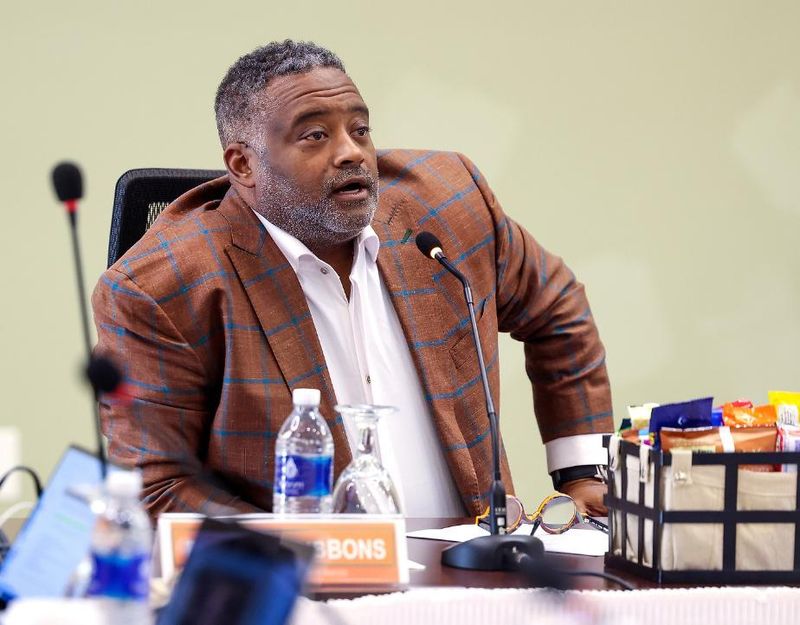
FAMU Board of Trustees chair Deveron Gibbons – who has been a supporter of Johnson since the presidential search process – says she brings “a lot of energy and enthusiasm” while leading the charge of recruiting and retaining world-class talent.
“In her inaugural year, there were a lot of firsts,” Gibbons said in a July 30 statement sent to the Democrat. “I saw President Johnson meeting with student leaders, attending athletic and alumni events, launching a strategic planning exercise and honoring FAMU’s past all while rolling out new fundraising initiatives.”
“This upcoming year,” he added, “I’m hopeful we can translate that momentum into new benchmarks and results this university hasn’t seen in a while.”
Attempts to get comments from FAMU’s National Alumni Association President Artisha Polk about Johnson’s performance over the past year were unsuccessful.
‘A great foundational first year’
Regarding some of the university’s achievements during Johnson’s first year as president, research and development expenditure reached $85.1 million in the 2025-26 fiscal year, which includes a 16.3% year-over-year jump from the last year.
When it comes to fundraising, the university raised over $559,000 during its annual 1887 Strikes Days of Giving campaign this year from 2,455 donors, with more than 1,400 of them being individuals who gave donations for the first time. “That is a measure of trust, momentum and the conviction our community carries about where this university is going,” Johnson said.
She also highlighted growth in research doctorates from 28 being awarded in 2021-22 to 43 in 2024-25, but the data addresses results from before her presidency began in August 2025.
More recently, two dean appointments have been made to spearhead the university’s pharmacy and law schools, which come after several hires in Johnson’s senior leadership team – including interim Chief of Staff Altony Lee, Executive Vice President and Chief Operating Officer Kelvin Lawson and Vice President and Director of Athletics John Davis.
In addition, Johnson said she’s embracing FAMU’s history as an 1890 land-grant institution, noting the university’s partnership with the electric utility company Duke Energy Florida to bring renewable energy to Hernando County. While an initial agreement to create a solar farm operation on FAMU’s Brooksville campus began in 2019, the partnership was expanded in May with the unveiling of the Rattler Renewable Energy Center, which is a 74.9-megawatt solar energy site on 800 acres leased to the company by FAMU.
“Our mission is to serve the underserved, and we are going to do that for the next 139 years and beyond,” Johnson said, referring to the university’s founding in 1887.
Despite the accomplishments, some challenges still underway include the road toward reaching a Carnegie R1 classification (Very High Research Activity) by 2030 – a longtime goal set by former President Larry Robinson in 2022 as FAMU is currently ranked Carnegie R2 (High Research Activity).
FAMU also has some construction work on the horizon, such as renovations for new office and teaching space in Howard Hall that are slated to be complete in November for the Army ROTC program to return to that building once it reopens. Plans have also been drafted for a 500-bed facility on the former Gibbs Hall and Paddyfoote Complex sites, according to Johnson, which would bring FAMU’s on-campus housing count from 3,400 beds to nearly 4,000.
The university’s administration has not made any plans public regarding continued renovations at Bragg Memorial Stadium, including renovations for restrooms and concession operations.
“The future growth of our university matters to our alumni as they think about where to send their children and where to make their investments,” Johnson said. “This has been a great foundational first year, and I am excited for what we will accomplish together in year two.”
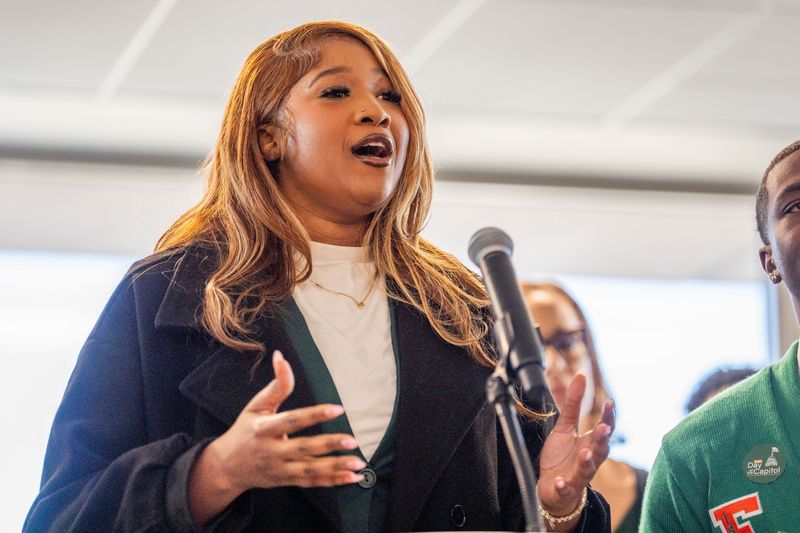
FAMU Student Body President and university trustee Kennedy Williams − who was vocal about her stance against Johnson’s candidacy last year while serving as vice president − says she has appreciated the president’s willingness to engage with students and listen to them during her first year.
“Leading an institution as transformational as Florida A&M University comes with both opportunities and challenges, and her first year has reflected a commitment to moving the university forward while building relationships across campus,” Williams said in a statement sent to the Democrat.
Here’s what Johnson shared in written responses to questions from the Democrat, reflecting on her first year at FAMU:
Q: Can you talk about how much you think the campus and alumni community have warmed up to you over the past year compared to when you were initially chosen to be FAMU’s new leader?
A: I like to say I am moving one Rattler at a time. I have had the pleasure of meeting with several alumni chapters during this first year, such as scholarship events with the Greater Orlando, Volusia County and Leon County chapters, where I was grateful to meet both alumni and incoming students. Meeting supporters in these social settings has been immensely helpful in getting a true pulse on the FAMU brand experience through the eyes of our stakeholders.
Rattler Nation’s passion is infectious. Wherever I go, someone stops me to share their ‘Because of FAMU’ story − how this university changed the course of their life, their career and their family. I am grateful for every Rattler who has taken the time to share their story with me because they have grown my own love for this institution.
Q: Given the two critical dean hires you’ve made for the pharmacy and law colleges, how did each candidate fit your vision for moving FAMU forward?
A: I am looking for leaders who have experience in the places where we’re aiming to grow. The recent additions to our team bring skills to the table that will help FAMU do more, faster. With Simone Marstiller, our new dean of the College of Law, her background is exceptional. From her role as secretary of the Florida Department of Juvenile Justice to her service as a judge on the Florida First District Court of Appeal, her experience will resonate with our students as they pursue similar career paths.
Through Dr. Vanessa Sheppard, our new dean of the College of Pharmacy and Pharmaceutical Sciences, Institute of Public Health, we have hired a true educator, scientist and advocate for health equity. She has a proven track record of growing student enrollment, increasing research expenditures and securing federal research funding that will help us continue our ascent toward our SUS30 (State University System’s 2030) goals.
Their appointments represent a resurgence in energy to increase the number of (doctoral level) degrees we award to highly skilled scholars.
Q: What’s your vision for FAMU athletics, considering some of the challenges at hand such as recent academic progress rate (APR) issues?
A: I’ve hired solid leadership in VP John Davis to lead the Division of Athletics and a dedicated head football coach in alumnus Quinn Gray, and we have a dynamic team in Academic Affairs under the leadership of Provost Allyson Watson. Together, with Head Basketball Coach Charlie Ward, we have implemented targeted enhancements − including the addition of certified academic advisors dedicated to football − expanded compliance staffing and strengthened coordination between Athletics and the Office of the Provost to ensure rigorous academic certification and monitoring.
Since that report came out, my team has been meeting with both coaches on a weekly basis to eliminate barriers that may have prohibited students from excelling previously. We’ve expedited taking care of our student athletes and identified ways to help them succeed according to their learning styles from more lab time to personal tutoring. We have hired Reginald Thomas as associate vice president for Athletics and Academic Excellence. This is a newly created role, and Thomas is at the center of a comprehensive effort to rebuild and strengthen FAMU’s academic support, NCAA compliance, and student-athlete development operations.
Q: What is your personal challenge in engaging more with alumni in the next year, and what do you expect of your leadership team as far as expanding alumni engagement?
A: No matter the industry or the geography, Rattlers are present, and Rattlers are thriving. They hold senior positions at Fortune 100 companies – Amazon, Boeing, Procter & Gamble, CVS Health, JPMorgan Chase, Ford Motor Company, Wells Fargo, State Farm – and they return. They return to recruit. They return to hire Rattlers. They launch their own enterprises and reach back to bring the next generation with them.
Alumni engagement is critical for another reason: our alumni are one of our greatest academic resources. They are practicing, right now, in the fields our students are training to enter, and they bring us real-time insight into where an industry is heading, what skills employers need and where our curriculum has to evolve to keep pace. The goal for my leadership team when it comes to connecting with our alumni is to continue to inform them of the exciting work happening on the Hill and to inspire them to keep reaching back and helping us rise.
Tarah Jean can be reached at tjean@tallahassee.com. Follow her on X: @tarahjean_.
This article originally appeared on Tallahassee Democrat: ‘One Rattler at a time’: Marva Johnson navigates first year at FAMU
Reporting by Tarah Jean, Tallahassee Democrat / Tallahassee Democrat
USA TODAY Network via Reuters Connect
By Tarah Jean, Tallahassee Democrat | USA TODAY Network