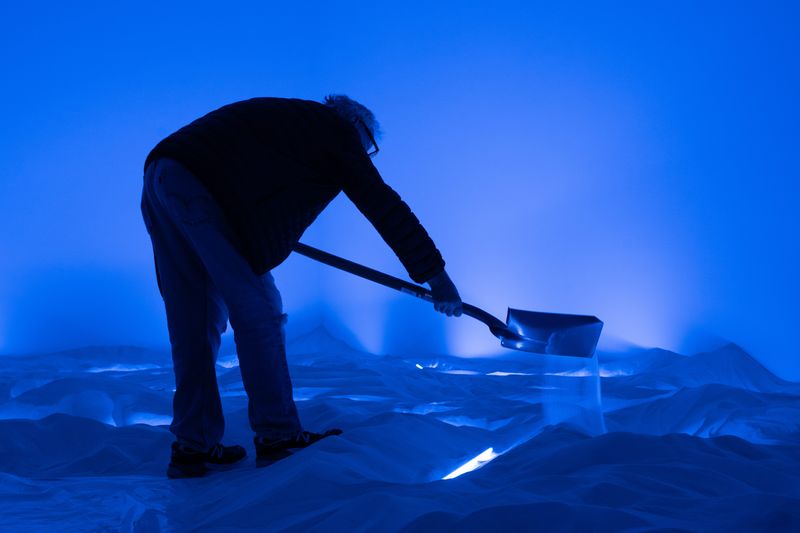
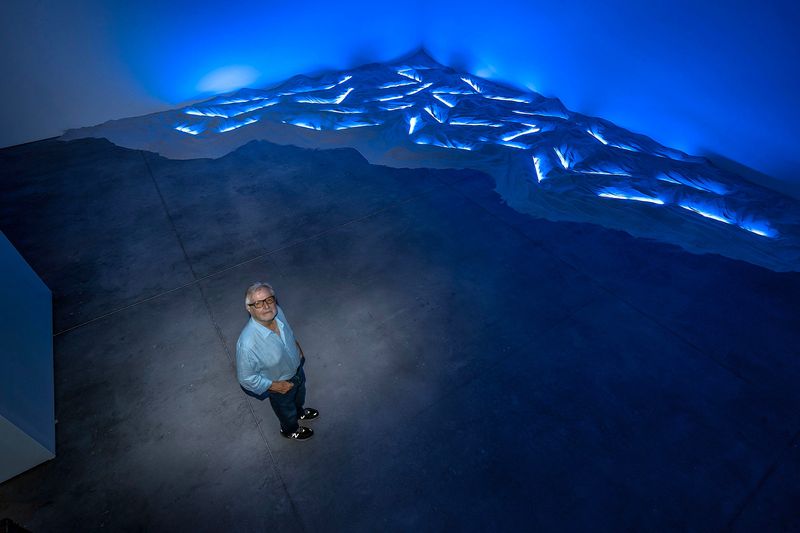
Inside the Norton Museum of Art’s Gioconda and Joseph King Gallery, California-based artist Laddie John Dill’s team dumps bags of sand as he creates what museum officials describe as one of its largest installation pieces.
Using a shovel, Dill carefully sculpts the sand in a process he describes as “painting in three dimensions,” carving out dunes and ridges before placing 37 argon and mercury tube lights throughout the piece in the weeks leading up to a May 9 preview event.

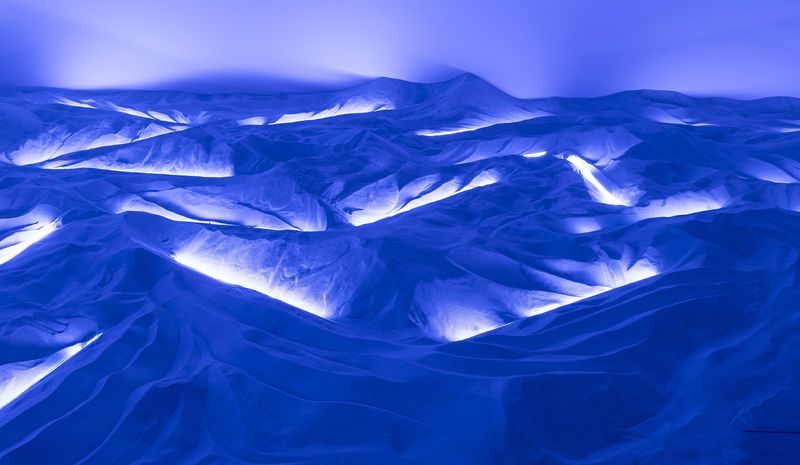
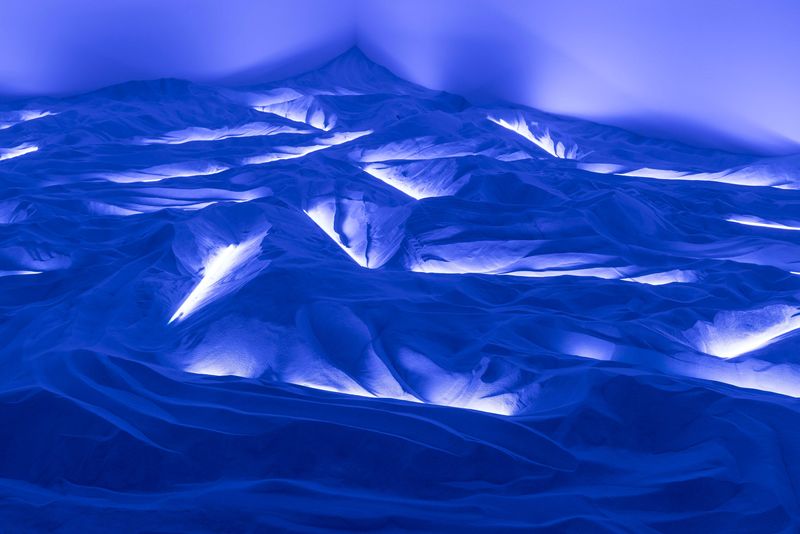
The end result? “Eastern Standard Time,” an ethereal landscape defined by its hypnotic rolling dunes and ridges, illuminated by the dreamy blue hue of Dill’s signature tube lights.
“It’s almost like a silver screen, so you see the light reflect inside the different crevices and waves that form in the sand, it’s just such an amazing experience,” said Arden Sherman, the Glenn W. and Cornelia T. Bailey senior curator of contemporary art for the Norton, during the preview event.
On view at the Norton through Oct. 19, the piece is the latest in Dill’s “Silica Landscape,” a series that combines silica and locally derived sand to create unique works that examine the interrelation between the installation’s material and the gallery space.
“That sand piece (‘EST’) exists because the architecture is there,” he said during a May 9 lecture at the Norton. “If we were in a different room, it would be a different piece.”
Dill described his approach to installations as creating “interesting situations” through a visual dialogue.
That visual dialogue is anchored by the objects Dill uses, which are often a combination of natural material and hardware to create an interplay between “the environment and the industrial,” he said.
Dill is recognized as one of the pioneers of California’s Light and Space art movement, a title given to a group of minimalist artists from the 1960s and ’70s that focused on how the use of light and shapes informs and influences an onlooker’s perception of the environment.
It’s an approach that challenges the traditional relationship between art and light, George Merck, Norton board trustee and owner of Palm Beach’s George Merck Art Collection exhibition space, told the Daily News during the installation’s May 9 preview.
“In New York, they often say ‘art hates light’ because UV rays destroy the pigments like acrylic works or oil on canvas,” Merck said. “But works like this not only accept light as an aspect of the work; it’s the most integral part of every light and space work. There is no pigment, light is the paint, and that’s what makes it so interesting to me.”
Merck was the driving force behind the new installation, Sherman said, noting that he had introduced Norton officials to Dill, and provided the funding for the installation.
Born in Long Beach, California, in 1943, Dill, 82, said he was raised in a household where “anything in the arts were encouraged.”
He described his mother as a vaudeville actress and his stepfather as a polymath who was not only a key scientist in the early development of night-vision technology, but also a musician who played with famed band leader Glenn Miller during World War II, he said.
His home was constantly filled with gadgets, as his stepfather would experiment with the latest laser technology and other cutting-edge technology of the day. This upbringing influenced Dill’s use of technology, though he admitted his tubes were “low-tech” in comparison to his stepfather’s gadgets.
His use of light also was influenced by the Southern California environment. The common sight of fog and smoke fueled his interest in light, and the way it fluctuates based on its surrounding environment, Dill said.
His experimentation with light began a year after graduating from the Chouinard Art Institute in 1968, with his iconic and ongoing “Light Sentences,” installations composed of different colored tube lights combined into a single multicolored tube.
While his breakout exhibition at New York’s Sonnabend Gallery in 1971 centered on “Light Sentences,” that opportunity came after the gallery’s owner, Ileana Sonnabend, witnessed his early experimentations with light and sand.
Unlike his static “Light Sentences,” Dill said his enjoys working with sand because it’s “almost like water, it’s pourable and formable.”
It also means every work in constant flux.
“I don’t put hairspray on it. I just let it do what it’s going to do. It’ll move slowly, and it’ll change,” he said.
The ephemeral nature of the artform continues to appeal to him. If he decides to recreate “(Eastern Standard Time,” it would be “a completely different piece; same elements, but different,” the artist said.
Dill’s work has been featured in New York’s Museum of Modern Art; the Los Angeles County Museum of Art; and the Smithsonian American Art Museum in Washington, D.C.
The Norton Museum, 1450 S. Dixie Highway, West Palm Beach, is open from 10 a.m. to 5 p.m. Monday, Wednesday, Thursday and Saturday; 10 a.m. to 10 p.m. Friday; and 11 a.m. to 5 p.m. Sunday. For more information, call 561-832-5196 or visit norton.org.
Diego Diaz Lasa is a journalist at the Palm Beach Daily News, part of the USA TODAY Florida Network. You can reach him at dlasa@pbdailynews.com.
This article originally appeared on Palm Beach Daily News: Norton Museum’s ‘Eastern Standard Time’ explores the hypnotizing beauty of light and sand
Reporting by Diego Diaz Lasa, Palm Beach Daily News / Palm Beach Daily News
USA TODAY Network via Reuters Connect