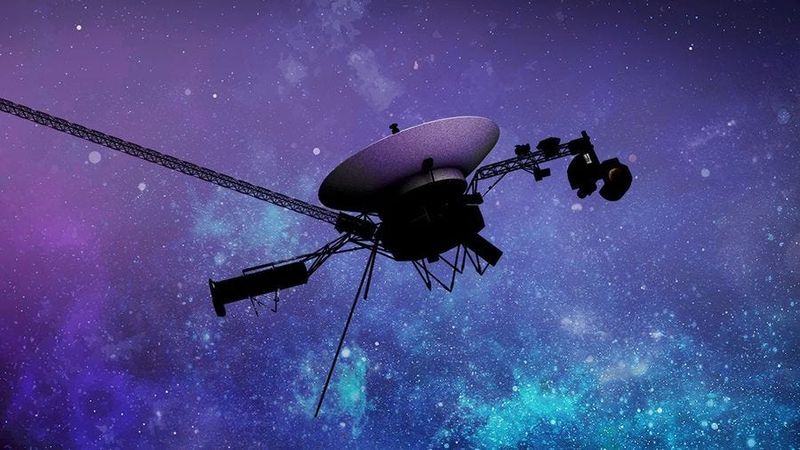
NASA has shut down one of the science instruments on board the iconic Voyager 1 space probe in an effort to extend the life of humanity’s first interstellar vehicle.
The decision was made as power flags on the aging spacecraft, one of a pair of spacecraft that launched nearly 49 years ago on a trailblazing mission to explore our solar system and beyond.

“While shutting down a science instrument is not anybody’s preference, it is the best option available,” Kareem Badaruddin, Voyager mission manager at NASA’s Jet Propulsion Laboratory in Southern California, said in a statement.
Here’s the latest on Voyager 1, and everything to know about the mission of the twin NASA probes.
NASA shuts off instrument on Voyager 1
NASA engineers sent commands April 17 to Voyager 1 to shut down an instrument on the probe called the Low-energy Charged Particles experiment, or LECP, the space agency said in a news release.
The decision came as the aging nuclear-powered spacecraft runs low on power. NASA officials are confident that by turning off the LECP instrument, Voyager 1 will be able to conserve energy without the spacecraft getting so cold that its fuel lines freeze.
Voyager 1 still has two of its 10 original science instruments remaining operations – including one that listens to plasma waves and one that measures magnetic fields, according to NASA.
What is the LECP on Voyager 1?
The Low-energy Charged Particles instrument has been operating almost without interruption since Voyager 1 launched almost 49 years ago.
Voyager 1 and Voyager 2 are the only spacecraft far enough from Earth to use the instrument to measures things like ions, electrons and cosmic rays originating from our solar system and galaxy – providing critical data about the space beyond the giant bubble around the sun and its planets known as the heliosphere.
A small motor on the LECP that spins and scans in all directions remains on, giving the team the ability to reactive the entire instrument if they find extra power.
When did the Voyager probes launch from Cape Canaveral, Florida?
The twin Voyager probes were launched on separate dates in 1977 from Florida from what is now the Cape Canaveral Space Force Station with the mission of exploring the outer solar system.
Contrary to its name, Voyager 2 was the first of the vehicles launched into space first Aug. 20 1977. Its twin probe, Voyager 1, then launched Sept. 5.
Though it was the second of the probes to get off the ground, Voyager 1 was on a faster route than its counterpart as it whizzed beyond the asteroid belt between Mars and Jupiter and overtook Voyager 2 by December of that year.
Voyager 1 has the distinction of being the farthest human-made object from Earth – a record it has maintained since 1998 when it bypassed NASA’s Jupiter-exploring Pioneer 10 probe.
What is the mission of Voyager 1, Voyager 2?
Both Voyager Probes have spent nearly five decades traveling billions of miles away from Earth.
The Voyager program’s main mission was originally to explore the far reaches of our solar system. To that end, the spacecrafts have investigated all the giant planets of our outer solar system ‒ Jupiter, Saturn, Uranus and Neptune ‒ as well as the planets’ magnetic fields and a combined 48 of their moons, NASA says.
The probes completed that portion of their respective journeys by 1989, after which NASA retooled their mission as an interstellar expedition – meaning one journeying beyond our solar system into the region between stars farther into the Milky Way.
In 2012, Voyager 1 became the first spacecraft to reach interstellar space, followed in 2018 by Voyager 2, according to NASA. To this day, the probes are the only spacecraft in history to operate outside of the heliosphere – the protective bubble of particles and magnetic fields generated by the sun.
What’s on the golden record?
Should they encounter extraterrestrial life, both Voyager 1 and 2 also carry the famous “golden record,” functioning both as a time capsule and friendly Earthling greeting.
None other than famed American astronomer Carl Sagan chaired the committee tasked with selecting the contents of the message, contained on a 12-inch gold-plated copper disk. The phonograph records contain aspects that encapsulate life on Earth, such as samples of music from different cultures and eras, natural and man-made sounds from Earth, and electronic information encoded in analog form that an advanced civilization could convert into photographs.
Where are Voyager 1 and Voyager 2 now?
Voyager 1 is more than 15.7 billion miles away from Earth, traveling through the cosmos at more than 51,300 mph, according to NASA. Voyager 2, meanwhile, is whizzing at about 50,300 mph while 13.2 billion miles away.
The space agency provides an interactive three-dimensional diagram tracking both Voyager probes’ positions outside the solar system.
When will the Voyager program end?
NASA anticipates that both Voyager probes could continue to operate into the late 2020s.
NASA engineers next plan to attempt an ambitious energy-saving plan on both Voyager 1 and Voyager 2 they call “the big bang” designed to further extend operations.
The team will first enact the plan on Voyager 2 in May and June by turning some devices off on the probe and replacing them will lower-powered alternatives, according to NASA. If successful, the process could be repeated as early as July on Voyager 1, which is farther from Earth and has less power to spare.
Eric Lagatta is the Space Connect reporter for the USA TODAY Network. Reach him at elagatta@usatodayco.com. Subscribe to the free Florida TODAY newsletter.
This article originally appeared on Florida Today: NASA turns off Voyager 1 instrument to prolong iconic probe’s life
Reporting by Eric Lagatta, USA TODAY NETWORK – Florida / Florida Today
USA TODAY Network via Reuters Connect