Mosquitoes seem to be out and about at all times, flourishing, making it difficult to control the pesky blood-sucking insects.
“This problem is throughout the whole state of Florida,” said Michael Hart, director of operations for the Indian River Mosquito Control District. “The mosquito production throughout the state of Florida is very, very high. It’s not just an Indian River County problem; it’s almost a Florida problem right now.”

Drought-like conditions and unusual tides are plaguing the state’s mosquito control districts as they continue to suppress the mosquito populations rather than contain them, as they have done historically. The state’s first mosquito control district was established in Indian River County in 1925.
“This is the first time, in my 20 years, that I’ve ever encountered something like this,” Hart said.
Florida has about 80 species of mosquitos; Indian River County has 40 to 50 of them, he said.
Mosquito control programs around the state have been discussing different approaches to mitigate the populations. The programs are monitored by the Florida Department of Agriculture and Consumer Services.
Those aproaches include aerial control by drone, helicopter or plane; ultra-low volume (ULV) spraying mounted on trucks; hand-held thermal fogging; and larvicide applications.
But why are mosquitoes flourishing in drought conditions?
“The reason is because the lack of rain is denying us the ability for us to do source reduction,” said John Thomas, Indian River Mosquito Control District’s inland inspector.
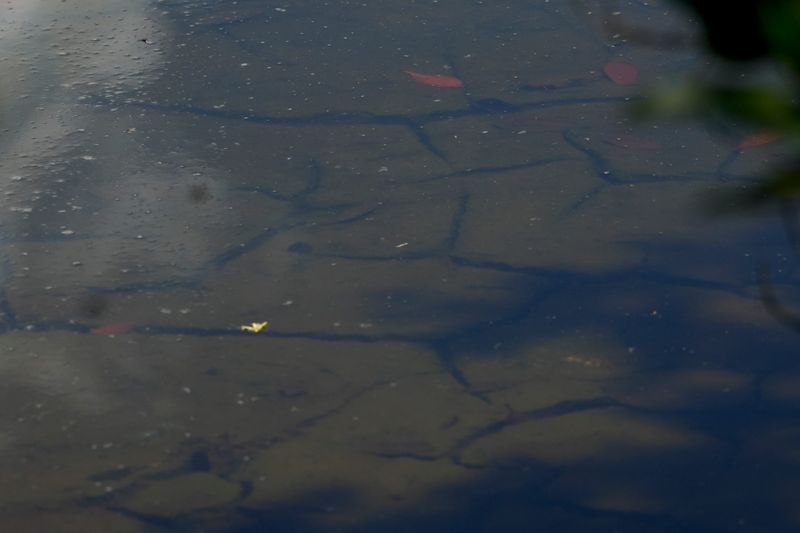
Source reduction involves trapping and pumping water into salt-water marsh impoundments and treating them to limit the insect’s ability to breed in the mud.
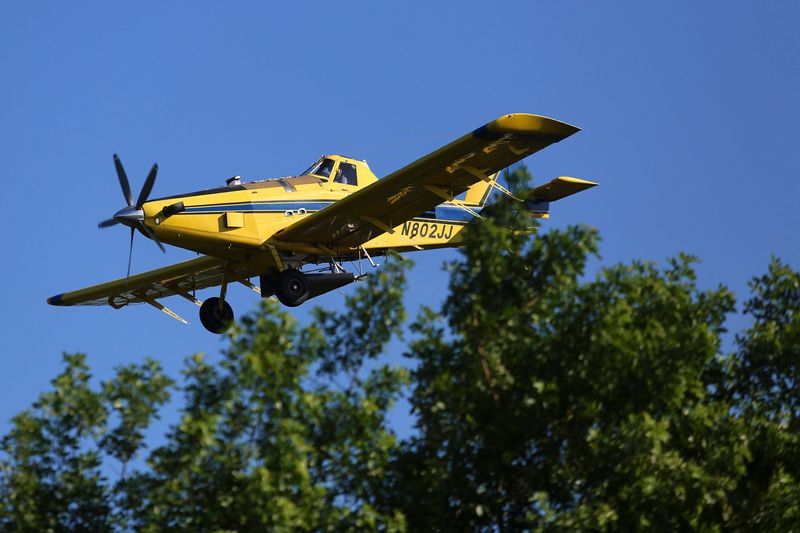
Indian River Lagoon water levels have been so low, that the iconic yellow plane that twirls around Vero Beach’s sky dropping granular larvicide over marshes and mosquito breeding grounds, hasn’t been able to contribute to the war against the pesky bugs as often as it has in years past.
The marsh impoundments are connected to the lagoon by culverts that are open to natural tides most of the year to allow for free exchange of water, nutrients and organisms.
“This year has been very difficult, because, where our pumps are located, you have to have a certain height of water over the intake,” Hart said. “The tide has been so far out. Normally we would start in April, but we haven’t turned a pump on yet because we don’t have the ability.”
So, mosquitoes are able to breed in the mud due to the heavy-spotty showers, he said.
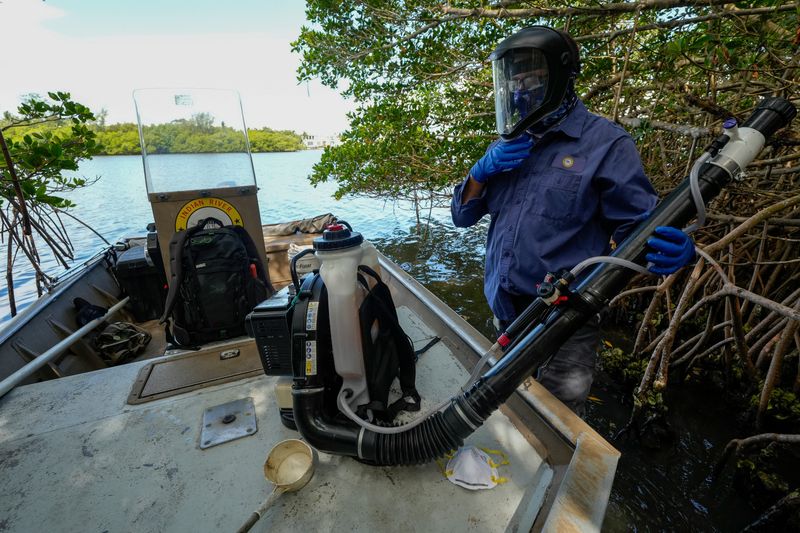
On a mid-July morning at Wabasso Causeway Park’s boat launch, Thomas and Marine Inspector C.L. Patton suited up in knee-high boots, long sleeves and pants to treat a spoil island on the Indian River Lagoon with adulticide.
They don’t wear mosquito repellent because, unlike the general population, they want to attract mosquitoes to determine how significant the “landing rate” is on the island. The number of mosquitoes that “land” on a person while in the field, determines the need for treatment in the area.
Then they treat with hand-held thermal foggers, targeting adult mosquitoes while in flight.
“Our No. 1 target priority is aedes taeniorhynchus,” Thomas said. “They are the big kahuna of salt-water marsh mosquitoes. They breed in vast numbers along this coastal region, and they also have a very wide range that they fly in.
“One might breed at the Wabasso Causeway, but in a day’s time it might be all the way in the north end of the county or the south end of the county — wherever it flies or wherever the wind might blow.”
Mosquito-borne diseases and the sentinel chicken program
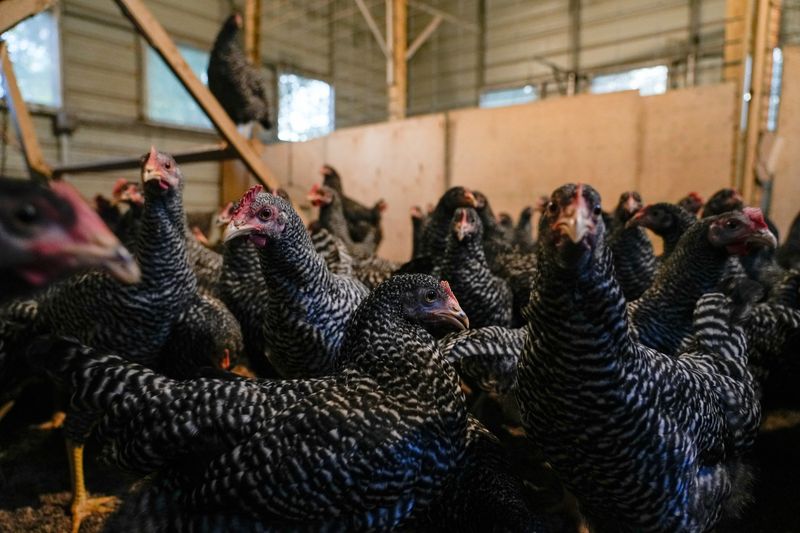
During the peak of mosquito breeding months — roughly March through November — sentinel chickens are tested weekly for mosquito-borne diseases.
The Indian River Mosquito Control District’s sentinel chicken program houses eight flocks, at six chickens per flock.
Mosquitoes carrying viruses prefer to bite birds, and while chickens can become infected, they don’t get sick from the viruses or replicate the virus enough to transmit it to other animals or humans. The produce anibodies. This makes them excellent indicators of virus activity in a given area, according to the Florida Department of Health.
The Mosquito Control District sends weekly blood samples from the chickens to the state laboratory in Tampa to screen for St. Louis Encephalitis and Eastern Equine Encephalitis in addition to West Nile Virus.
Also, in-house testing capabilities for West Nile Virus shortens the window to implement strategies to overcome any outbreaks of the disease while waiting for the state lab results.
Kyle Kosinski, the district’s director of scientific programs, said they’ve been working with the University of Florida’s Medical Entomology Laboratory to begin saliva-based diagnostic testing with the mosquitoes next year.
This will allow testing closer to residential or public areas. Chickens are housed in isolated areas.
“If you test the saliva, we know it’s actively being transmitted,” Kosinski said.
There are no indications of mosquito-borne illnesses on the Treasure Coast, as of mid-August.
Brevard remains under a mosquito-borne illness alert after state health officials recently confirmed several human cases of locally-acquired dengue fever. Escambia and Miami-Dade counties also are under mosquito-borne illness alerts. Lafayette and St. Johns counties have a mosquito-borne illness advisory, a less serious level of health risk.
The areas under alerts could be correlated to popular destination areas that encounter international travel, such as cruise ship ports.
Dengue fever is characterized by flu-like symptoms including aches and pains of muscles, joints, bones; nausea and vomiting; and a rash.
“It’s not something that is actually in Florida. It has to be brought in from somewhere else,” Kosinksi said.
After testing is complete, if a few chickens are positive for mosquito-borne disease, district scientists will conduct heightened surveillance to locate where larvae might be hiding. They’ll use larvicide and adulticide in 48-to-72-hour cycles within a half-mile radius while looking for anything that might hold water.
“If we have multiple at one site or multiple sites, then we have to put out an alert for that area and for the county, depending on if it’s countywide,” Kosinksi said.
He said there’s not been many positive chckens in the area over the last few years.
“It’s concerning because we’re not sure why,” he said. “In a way, it’s nice that viruses aren’t happening, but around us, things are happening – it could be that bird migration has changed.”
Other treatment approaches
In years past, district scientists would treat areas where mosquito populations were high. But this year, they’re concentrating on targeting areas of concern after rainfall.
With spotty showers and rain accumulating in inland areas west of U.S. 1, the rain is conducive to mosquito production in areas closer to neighborhoods.
“Whenever we try to perform any mission, it’s well planned out and they’re targeted missions for when the mosquitoes are active,” Hart said.
The intricacies of mosquito control may be inconspicuous to a novice bug lover; however, there is a method to the art of controlling the populations.
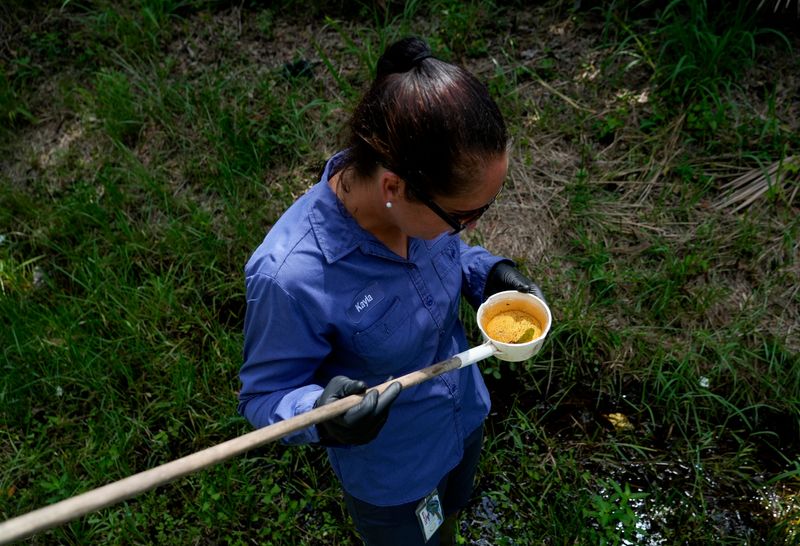
Before larvicide treatment is sprayed, mosquito technicians use a dipper, the size of a measuring cup, to inspect drainage areas in neighborhoods.
Treasure Coast law enforcement agencies: Finding new ways to help public prevent crime
New records: Light shed on memorial plaque removal decision at Fort Pierce Jetty Park
Aside from looking for larvae, they also determine how long the stagnant water has been producing mosquitoes by the size of the larvae.
“It’s wearing the guys out, to be honest, but they’re making that sacrifice,” Hart said. “We’re going out at 3 (a.m.) in the morning, 8 in the evening and then some days during the day we are targeting small areas, so (mosquitoes) won’t come out to go in the neighborhood.”
Kaila Jones is a visual journalist for TCPalm and Treasure Coast Newspapers. You can reach her at kaila.jones@tcpalm.com and can view some of her recent work here.
This article originally appeared on Treasure Coast Newspapers: Mosquito populations are flourishing, and entomologists are combatting the problem
Reporting by Kaila Jones, Treasure Coast Newspapers / Treasure Coast Newspapers
USA TODAY Network via Reuters Connect