FIFA World Cup bedlam, a wave of seething crowds and fan fervor, is descending on South Florida during its most atmospherically combustive time of year.
On Saturday, May 16, Hard Rock Stadium begins its metamorphosis into Miami Stadium, the host of seven World Cup matches, the first of which starts two weeks into hurricane season.

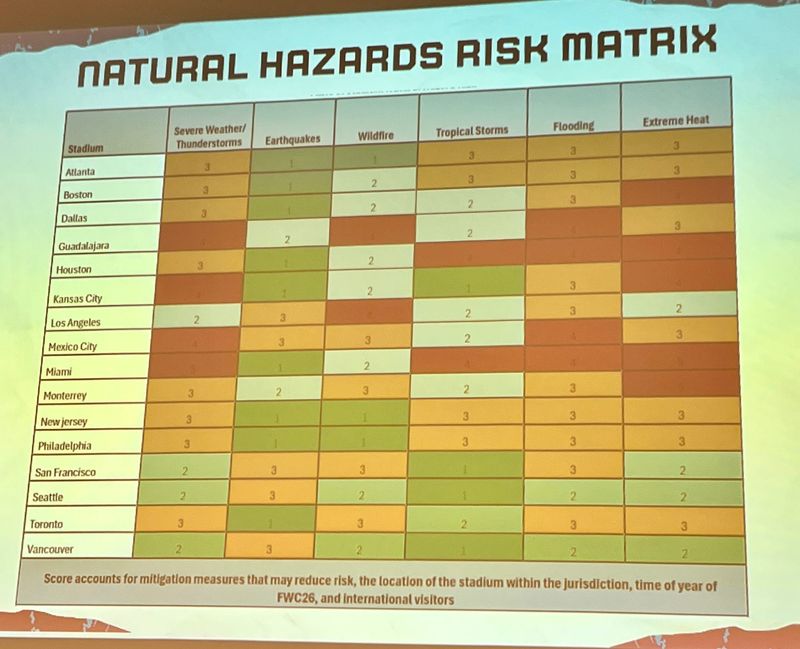
Of the 11 U.S. host cities, Miami has the most high-risk weather hazards — tropical cyclones, extreme summer heat, thunderstorms and flooding. Lower on Florida’s list of concerns are earthquakes and wildfires.
“Miami is hosting one of the world’s largest sporting events during hurricane season,” said Jesse Spearo, Miami-Dade County assistant director of emergency management. “This is going to be quite the event. It’s seven Super Bowls over 30 days with all sorts of other events occurring.”
The matrix of hazards by city was presented during a workshop at the Governor’s Hurricane Conference in West Palm Beach on Thursday May 14 that included a FIFA official, emergency managers and the National Weather Service.
For Los Angeles, wildfires topped the list of weather worries. Thunderstorms were also listed as potential dangers in Atlanta, Boston, Dallas and Houston. San Francisco and Seattle both have earthquake concerns.
While communicating those weather risks is a challenge on a normal day, the World Cup brings the complexity of messaging to another level.
Miami’s summer humidity, heat will be unpleasant for some World Cup visitors
Language barriers, an unawareness of how to get weather alerts and what they mean, and cutting through a potential haze of intoxication — the adult beverage kind or just jubilation — are all barriers to overcome.
While South Floridians are accustomed to watch for raucous afternoon thunderstorms during summer months, Scotland’s Tartan Army probably isn’t as educated on sea breeze stirred tempests.
Scotland plays Brazil in Miami on June 24. Thousands of Tartan Army marchers in 30 buses are expected to descend on Miami for the match.
“A lot of these places have big marches and it’s a big part of the event.” said Greg Terp, director of public safety and security for the FIFA World Cup 2026 Miami Host Committee. “We’re trying to talk to these groups ahead of time because they don’t understand the weather and the humidity and what it can do to them.”
The National Weather Service started planning more than a year ago for the World Cup games, coordinating with the forecast offices in each city and ensuring they have dedicated meteorologists for each events.
Stephanie Sipprell, the NWS World Cup Planning Lead at the national level, said high temperatures at host cities are becoming a bigger concern as summer approaches.
“Some of the long-term models are highlighting that heat can potentially be an issue and that’s something we are telling our partners so they can start looking at mitigation efforts as far as having extra water or more fans,” Sipprell said. “Fire and smoke also may be a concern on the west coast, so we are coordinating with the EPA on air quality.”
Organizers speaking at the hurricane conference said they learned lessons from last year’s FIFA Club World Cup in Miami, and 2024’s Copa América where rabid fans busted through security barriers and climbed into air ducts to get into the stadium.
During the 2020 Super Bowl a squall line riding a winter cold front sweeping in from the Gulf forced emergency managers to evacuate a pre-Super Bowl event that was set up in a structure that wasn’t storm hardened.
“Harry Styles wasn’t happy,” said Alex Fernandez, assistant director of emergency management in Miami-Dade County.
Concertgoers did get to see Lizzo perform before the storms started.
Miami World Cup weather is much different than Miami Super Bowl weather
But where the Super Bowl is a week-long concern with a handful of fan events ahead of the game during the dry season, the World Cup is weeks of events, multiple games, and fan parties that can draw tens of thousands of people during the peak of the rainy season.
The stadium, which seats 65,000 people, is a hardened location with lightning detection devices where people can be asked to move inside if thunderstorms start but fan parties in open air venues may not have quick access to lightning-safe shelters.
“That has me a little concerned,” Sipprell said about exposed fan parties. “But we can forecast that the potential is there.”
Meteorologists in Miami will start daily briefings with World Cup officials on Saturday and continue through the Bronze Final match July 18 and subsequent days-long work to return the stadium to the Hard Rock.
FIFA has standardized some weather rules across all of the venues. It also has a “tropical system trigger chart” that outlines when games would be postponed or relocated if a tropical cyclone threatens.
How far does lightning need to be to evacuate Miami’s stadium?
When lightning is detected within 16 miles, match organizers will huddle to more closely monitor the weather.
Lightning detected within eight miles means evacuating the stadium seats and sheltering in the concourses or other covered areas.
If players are on the field when weather comes through, the decision to stop the match can only be made by the “fourth official” stationed on the sidelines, who is in communication with match organizers and referees.
Robert Garcia, the warning coordination meteorologist for the NWS office in Miami, said the World Cup is the first time his office has supported such a huge event during hurricane season since Olympic soccer tournaments were held in the Orange Bowl in 1996.
And he knows meteorologists and meteorologists and emergency managers will have to be “loud” to cut through the World Cup hullabaloo.
“We have to assume people will be imbibing,” Garcia said. “So, in our messaging we need to be louder, significantly louder, especially in our social media messaging to explain the need for hydration and the risk of the heat.”
Kimberly Miller is a journalist for the USA TODAY NETWORK FLORIDA. She covers weather, the environment and critters as the Embracing Florida reporter. If you have news tips, please send them to kmiller@pbpost.com. You can get all of Florida’s best content directly in your inbox each weekday by signing up for the free newsletter, Florida TODAY, at palmbeachpost.com/newsletters.
This article originally appeared on Palm Beach Post: Miami’s heat, lightning, rain, create World Cup’s biggest weather concern
Reporting by Kimberly Miller, USA TODAY NETWORK – Florida / Palm Beach Post
USA TODAY Network via Reuters Connect