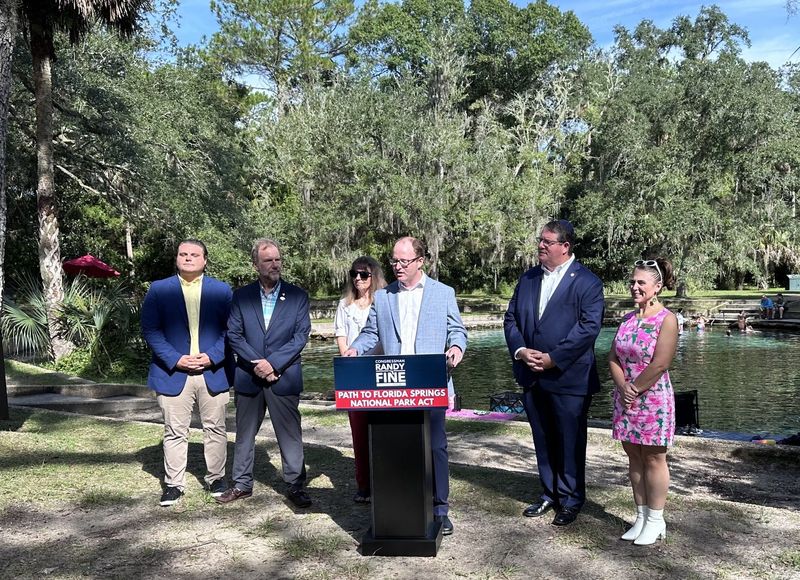
After hearing talking points about reductions to park staff budgets, both in the state and nationwide, Floridians got a big, splashy surprise from U.S. Rep. Randy Fine, District 6.

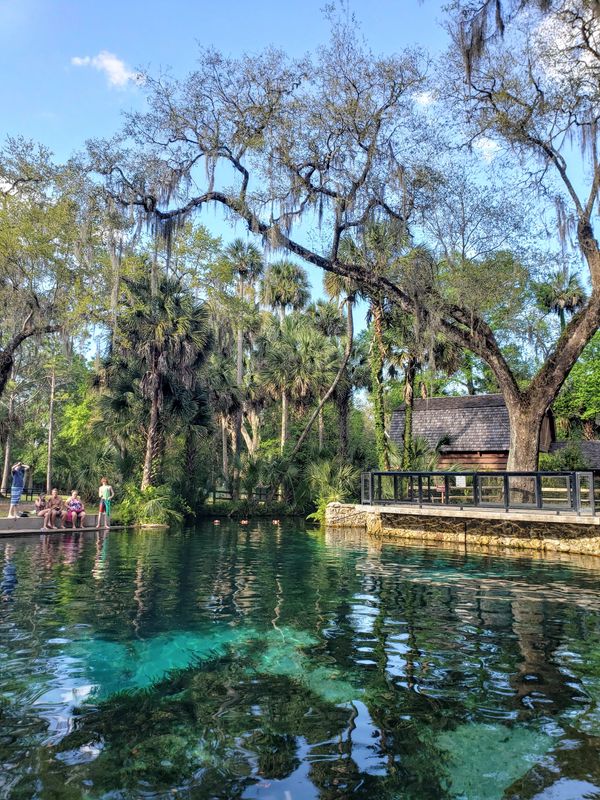
He has plans to create a massive multi-county national park dedicated to the preservation of the springs in the Ocala National Forest (and nearby.)
The announcement starkly contrasted news from earlier this year, when the Trump administration threatened to slash $1 billion from the National Parks Service. The budget that passed Congress earlier this year included a reduction, but one not as severe as previously announced. Congress cut $210 million to the NPS workforce.
Still, a grander vision of federally protected land hasn’t emerged more clearly.
Though the topic of harvesting more timber from federal lands has come up.
“A concerted effort by the Trump administration to sell off and sell out America’s public lands to the highest bidder puts these special places, local economies and future travel plans in jeopardy,” writes the Center for American Progress, an independent nonpartisan policy institute.
The White House website has a page on how the federal government is now championing national parks with new tactics, such as charging higher admission fees to foreign visitors.
“The Secretary of the Interior, working with the Secretary of State, shall work to encourage international tourism to America’s national parks and outdoor recreation areas, and especially wider utilization of America’s many such areas that may be underutilized,” a White House memo says.
Why does Rep. Fine want a new national park?
Rep. Randy Fine surprised us with his new plan to convert the Ocala National Forest, the first national forest east of the Mississippi River, into the new Florida Springs National Park.
Fine’s talking points don’t mention “wider utilization.”
At an Aug. 25 press conference at the Juniper Springs Recreation Area, near the border of Lake and Marion counties, the 6th District Republican congressman said that Florida springs are “as miraculous and amazing as any other natural asset that we have in this country, and they are deserving of our protection.”
“When I saw these Florida springs, places unlike anything else you’ll find in Florida, unlike anything else you’ll find in America, unlike anything else you’ll find in the world, I thought these, too, are worthy of designation,” Fine added. “We literally are the Yellowstone of springs.”
The Daily Commercial requested to speak to Fine numerous times, but he has not returned our phone calls or emails.
Who is Jonathan Rubin?
At the press conference, Jonathan Rubin, president and executive director of the Boca Raton-based Clean Earth Initiative, said Florida springs produce more than 10 billion gallons of water per day, serving some 90% of the state’s population.
Rubin said that he thought that Fine is correct about the effort being “a nonpartisan issue,” adding that “the springs have decreased in flow level by 30% to 50%, with many of the springs being severely polluted.”
“National parks not only protect ecosystems, but they also create tourism, provide educational opportunities, and foster healthy, vibrant communities,” he said. “That’s why this region needs to be a national park, not just a national forest.”
Rubin launched Fresh Florida Farms in November 2020 and sold his company in November 2024 before launching Clean Earth Initiative. With Florida Fresh Farms, he received a school grant to build an aquaponic system and specialized in hydroponic, vertical gardening, according to his organization’s website, his LinkedIn page and an article in the publication Mishpacha.
Rubin wrote on his LinkedIn that he has a graduate degree from Columbia University and has studied public policy analysis, international relations, environmental science and renewable energy.
In his early career, Rubin worked as a congressional aide with former Congressman and current Florida Gov. Ron DeSantis.
Rubin’s team at the Clean Earth Initiative is not the traditional board of directors you find at a nonprofit conservation group. His board members don’t have backgrounds in science and fieldwork. Instead, they bring experience in military leadership, restaurant management and investment financing.
How will those living inside the forest boundaries be affected?
According to the National Park Service, owners of private property within a national park continue to hold all the rights of a private property owner, including the ability to sell their property.
On rare occasions, the federal government will require the purchase of forest dwellers’ properties.
What are local officials saying about the proposed national park?
At the Aug. 26 Lake County Board of County Commissioners meeting, Commissioner Leslie Campione questioned whether the project was going anywhere at all and said restrictions on hunting would be “really, really unpopular” with the Lake, Marion and Volusia County hunters.
Commissioner Sean Parks expressed cautious optimism in a Facebook comment.
“Changing from a national forest to a national park would likely shift management more toward preservation of our springs and aquifer, with details (like hunting, forestry, and motorized access) defined by any future legislation. So I’m definitely interested.”
Parks emphasized that Lake County should work with the forestry service to best protect water, keep smart access, and support the local economy:
“This could help us with all of these issues. There are spin-off benefits I see as well, like more resources to manage the growing crime problem in the forest associated with transients and homeless.”
Parks also pointed out that there might be a conflict with the bombing range that would have to be addressed.
The recently sold Embry-Riddle air strip located inside the forest has yet to be addressed.
“Whatever happens, please don’t change the designation of the Juniper Wilderness Area in the forest,” Parks added. “That needs to remain officially designated a ‘Wilderness Area’ per the National Wilderness Preservation System of 1964, meaning no roads; trail access only. But all in all, this could be very big for Florida and a great move.”
Friends of Lake County Trails chairman Mike Stephens, who’s also chairman of the Florida Greenways and Trails Council for the Florida Department of Environmental Protection, spoke at the meeting to advocate for the North Lake Trail Phase 3, a shared-use trail designed for pedestrians and bicycles. The Trail begins at East Altoona Road in Altoona and extends about 16 miles north to State Road 40 in Lake County.
The commission approved the project.
Commissioner Campione asked Stephens what he thought about the national parks idea.
“We’ll continue to work on it,” Stephens said about continuing the project if the national park project gets pushed through, conceding that the project might make things worse.
This article originally appeared on Daily Commercial: Local reactions to effort to make the Ocala National Forest part of a national park
Reporting by Julie Garisto, Leesburg Daily Commercial / Daily Commercial
USA TODAY Network via Reuters Connect