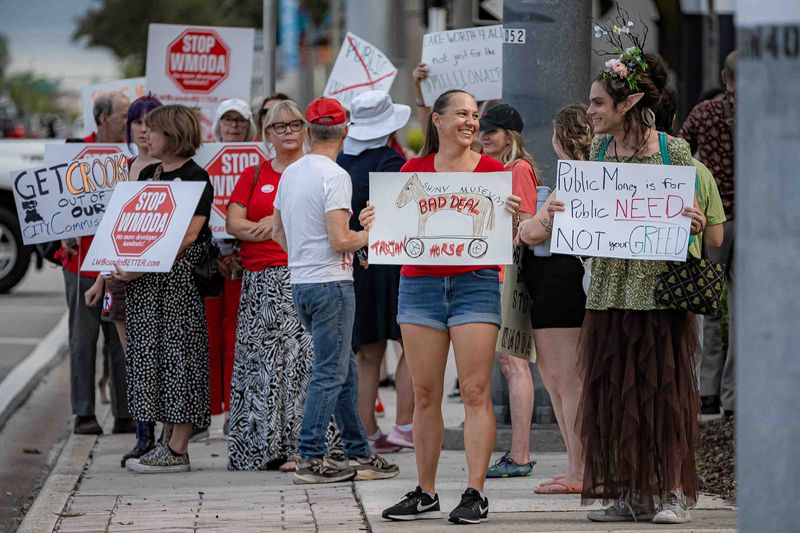
One side says Lake Worth Beach taxpayers will save millions of dollars if voters approve ballot proposals in the upcoming city election, while opponents claim private companies will take over the city’s public beach and parks if the ballot questions pass.
If residents on Tuesday, March 10, vote yes on Questions 2 and 3 on their ballots, the majority of the city’s elected leaders will have the final vote on leasing terms the city offers to private organizations looking to rent public property for up to 99 years. That power to approve such leases currently rests with the voters.

Question 2 applies to city property east of State Road A1A, which includes the public beach. It bars “lodging and residential use,” prohibiting construction either of a hotel or housing. The investment group Copperline Partners in 2025 pitched a plan to commissioners that included a Hyatt hotel on the beach, drawing opposition from residents. Copperline withdrew its plan that year.
Question 3 applies to public property west of A1A, which includes the golf course and the old city hall. It does not prohibit hotel or lodging. Copperline’s pitch included transforming the links into a Jack Nicklaus-designed golf course, with a Hyatt there, too.
Lake Worth ‘yes’ voters say city needs money for roads, buildings, parks
Supporters say voting yes will entice businesses to invest millions of dollars that can go to fixing roads, as well as municipal buildings and public facilities, instead of burdening taxpayers with those costs.
City Commissioner Anthony Segrich leads the “yes” effort.
Businesses right now are loathe to invest and build on city-owned property, Segrich said, because a small number of voters can reject their plans after years of going through city engineers and zoning boards and gaining approval from city commissioners.
As an example of the prospect of a public vote delaying development, Segrich pointed to renovation of the $100 million waterfront Gulf Stream Hotel downtown. It sat vacant for decades until the husband-and-wife developer duo of St. Louis Restoration won voter approval in 2020 to build up to 85 feet in height. It is finally opening, taking reservations starting this summer.
“It actually cost them $3 million to get through the referendum process,” Segrich said. “They did it because they’re billionaires and they wanted to do this project, not because it made any kind of economic sense.”
Segrich points to the city-owned golf course on the Intracoastal, as well as the old city hall in the Cultural Plaza downtown, originally built in 1916 and known as the city hall annex. It closed in 2024 for renovations. A 2025 report found that it failed to meet standards for wind and mold prevention.
“Do you want to see the golf course redone? Do you want to see the old city hall rebuilt and brought back to its former glory? Do you want to finally see the old rotting pool on the beach finally fixed?” Segrich said. “The solution is to offer favorable terms to potential investors.”
Segrich also argues that the city will need millions of dollars from private investment if property taxes are abolished statewide. He estimates the city will have a deficit of more than $25 million if state lawmakers and Gov. Ron DeSantis approve placing severe property tax cut measures on the ballot this November and voters statewide approve it.
Lake Worth ‘no’ voters say decisions on public lands must rest with people
Opponents say voters’ right to be the final decisionmakers on private plans on public lands must be upheld to stop “overdevelopment” on the beach, parks and other publicly owned properties.
Former City Commissioner Kim Stokes, head of the nonprofit Lake Worth For All, leads the opposition to all five ballot questions.
Stokes and other opponents argue that any business that enters into a 99-year lease with the city’s golf course or other properties will want to make money off them, which will be bad for residents. “Why would a developer fix up our city hall and annex?” Stokes said. “There’s not profit for them in that. … They’ll want a return on their investment.”
“If you have such a big project it requires a 99-year lease, bring it to the voters,” Stokes said. “Has it (referendums for such lease agreements) scared people off from wanting to make massive developments on our beach? Absolutely. But that’s what we want.”
Stokes also criticized Segrich for saying residents should vote yes because the city could lose tens of millions of dollars should voters pass big property tax cuts. “I think its premature to say that something may or may not happen,” she said, “To try to scare voters into giving away their rights to future developments on public spaces.”
Segrich has argued that city commissioners can be voted out of office if residents do not like public land lease agreements they award to organizations or companies seeking to build on public land they rent.
Stokes and her group also want voters to select “no” for the other three ballot questions.
Question 1 asks voters to change the city’s charter to reflect that the Palm Beach County Supervisor of Elections certifies Lake Worth Beach’s election results, as is the case everywhere else in the county. The charter is the city’s governing document, outlining its departments, laws and how the city is run.
Question 4, if voters pass it, says that if the city manager leaves their position, city commissioners must start looking for a new one within 90 days and continue until the position is filled.
Question 5, if passed, would remove references to the city police and fire departments from the charter. Lake Worth Beach does not run its own police and fire agencies. The city contracts with the Palm Beach County Sheriff’s Office and Palm Beach County Fire Rescue for those services.
The questions made it onto the ballot after city commissioners approved them.
Stokes opposes Questions 1, 4 and 5 because commissioners approved them without going through a process such as a city charter review committee with experts on crafting ballot language that can withstand legal challenges.
“We prefer a public process where everybody gets to be involved,” Stokes said. But, she said, “there’s no bad thing that happens” if voters pass Question 4, and it’s unlikely an outside entity can successfully seize policing or fire rescue services should voters pass Question 5.
Segrich feels it makes no sense to oppose all five ballot questions. “How can you trust somebody who’s telling you to vote no on everything when three of them are for the good of the city and there’s no logical reason to vote no?”
Email news tips and ideas to Chris Persaud at cpersaud@pbpost.com.
This article originally appeared on Palm Beach Post: Lake Worth Beach voters to decide who controls public land leases
Reporting by Chris Persaud, Palm Beach Post / Palm Beach Post
USA TODAY Network via Reuters Connect