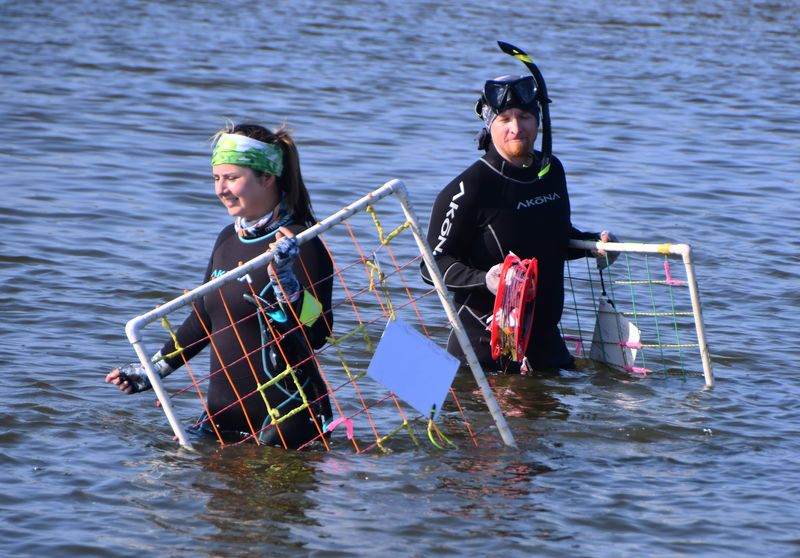
Seagrass, the foundation of the Indian River Lagoon food web, has more than doubled in acreage in just four years. That inspired congratulatory gestures Tuesday, May 12, from regional water managers.
Algae blooms have all but wiped out the lagoon’s seagrass over the past 20 years.

During that time, there have been periods when the seagrass seemed to be rebounding, only to die off again.
This time will be different, some lagoon scientists assert, because of the efforts made to cleanse the lagoon of the things that trigger algae growth. Anglers are seeing the same on the water.
Only time will tell if they are right.
Truth is told on the water
Alex Gorichky, who witnesses the realities on the lagoon almost daily via his Local Lines Charter Lines Guide Service fishing trips, sees the recovery. “It was barren sand,” Gorichky said of the lagoon bottom. “It takes years.”
Now, in the wake of worst drought in 25 years and another record hard freeze, SJRWMD again is touting seagrass recovery:
Five of six sub lagoons increased in seagrass coverage, district data shows.
2011 ‘superbloom’ ruins lagoon
A major “superbloom” of green and blue-green algae was first seen in Banana River Lagoon in March 2011. Within a month or two, the bloom spread westward through the Barge Canal and into the northern Indian River Lagoon near Cocoa, then northward through Haulover Canal and into southern Mosquito Lagoon. Ultimately, the bloom covered 132,500 acres.
The superbloom was preceded and accompanied by a less intense bloom that began in late 2010 and eventually covered 47,500 acres from southern Banana River Lagoon to just north of Fort Pierce Inlet, according to SJRWMD.
Extreme cold also killed red drift algae, the stringy stuff that looks like seaweed, creating more muck on the bottom that fed nutrients to other algae that blooms and blocked sunlight to seagrass, according to the report.
Lagoon water temperatures dipped as low as 39 degrees Fahrenheit in January 2010.
According to prevailing theories at the time, the dead drift algae rotted, increasing nutrient availability for phytoplankton growth. Also, less drift algae was around to sponge up nutrients in the water.
Rotting fish and other marine life that died in the cold also left behind more nutrients for algae to thrive.
Indian River Lagoon will never be what it was
Despite the millions in restoration projects in the past two decades, proponents say the lagoon will never be what it was.
“While we’re seeing this increasing seagrass coverage in the past two years, we’re still far behind our historical 2009 coverage, so we still have a long way to go,” Lorae Simpson, supervising environmental scientist with the St. Johns River Water Management District, said before Tuesday’s board meeting.
District data shows the lagoon still is 47% behind historical seagrass coverage.
Will another freeze do the same?
This year, the record freeze in early February raised concerns that a similar series of events could be setting the stage for another ‘superbloom.’ But so far, it hasn’t happened.
Among others, the district points to major canal projects that diverted fresh water westward to mimic how basin waters flowed before the land was drained for farming and development.
Contact Waymer at 321-242-3663 or jwaymer@floridatoday.com Follow him on X at @JWayEnviro.
This article originally appeared on Florida Today: Indian River Lagoon seagrass is growing back
Reporting by Jim Waymer, Florida Today / Florida Today
USA TODAY Network via Reuters Connect