Thank goodness the summer rainy season has kicked in. The spring drought was starting to wear on our landscapes. While summertime is great for our grass, as evidenced by us having to mow at least once a week, the growing season can bring its own set of lawn problems and pests. Over my next three articles, I will cover chinch bugs, take-all root rot, and turf caterpillars. This week, we will cover the southern chinch bug.
Before we get into those pests, let’s briefly go over some cultural concerns. Most turf requires 1-1.5 inches of irrigation per week. With the summer rains kicking in, it is easy for turf to become overwatered. You may want to use a rain gauge to monitor rainfall and turn off your irrigation systems when summer rains are sufficient. This will go a long way in preventing insects and other pests such as chinch bugs.

Additionally, weeds are a bigger problem than normal this year because the temperatures went from cool to warm in a short period of time, and weed seeds sprouted quickly. While summertime temperatures often curtail chemical weed control, next year, keep an eye out and apply a pre-emergent herbicide when daytime temperatures reach 65°F–70°F for 4 or 5 consecutive days. This will drastically reduce weed problems that emerge in the summer. Now, let’s get back to chinch bugs.
The southern chinch bug is active from April through October. The damage they cause is often confused with other pests or diseases, such as take-all root rot. With chinch bugs, the damage will start out as localized patches of what looks like drought-stressed grass. This is because the insects are feeding on the sap in the grass blade. The spots will get larger as the chinch bugs progress outward, feeding on healthy turf as the spot expands. As the spots enlarge, the damaged turf will turn yellow, start to decline and eventually die out. Since chinch bugs thrive in the heat and sun, the spots will typically start in the hotter, drier sections of your lawn.
How to spot chinch bugs in your yard
Scouting for chinch bugs is critical to being able to identify them before they get numerous enough to cause major damage.
One of the simplest methods of scouting for chinch bugs is to get down to their level. Tease apart the grass blades and inspect the thatch, the stolons, and the soil surface. Don’t look in the dead or dying grass. The chinch bugs have already moved on. Instead, look in the healthy lawn that surrounds the dying grass. Another scouting method is called the “coffee can’ method. You will need a cylinder, such as a metal coffee can open on both ends. Press it a few inches deep into the soil at the edge of damaged turf and fill it with water. Be sure to have enough water on hand to keep the level above the height of the grass for 5 minutes. The chinch bugs will float to the water surface, where you will need to count them. Perform this test at three or four places in your lawn to get an appropriate idea of the infestation level. If you find more than 20-25 chinch bugs per square foot, you may need to apply an insecticide. A coffee can has an area of about 1/5 of a square foot. However, do the math just to make sure.
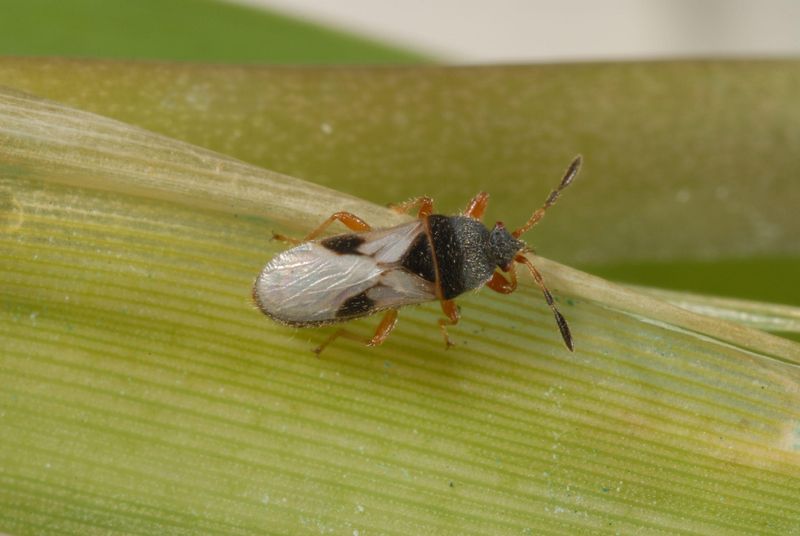
While scouting, you’ll be looking for small, slender bugs ranging from 1/6 to 1/5 of an inch long as adults. Nymphs will be smaller than that. The young, wingless nymphs are reddish orange with a lighter colored band across the fore part of their abdomen. Adults have black bodies with white wings marked by a black triangular section.
Why pesticides may not stop chinch bugs
The emphasis for chinch bug control for a long time has been to spray them early and often with pesticides.
This has created a pest that has become increasingly resistant to standard methods of control. Insecticide resistance occurs when insects are repeatedly sprayed with chemicals that work similarly. Some of the insects survive and pass this resistance to their offspring, gradually creating populations that are no longer controlled by products that used to work. This process of resistance has occurred faster due to more reliance on chemical control and less on cultural controls.
For a long time, the use of pyrethroid insecticides such as bifenthrin (and others) has been the go-to method for chinch bug control. However, chinch bugs have become resistant to four different classes of insecticides: pyrethroids, neonicotinoids, organochlorides and organophosphates. This makes chemical control extremely difficult. Rotating chemical products may help. Try to use insecticides with different modes of action (not just different brands or active ingredients) than you did last year. The mode of action may or may not be listed on the insecticide label and contains a number and one or 2 letters. Examples include 1A, 4B, and 10A. There are even new biological pesticides, such as azadirachtin or Beauveria bassiana, to try. Although, these organic options may need to be applied more often. Keep in mind that no matter what insecticide you are using, always read and follow the label when mixing and applying.
By practicing proper cultural practices on your turf, such as proper irrigation, proper fertilization, proper weed control, and mowing at the correct height, you can get ahead of the game in preventing many summertime turf issues, such as chinch bugs. Next time, we will go over Take All Root Rot.
Larry Figart is an urban forestry extension agent with the University of Florida/IFAS.
This article originally appeared on Florida Times-Union: How to spot and stop chinch bugs from destroying your summer lawn
Reporting by Larry Figart, For the Jacksonville Florida Times-Union USA TODAY NETWORK / Florida Times-Union
USA TODAY Network via Reuters Connect
By Larry Figart, For the Jacksonville Florida Times-Union USA TODAY NETWORK | USA TODAY Network