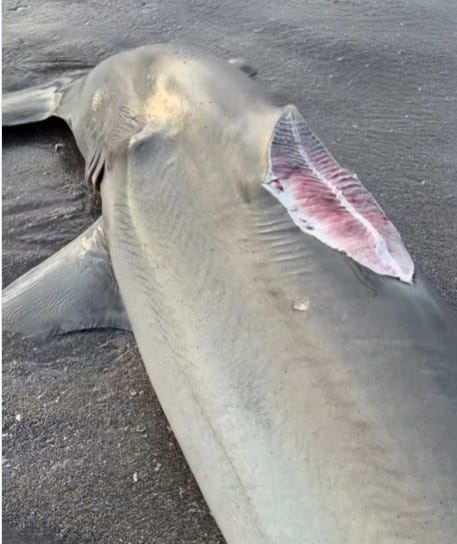
A great hammerhead shark that washed ashore in Juno Beach was brutally mutilated with its dorsal fin and tail sawed off.
The shark, considered a critically endangered species by the International Union for Conservation of Nature, was found by beachgoers Sunday, March 15, near the Juno Beach Pier and reported to the Florida Fish and Wildlife Conservation Commission.

Great hammerheads are particularly vulnerable to dying after struggling on a fishing line, and experts said it’s not uncommon for their bodies to be found lolling in the shore break hours or days after being snagged by an angler.
Michael O’hagan, who took video of the shark and posted it on social media, said he’s seen hammerheads dead on the beach but never with injuries that he speculates were done with a hacksaw.
“I’ve seen this before, we’ve all seen this before, but the finning was not usual,” said the Palm Beach Gardens resident. “Whoever did this came prepared. It’s not easy to cut that dorsal fin off.”
How common are hammerhead sharks off Florida’s coasts?
Great hammerheads are common predators along Florida’s east coast, especially in spring when they hunt blacktip sharks migrating in mass shivers hugging the beach.
But hammerheads are a prohibited species in Florida, meaning they cannot be harvested in state waters. If they are caught on a fishing line they must be released without delay and must remain in the water with their gills submerged the entire time.
That means no dragging them up on the beach for photos, although O’hagan said that still happens.
“The law is that as soon as you realize it is a great hammerhead; you have to cut the line. The problem is nobody, and I mean nobody does that,” said O’hagan, who believes the fin and tail were taken as a trophies. “Fishermen like the fight, and no shark fights harder than a great hammerhead.”
O’hagan speculates the shark was caught by a shore-based fisherman because it’s body would have sunk to the ocean floor if it was caught out at sea.
Palm Beach County conservationist Jim Abernathy and University of Miami shark scientist and PhD student Spencer Roberts agree.
Removing a shark’s fins is a federal crime
In addition to the shark’s body sinking offshore if it had been caught from a boat, Roberts said removing a shark’s fins is a federal crime, something commercial fishermen wouldn’t risk, and there was no injury to the shark’s head. A knife to the brain would be one way to kill the shark before bringing it on a boat.
O’hagan estimates the shark was 11 to 12 feet long with its tail and that a boat would need a crane to lift it onboard.
Roberts, whose non-profit organization Fish Defender was instrumental in helping get land-based shark fishing banned in Miami Beach last month, said he’s also never seen a hammerhead’s tail and fin cut off.
“Maybe the shark died during handling, or during the fight, or shortly after release, and they salvaged some trophies,” Roberts said. “Hammerheads are much more susceptible to capture stress. A lot of other sharks can use their mouths to pump water over their gills. Hammerheads just can’t do that.”
When a shark is struggling at the end of a fisherman’s line, its body goes into survival overdrive. Deadly amounts of lactic acid build in muscles that can become so fatigued they just stop working. Even if released, the shark can sink to the bottom of the ocean and suffocate.
If a large shark is hauled onto a beach, its motionless tail no longer helps pump blood to its small heart. Capillaries on its belly burst, turning white flesh to a rose pink. Internal organs can hemorrhage under the crush of gravity.
In Florida state waters, which extend 3 miles from shore, 29 shark species are considered prohibited, including the hammerhead and tiger shark.
“Hammerheads can’t fight and live. Even if they are released, they die,” said Abernathy, who runs a nonprofit called Wildlife Voice. “If they’re caught from land, they may swim out of sight, but usually the next morning, they’ll wash back on the beach dead.”
Florida fishermen are required to get shark-fishing licenses
In 2019, FWC commissioners voted unanimously to give the state better oversight of shore-based shark fishing. Fishermen are required to get a free shark-fishing license, view an online educational course and ensure that prohibited species remain entirely in the water during release.
The rules also ban chumming from the beach.
O’hagan said he initially thought the brutalized hammerhead was a small shark caught in a trough between sandbars. But then he saw the shark, which was a female, was dead.
“Everyone is abhorred by the finning but not about the death. That’s what I want to draw attention to,” O’hagan said. “Every hammerhead that dies, especially a female hammerhead is a problem, a big problem.”
The FWC is looking into the incident and asks anyone with information to call the Wildlife Alert Hotline at 888-404-3922.
Kimberly Miller is a journalist for the USA TODAY NETWORK FLORIDA. She covers weather, the environment and critters as the Embracing Florida reporter. If you have news tips, please send them to kmiller@pbpost.com. You can get all of Florida’s best content directly in your inbox each weekday by signing up for the free newsletter, Florida TODAY, at palmbeachpost.com/newsletters.
This article originally appeared on Palm Beach Post: Horrific mutilation to great hammerhead shark found on Florida beach
Reporting by Kimberly Miller, USA TODAY NETWORK – Florida / Palm Beach Post
USA TODAY Network via Reuters Connect