By Stephen Culp
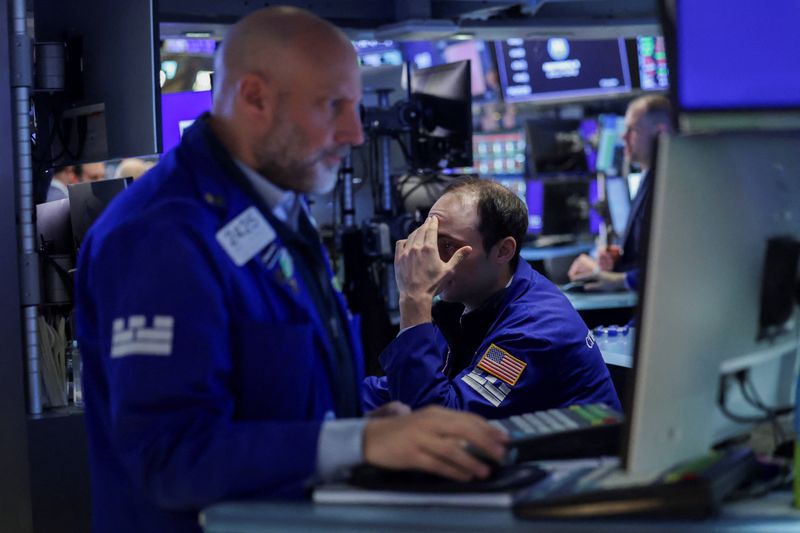
NEW YORK, April 23 (Reuters) – Wall Street stocks dipped on Thursday and crude prices rose as Iran flaunted its control over the Strait of Hormuz and on signs of escalation in the Middle East, while investors parsed mixed corporate earnings.

All three major U.S. stock indexes lost ground, with the S&P 500 and the Nasdaq pulling back from Wednesday’s record closing highs.
Gold slid and the dollar edged higher.
Iran displayed its grip over the strait with a video of its commandos storming a cargo ship following the collapse of peace negotiations and U.S. President Donald Trump’s indefinite extension of the ceasefire.
Reports of Iran’s air defences engaging targets over Tehran, and of a struggle between Iran moderates and hardliners, sent crude prices spiking.
U.S. crude rose 3.11% to settle at $95.85 per barrel, while Brent settled at $105.07 per barrel, up 3.10%.
HEADLINE-DRIVEN MARKET
“The half-life of a headline-induced move is shortened quite a bit over the last probably two or three weeks,” said Scott Ladner, chief investment officer at Horizon in Charlotte, North Carolina.
“(Stocks) are at all-time highs with oil up 40% over six weeks while a war is going on,” Ladner added. “That’s telling you that like headlines aren’t driving everything, but they can certainly move markets over a day, or a couple of days.”
On the economic front, new claims for unemployment benefits remained muted, while S&P Global’s advance PMI reading showed business activity is picking up steam this month, although output prices jumped to the highest reading since July 2022, reflecting supply chain complications arising from the Middle East conflict.
First-quarter earnings season has shifted into high gear, with 123 companies in the S&P 500 having reported. Of those, 82.1% have beaten analyst expectations. Analysts see year-on-year S&P 500 earnings growth of 15.6%, on aggregate, according to Tajinder Dhillon, head of earnings research at LSEG.
Among companies reporting first-quarter results, American Airlines and Honeywell, among others, provided disappointing guidance due to higher costs and other disruptions related to the U.S.-Iran war.
“The world is somewhat changed since the period that’s under inspection,” Ladner said. “Guidance is obviously going to play a lot larger role.”
The Dow Jones Industrial Average fell 180.70 points, or 0.37%, to 49,309.33, the S&P 500 fell 29.60 points, or 0.41%, to 7,108.30 and the Nasdaq Composite fell 219.06 points, or 0.89%, to 24,438.50.
European shares closed nominally higher, reversing earlier weakness as investors weighed developments in the Middle East and weak economic data against a wave of corporate results.
MSCI’s gauge of stocks across the globe fell 4.84 points, or 0.45%, to 1,066.47.
The pan-European STOXX 600 index rose 0.05%, while Europe’s broad FTSEurofirst 300 index rose 3.24 points, or 0.13%.
Emerging market stocks fell 10.14 points, or 0.63%, to 1,596.93. MSCI’s broadest index of Asia-Pacific shares outside Japan closed lower by 0.55%, to 818.13, while Japan’s Nikkei fell 445.63 points, or 0.75%, to 59,140.23.
The dollar was essentially flat but headed for weekly gains as mounting U.S.-Iran tensions undermined hopes for a near-term resolution.
The dollar index, which measures the greenback against a basket of currencies including the yen and the euro, rose 0.19% to 98.80, with the euro down 0.16% at $1.1684.
Against the Japanese yen, the dollar strengthened 0.14% to 159.71.
In cryptocurrencies, bitcoin fell 0.96% to $77,682.51. Ethereum declined 3.15% to $2,316.77.
U.S. Treasury yields turned higher as the ceasefire between the United States and Iran showed strain.
The yield on benchmark U.S. 10-year notes rose 3.3 basis points to 4.327%, from 4.294% late on Wednesday.
The 30-year bond yield rose 1.8 basis points to 4.9204% from 4.902% late on Wednesday.
The 2-year note yield, which typically moves in step with interest rate expectations for the Federal Reserve, rose 4 basis points to 3.834%, from 3.794% late on Wednesday.
Gold prices reversed earlier gains following news of a possible extension of the Israel-Lebanon truce.
Spot gold fell 0.91% to $4,694.44 an ounce. U.S. gold futures were flat to $4,732.40 an ounce.
(Reporting by Stephen Culp; Additional reporting by Marc Jones in London and Stella Qiu in Sydney; Editing by Louise Heavens, Nick Zieminski, Rod Nickel)