Florida may start enforcing a law meant to prevent children from attending “sexually explicit” performances, according to an appeals court decision. The contentious law, which was passed in 2023, has been held up in court ever since over First Amendment questions.
An 8-5 majority in the 11th U.S. Circuit Court of Appeals agreed in its ruling released Aug. 4 that the state law was constitutional and struck down a preliminary injunction that prevented enforcement of the law while the case is pending. The case now heads back to a trial court in Orlando.

Critics have warned that the law imperils the free expression of LGBTQ+ and drag communities and was intended to have a chilling effect on all public LGBTQ+ performances and drag shows, including family-friendly drag story hours, brunches, and fundraisers that welcome minors. Supporters of the law say it is necessary to protect children in the state.
“In Florida, we don’t let people groom our kids,” Florida Attorney General James Uthmeier said on X in response to the appeals court decision.
Watch “RuPaul’s Drag Race” on Paramount+
Does that mean that drag performances are now illegal in Florida? How will this affect Pride events? What happens next? Here’s what to know.
What does Florida’s ‘adult performance’ law do?
SB 1438, dubbed the Protection of Children bill, blocks venues from knowingly admitting children to “adult live performances,” which it defines as “any show, exhibition, or other presentation that is performed in front of a live audience and in whole or in part, depicts or simulates nudity, sexual conduct, sexual excitement, specific sexual activities, … lewd conduct, or the lewd exposure of prosthetic or imitation genitals or breasts.”
Under the law, venues would risk fines, suspension or loss of license and the possibility of an additional $5,000 fine for the first violation and a $10,000 fine for the second and subsequent violations. Knowingly allowing a child to attend an adult performance would be a first-degree misdemeanor.
Critics accused the bill of being a vaguely worded attack on LGBTQ+ culture that would severely limit public Pride celebrations and parades and potentially even beauty contests and theatrical performances.
The law was passed amid a flurry of legislation in the Florida Legislature in recent years aimed at restricting or removing mention of LGBTQ+ people in schools, limiting transgender options, and strictly defining human sexes as male and female in state statutes.
Does Florida’s adult performance law ban drag shows?
Not by name. The word “drag” does not appear in the law, nor does any specific description. That’s part of the problem, critics point out.
According to the appeals court decision, the law does not ban drag. “The Act is consistent with a legislative intent to target drag shows that are obscene for children, not drag shows writ large,” wrote Circuit Judge Andrew Brasher, who authored the majority’s opinion.
What is drag?
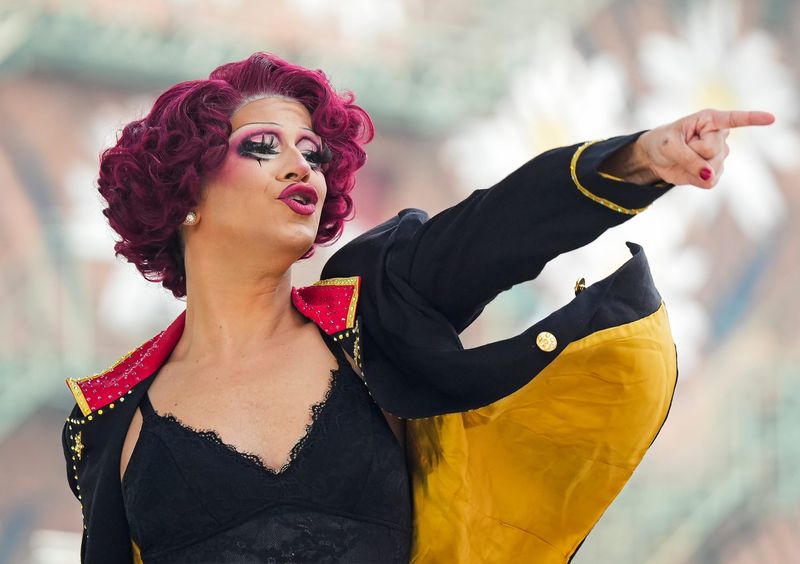
Drag is an art form in which a person dresses in elaborate clothing and makeup designed to present an exaggerated, over-the-top version of a man or woman, often of the opposite sex. Drag also has a history of political commentary and activism.
It’s become increasingly accepted and popular thanks to movies like “The Birdcage,” “Hairspray,” “Kinky Boots, “To Wong Foo, Thanks for Everything, Julie Newmar,” and “The Rocky Horror Picture Show,” as well as the blockbuster reality competition “RuPaul’s Drag Race,” which made drag a household name and national stars of its contestants.
Along with regular performances at local clubs and festivals, Florida has a variety of public drag events, including “Drag Me to Pride” in Miami Beach, the national 2026 Drag Queen Christmas touring production, and the New Year’s Eve “Red Shoe Drop” in Key West when a drag queen is lowered in an 8-foot-long shoe to Duval Street to ring in the new year.
Critics claim drag normalizes aberrant behavior and mocks gender norms.
Florida adult performance law vague, critics say
The law effectively puts bars, restaurants, festivals, city permit offices, and law enforcement in the position of deciding what counts as “adult” — and what happens if kids are in the crowd.
In the dissent, Circuit Judge Robin Rosenbaum said that the state intentionally created the statute to “chill drag” and that the vague language “serves as an especially pernicious club to silence political speech.”
“Under this form of jurisprudence, a citizen can learn whether a law prohibits their speech only by taking a wild guess, presenting their speech, and then seeing if they get arrested and face imprisonment, thousands of dollars in fines, and loss of their business license,” wrote Rosenbaum.
When the bill first passed, venues and performers across Florida began rethinking family-friendly drag brunches and fundraisers where minors might be present. Many local governments quietly tightened event rules, and some businesses canceled or rebranded drag events to avoid potential penalties. Organizers of Pride celebrations in several cities canceled to be on the safe side.
Wasn’t the state’s anti-drag law struck down?
A federal appeals court previously ruled against Florida’s drag show law, siding with Hamburger Mary’s, a Central Florida drag venue that argued the statute violated free speech protections.
The Aug. 4 ruling gives the state more leeway while the lawsuit continues through the courts to penalize businesses that allow minors to attend shows the government considers “adult performances,” even if those events are billed as drag or Pride entertainment rather than explicit adult content.
What does this mean for venues, performers, and parents across Florida right now?
The new ruling creates new uncertainty about how the law will be enforced, what behavior or representation the state and local judges will decide counts as “adult,” and what venues can safely host. A misstep could mean fines, license issues, or being made an example by state regulators.
For venues, it means consulting lawyers, tightening event policies, and deciding whether to bar minors from any show that could be deemed “adult,” including drag performances that aren’t overtly sexual.
For performers and Pride organizers, it means evaluating every costume, routine, and promotional flyer with legal risk in mind, and potentially shifting events to 18+ or 21+ audiences.
Some communities may pull back on family-friendly drag and Pride events, while others quietly keep them going and wait to see how aggressively the state chooses to enforce the law.
C. A. Bridges is a journalist for the USA TODAY Network-Florida’s service journalism Connect team. You can get all of Florida’s best content directly in your inbox each weekday by signing up for the free newsletter, Florida TODAY.
This article originally appeared on Tallahassee Democrat: Has Florida banned drag shows? What happened with the law, what’s next
Reporting by C. A. Bridges, USA TODAY NETWORK – Florida / Tallahassee Democrat
USA TODAY Network via Reuters Connect
By C. A. Bridges, USA TODAY NETWORK – Florida | USA TODAY Network