It is time for summer tropical fruit! Our mangos, pineapples and bananas are ripening all over Marco Island and Southwest Florida and they are all delicious so enjoy!
BANANAS

Bananas give a landscape a lush, tropical look with their oversized, palm-like leaves. They are not a true woody tree but are herbaceous plants that grow from two to 30 feet tall. The dwarf varieties like Dwarf Cavendish grow two to 10 feet. Medium varieties like Blue java 10 to 15 feet and the full size commercial varieties 25 to 30 feet.
While they can be grown throughout Florida some varieties withstand the colder temperatures better than others. Central to south Florida are better climates for bananas. They prefer moist, fertile soil and to be planted out of the wind. And they prefer full sun but will tolerate partial shade. Because of our sandy soil bananas need to be fertilized often (four to six times a year) for high fruit production. Fertilize the young plants every two months using one half pound of a 6-2-12 and up to five pounds when flowering and fruiting begins.
They like regular watering using one to one and a half inches of water a week. Without adequate water they may not produce fruit or it will be small or will produce very little fruit. But don’t overwater because they don’t like wet feet. Bananas have a rhizome root which spreads sideways underground and grows new upright shoots. For great bananas they suggest limiting the plant to three or four stalks of different ages. The oldest and tallest should be the one fruiting. The second one should be one half to one third the size of the first. And then there should be one or two young plants that are six inches to three feet tall. Mulch your bananas by cutting down older leaves and pseudostems to decompose and feed the surrounding soil.
The best varieties are Dwarf Cavendish, which is popular for its compact size and easy fruiting, Rajapuri and Blue java or ice cream. Harvest your bananas by cutting off the entire bunch when the first hand starts turning yellow. About three months after the plant flowers. The hang the rack in your garage or shed and be prepared to eat a lot of bananas fast!
Although the climate of Florida is not perfectly suited to large scale commercial production of pineapple, there was at one time a large pineapple farm on Hoar’s Island, now known as Key Marco. This was in the days when the clam factory was also in operation. You can grow very sweet pineapples here and many people have a plant or two tucked into their garden.
PINEAPPLES
The pineapple originated in Brazil and Paraguay but will grow in all the tropical and warm, subtropical areas of the world. The plant is a small, herbaceous perennial with long sword-like leaves which spiral around the short stem. The fruit develops from the end of the stem and consists of many small, seedless fruits fused together. Size can vary from one to ten pounds or more. Pineapples are oval to cylindrical in shape and yellowish to orange in color when ripe. They can add an interesting year-round shape to a border garden or flower bed.
In the tropics fruit production occurs throughout the year. In Florida greatest production occurs during the summer months. There are many new pineapples on plants in the spring which ripen in July. The fruit should be allowed to ripen on the plant for maximum flavor and sugar content. You can often smell them before you see them as you come upon them in a garden.
Pineapples grow best where the temperature is warm and relatively uniform throughout the year. They will survive a temperature of 28 F. with much leaf damage and will be killed at lower temperatures. Therefore, in Florida planting should be restricted to southern coastal areas like Marco Island. Prolonged exposure to temperatures in the low 40’s causes internal breakdown or heart-rot of the flesh. Extremely high temperatures cause sunburning and cracking of the fruit.
While most sandy, well drained soils are satisfactory for growing pineapples, they thrive best in a sandy loam, mildly acid of medium fertility. The plant tolerates drought very well but adequate soil moisture is necessary for good fruit production.
Propagation is by planting new vegetative growth from the mother plant. There are four types: “slips” from the stalk below the fruit, “suckers” which originate at the axils of leaves, “crowns” which grow from the top of the fruits, and “ratoons” which grow from underground portions of the stem. Slips and suckers are the preferred planting material if they are large and vigorous. My personal favorite is the crown. Simply cut the green, leafy top from your pineapple that you bought at the grocery store, strip a few leaves to expose the stem and stick it in soil in a pot or your garden.
Pineapples do best when planted during the summer in beds with two to five rows of plants spaced 18 to 30 inches apart. Mulch will help eliminate weeds and conserve moisture.
Fertilizer containing 7-2-7-3 or 8-3-8-4 (N-P-K-Mg) with 40% of the nitrogen from organic sources can be alternated with foliar sprays of urea nitrogen mixed with ferrous sulfate (iron) about every four months.
The most troublesome pests of pineapples in Florida are mealybugs and nematodes. For control of mealybugs apply a spray containing Malathion. Do not apply Malathion within 7 days of harvest.
Nematodes weaken and destroy roots. Affected plants are unable to use fertilizer effectively and lose vigor. Preventive measures are the only way to avoid nematode damage. Use nematode free planting material. Crown and slips which have never been rooted will be free of nematodes or any planting material from nematode free soils. Virgin soil is not necessarily free of the kinds of nematodes which injure pineapple, but is less likely to have injurious nematodes than land in which vegetables or ornamentals have been grown in preceding seasons. Finally, you can fumigate nematode infested soil using a chemical fumigant. Because you need to treat the soil at a fairly deep level for pineapples solar fumigation would probably not be effective.
Trust me, you don’t know what you’re missing until you’ve tried a pineapple from Marco Island. Plant your own today! And be prepared to visit in July for the harvest.
MANGOES
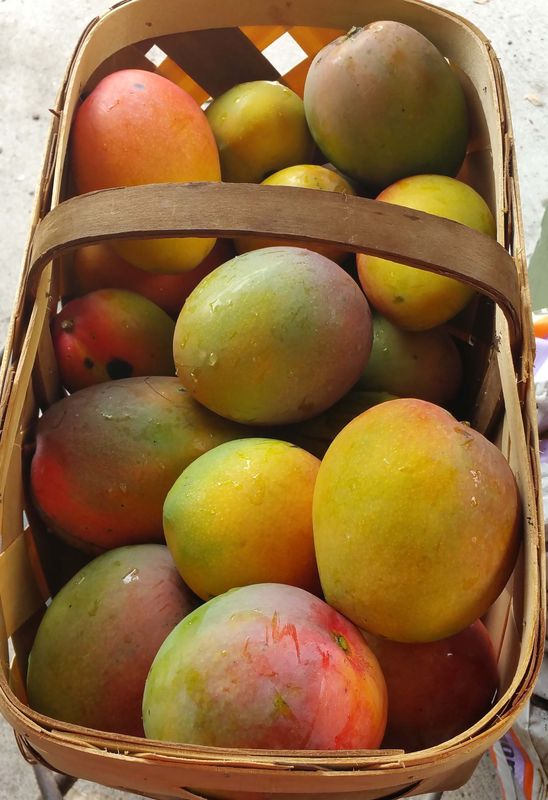
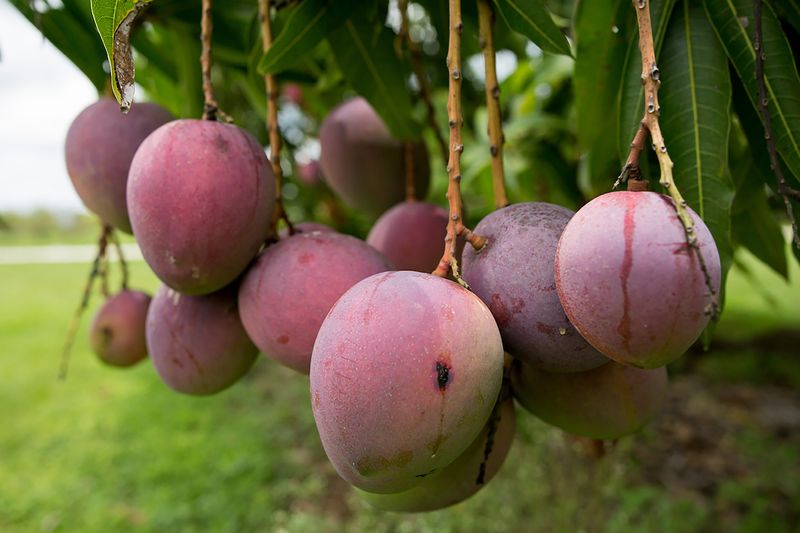
Mango trees are full of ripening fruit all around Marco. Mangos are a native of India and Southeast Asia. They were first introduced to Florida in the 1800s. Mango trees are medium to large with a symmetrical, rounded canopy which can be low and dense or upright and open. The leaves vary from six to 16 inches in length and are leathery in texture, wine colored when young becoming dark green when mature.
The flowers are small, pinkish white and appear from December to April. The large flower clusters contain 500 to more than 4000 flowers. However, the number of fruits which set and mature is very small in relation to the number of flowers produced. Most commercial varieties in Florida produce less than one fruit per cluster of flowers. Average yields of 3 to 5 bushels can be expected from mature trees. You can achieve better yields with good management and favorable weather.
The fruit of most varieties matures from May to September with a peak in June and July. The time from flowering to fruit maturity is 100 to 150 days. Less time in warmer climates. A dry season preceding and during the blooming period is considered necessary for good fruit production. Anthracnose disease and low temperatures during bloom are the main causes for limited fruit production in Florida. Pollination is mainly by insects.
The fruits vary in size, shape and color. They can be greenish, yellow or red and can range in weight from a few ounces to more than 5 pounds. Smooth, leathery skin surrounds the fleshy yellow edible portion. This skin can cause severe allergic reaction in some people and should be handled with caution. The crop is considered mature when some fruits on the tree have begun to change color from green to yellow.
The best temperatures for ripening are 70 to 75 degrees F. Fruits ripened at higher temperatures can shrivel and develop off-flavors. Mature fruits will ripen in three to eight days after harvest. Ripening can be delayed by cold storage for shipping purposes. The lowest safe storage temperature is 55 degrees F.
Mango trees should be planted to allow 20 to 30 feet of space on all sides. Pruning of young trees is not necessary. After several years of production you might want to cut back the tops and sides of the trees occasionally to make spraying and harvesting easier and to lessen storm damage. The best time to do this is in the summer after all the fruit has been harvested. While severe pruning does not injure the tree it will reduce fruit production the following season.
Mango trees will grow in many types of soils. They can tolerate some flooding but good drainage is a must for satisfactory fruit production.
Because of our sandy soil mango trees must be fertilized periodically for good growth and fruit production. Young trees should be fertilized every two months during the first year, beginning with 1/4 pound and gradually increasing to one pound. After that three to four applications a year are sufficient. A quality 6-6-6 or 10-10-10 fertilizer with 4 to 6% magnesium is a good choice for young trees. For bearing trees reduce the phosphoric acid (the middle number) and increase potash (the last number).
Successful control of fungus disease requires that all susceptible parts of the tree be thoroughly coated with a fungicide before infection occurs. Sprays applied after infection will have no effect on disease development. Sprays must be reapplied as new growth occurs to protect the new tissue and also if weather has reduced spray residues. A successful program depends on the right amount of a recommended fungicide, timely applications before infection is most likely to occur and thorough coverage of susceptible parts. The most important disease of mangos is anthracnose. It attacks flowers, young fruits, leaves and twigs. Black, slightly sunken lesions of irregular shape appear and gradually enlarge and cause blossom blight, leaf spotting, fruit staining and fruit rot. Development is caused by rains or heavy dews. For prevention copper fungicide should be applied weekly from first appearance of flower clusters until all fruits have set and then monthly from fruit set until mid-May for early varieties and mid-June for late varieties.
Mango scab attacks leaves, flowers, fruits and twigs. In early stages it resembles anthracnose. Lesions of fruit usually become covered with corky brown tissue. It causes distortion of leaves and so is a problem mainly for nurseries. The anthracnose spray program will control scab.
Powdery mildew attacks leaves, flowers and young fruits. Infected tissues are covered with a whitish powdery growth of the fungus. Lesions develop along the midrib on the under sides of leaves and become dark brown and greasy looking as leaves mature. Severe infections cause failure of fruit set and defoliation of trees. Applications of sulfur will prevent spread of infection to new growth.
Pests which attack mango trees include mites, scale insects and thrips. These pests only occasionally build up populations large enough to require control measures.
The mango is considered one of the finest fruits in the world. It can be eaten fresh, frozen, dried, canned, cooked in jams, jellies, preserves, pies, chutney and ice cream. The fruit is a good source of vitamins A and C. One of my favorite recipes is mango upside-down-cake. Yum!
Learn more about Eileen Ward at her website, TheWickedGardener.com. You will find additional information, along with a plant of the month, cocktail recipes, a store with Wicked Gardener merchandise, how-to videos and much more. Follow her on Instagram and Facebook. Feel free to contact her with any gardening questions you may have at Eileen@Thewickedgardener.com. Or call 239-269-0192.
This article originally appeared on Marco Eagle: Gardening: It’s time for summer tropical fruit
Reporting by Eileen Ward, Columnist / Marco Eagle
USA TODAY Network via Reuters Connect
By Eileen Ward, Columnist | USA TODAY Network